EU Launches OceanEye to Replace Dismantled US Deep-Sea Monitoring
Commissioner Says Timing of Oceaneye Initiative Could Not Have Been Better
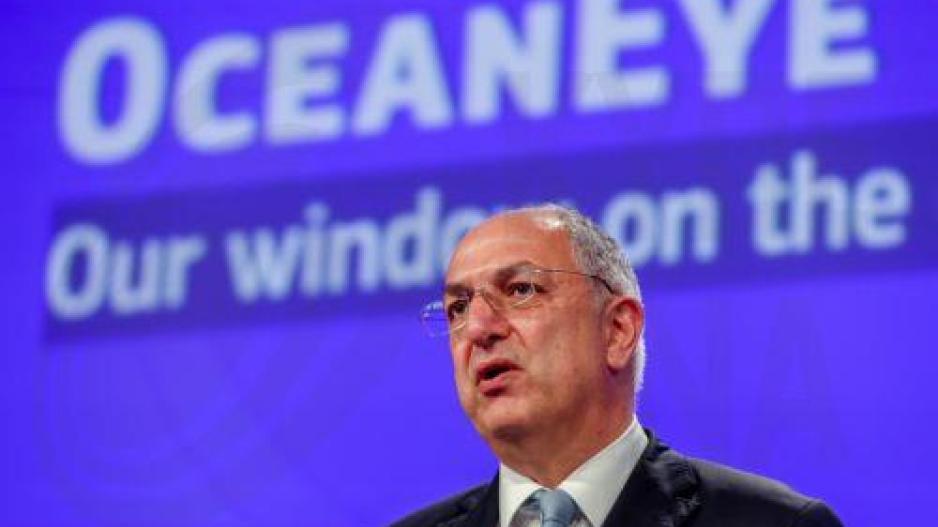
As the Trump administration aggressively tears down America's €320 million deep-sea observation infrastructure, Brussels strikes back with the OceanEye initiative. Weaponizing a multi-pillar strategy backed by Horizon Europe funding, the EU is transforming ecological data collection into a high-tech, secure dual-use asset. Here is the fast-forward breakdown.
Against the backdrop of the Trump administration's withdrawal from key international scientific cooperation programmes, the European Commission on Wednesday presented the OceanEye initiative, aiming to take a leading role in global ocean observation. As Commissioner for Fisheries and Oceans Costas Kadis put it, the timing of the announcement could not have been better.
Asked by CNA whether the EU was prepared to mobilise the level of investment needed to fill the gap, Commissioner Kadis acknowledged the scale of the challenge while pointing to the International Alliance as a key instrument. In his opening remarks, he had already flagged "extremely worrying signals coming from the other side of the Atlantic about the dismantling of ocean monitoring systems", stressing that in this context, positioning the EU at the forefront of ocean observation "is not a goal per se, but a necessity".
According to reports, the US government is proceeding with the dismantling of the Ocean Observatories Initiative — the deep-sea monitoring system estimated to be worth around €320 million that has served as a key source of global ocean and climate data for over a decade.
"OceanEye could not have been announced at a better time," Kadis said. "We see that the United States administration is no longer paying emphasis on these activities. Therefore, there is a gap, and we will try to cover part of this gap with this initiative," he stated.
"From tomorrow we start our effort to attract the support of third countries, like-minded countries, international organisations and philanthropies, in order to support the international alliance we are creating," he added, noting that this would help cover "at least part of the gap that will be created by the approach of the United States."
"I read the article yesterday and I truly regret this decision," the Commissioner said, pointing out that "the annual budget of €48 million of this monitoring network was small compared to the value of the data it collected." He described the withdrawal as part of "a continuous dismantling by the US across various domains of international scientific support."
For her part, Commissioner for Research Ekaterina Zaharieva framed the development not only as a gap but as "a huge opportunity for the European Union to lead", arguing that "Europe can lead in technology" and create companies that could reach multi-trillion valuations.
Zaharieva also stressed the strategic dimension of the initiative, noting that "the ocean is surely an environmental and economic asset, but it is also a security one." She announced that technology development would embed "dual-use and security by design considerations from the outset", aimed at protecting against sabotage and foreign interference. "We want to make our continent the leading global power of secure and responsible ocean intelligence solutions," she said.
The Commissioner further noted that the ocean observation market is worth between €10 and €20 billion, growing at 5 to 10% annually, serving a broader business ecosystem valued at up to €90 billion. "Every euro invested in ocean observing systems generates a return of €5 to €6 in economic and societal benefits," she stressed.
The OceanEye initiative, which forms part of the European Ocean Pact adopted in 2025, is structured around four pillars. The first concerns improved governance for a more unified European approach, with the new framework to be codified in an Ocean Act to be proposed by the end of 2026.
The second focuses on global leadership through an International Alliance to strengthen the Global Ocean Observing System (GOOS), with particular attention to under-monitored regions such as the Southern Hemisphere, the Arctic and the deep sea.
The third pillar centres on the European Digital Twin Ocean, a virtual representation of the ocean set to be fully operational by 2030, combined with support for innovation and industrial development. The fourth covers societal engagement and skills development, including the launch of a New European Bauhaus Ocean, Coastal and Island Communities Lab.
The Commission is committing €92 million from the Horizon Europe programme: €50 million to strengthen GOOS, €12 million for data systems, and €30 million for innovation through the European Innovation Council. It is also calling on member states, third countries and private actors to join the International Alliance with additional funding commitments and access to observation infrastructure.