Internationally Significant Discovery for the Treatment of Alport Syndrome by the Research Team of the biobank.cy Center of Excellence & the UCY Medical School
Findings Published in Kidney International, the Leading Nephrology Journal With the Highest Global Scientific Impact.
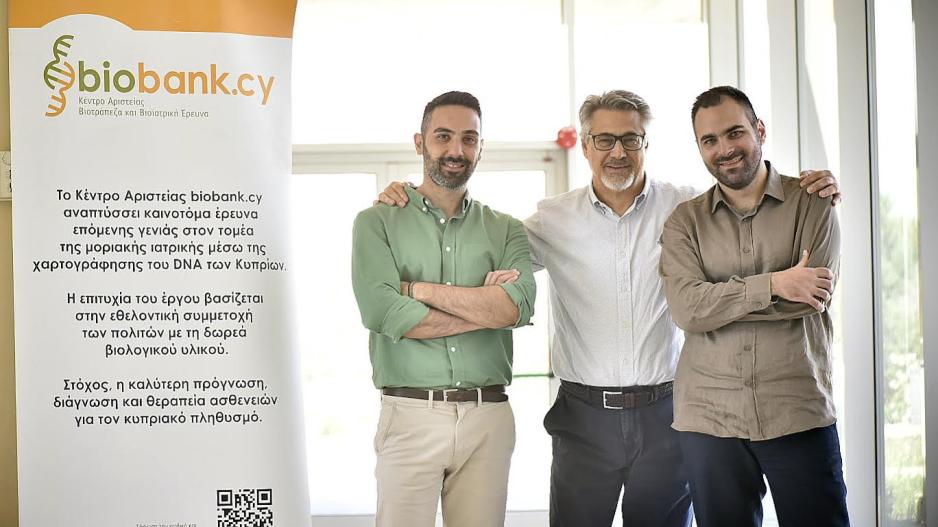
New scientific data from the biobank.cy Center of Excellence for Biobanking and Biomedical Research and the University of Cyprus Medical School offer promising prospects for treating a rare inherited kidney disease—Alport syndrome. The study was recently published in Kidney International, the most prestigious journal in nephrology worldwide.
These hopeful findings address a condition for which no effective treatments currently exist and are the result of pioneering research conducted at the Center over recent years, aimed at developing new drugs for this syndrome. In 2014, researchers at the Center were the first to describe a novel disease progression mechanism, showing that mutated collagen IV molecules activate a molecular pathway involved in the proper spatial structuring of collagen. This led to a new scientific hypothesis: synthetic molecules could potentially assist in the correct three-dimensional folding of collagen molecules, even if they are mutated.
Subsequently, the researchers took the most common genetic variant found among Cypriot Alport patients and introduced it into a mouse, thus creating an animal model that closely mimics the condition in humans. Administration of a pharmaceutical compound to the diseased animals yielded remarkable results, with the treated mice showing significant improvement compared to those that received a placebo.
The research was carried out as part of the PhD dissertation of Mr. Pavlos Ioannou, under the guidance and supervision of Dr. Christoforos Odiatis. Both played a key role in the design, implementation, and description of the experimental animal model, collaborating with researchers from Cyprus and abroad in an extensive interdisciplinary international effort. The scientific lead of this research series was Dr. Constantinos Deltas, Professor of Medicine and Molecular Genetics at the University of Cyprus Medical School.
Publication in the prestigious Kidney International underscores the contribution of Cyprus’s research community to global scientific progress in cutting-edge fields, opening new pathways for treating rare diseases. It also marks another high-profile publication in nephrology from the same team, which continues to attract international interest.
As Professor Constantinos Deltas, Director of the biobank.cy Center of Excellence, noted:
“We are particularly proud of the progress in our research and its encouraging findings. With this publication in Kidney International, the scientific community now has new avenues for therapeutic approaches to Alport syndrome, a rare kidney disease without effective treatment to date. This work is based on an animal model for the syndrome that we developed in our lab at the University of Cyprus, forming the core of Mr. Pavlos Ioannou’s doctoral research, under the supervision of Dr. Christoforos Odiatis and in broader collaboration with scientists from Cyprus and abroad. Among the many collaborators who contributed to the project—whom I sincerely thank—special contributions came from Dr. Myrtani Pieri, who co-developed the model in my lab, and from my PhD students Dr. Haris Stefanou and Dr. Isavella Savva, a nephrologist, who meticulously described the disease manifestation in the model. In our preclinical study, we observed that mice treated with 4-PBA showed significant improvement in key pathological features of the disease compared to those that received a placebo. While further independent validation of the results is needed—and we are already working toward that—our findings pave the way for targeted therapies and lay the groundwork for potential clinical trials in humans.”
The article is titled: “Chemical chaperone 4-phenylbutyrate treatment alleviates the kidney phenotype in a mouse model of Alport syndrome with a pathogenic variant in Col4a3” and is available at DOI: 10.1016/j.kint.2025.05.016
The study was co-funded over time by the Alport Syndrome Foundation (USA), the Pedersen Family, the Kidney Foundation of Canada (KFOC), the Cyprus Research and Innovation Foundation (RIF), and the European Union through the Horizon 2020 program (project CY-Biobank). Professor Deltas’ team continues to seek additional funding sources to expand this research and validate the findings before moving forward with human clinical trials in collaboration with a major European consortium.
Alport syndrome is a rare inherited kidney disorder caused by pathogenic variants (mutations) in a specific type of collagen, type IV collagen. While similar to the more familiar type I collagen found in skin and bones, type IV has a distinct function and is fundamental to kidney structure and function. When absent or defective due to genetic damage, kidney function is impaired, leading to insufficient blood filtration and progressive kidney failure. Patients often require dialysis or kidney transplantation at relatively young ages, usually before 40.
Although symptomatic treatments exist to prolong kidney function, there is an urgent need for better and more targeted drug therapies.
The compound administered to the mice in the study is 4-phenylbutyric acid (4-PBA), a synthetic “chemical chaperone.” It is approved by the FDA and EMA for treating other rare metabolic disorders involving the urea cycle. This means that its potential use in humans for Alport syndrome would be considered drug "repurposing," which could accelerate approval and availability processes for this new indication. Still, this preclinical trial in animals requires further independent confirmation before clinical human studies can proceed.
Nevertheless, it is reasonable to assume that if the positive effects in the mouse model are confirmed, this drug could be more easily applied to human patients alongside existing therapies.
Investing in Biobanking Means Investing in a Healthier Cyprus