Cyprus Presses the Red Button Before Water Levels Fall for Good
Reservoirs at 20% Capacity, Schools Mobilized to Help Save Water.
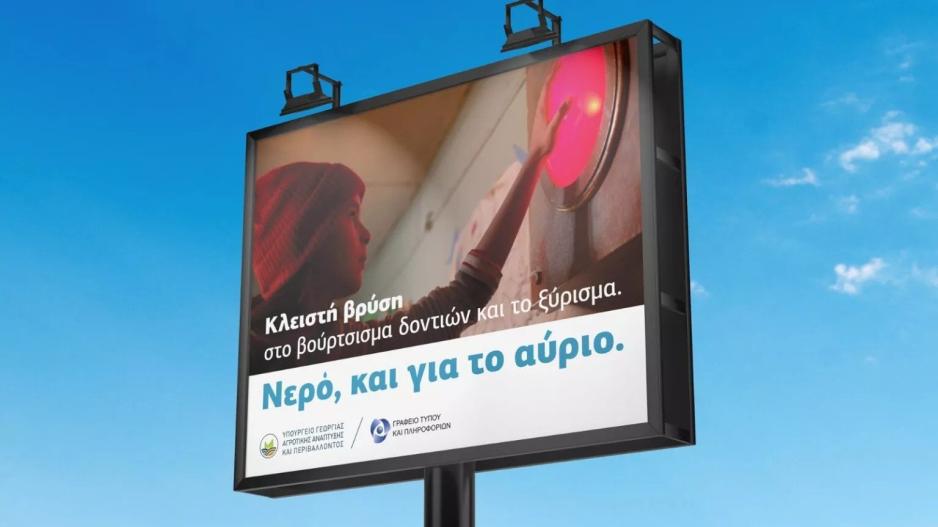
With reservoir levels resembling a thriller-like scenario, hovering around just 21% capacity, and the climate crisis turning once-plentiful rainfall into a distant memory, the Republic of Cyprus is launching a nationwide mobilization to safeguard its most valuable resource.
Beyond the measures and investments already being implemented to strengthen water security, such as expanding desalination capacity, utilizing recycled water, improving infrastructure, and enhancing water resource management, the new effort sets an additional key objective: turning water conservation into a collective responsibility.
Under the title “Water for Tomorrow,” the Ministry of Agriculture, Rural Development and Environment, in cooperation with the Press and Information Office and the Water Development Department, is launching a multi-layered campaign aimed at awakening citizens from the complacency surrounding water waste. The Ministry of Education, Sports and Youth is also participating, as students can become some of the most important ambassadors of responsible water use.
The campaign is being implemented during a critical period for the island’s water reserves. Its goal is to inform the public about the real situation of the country’s water resources under current climatic conditions, while also addressing common questions, such as water use in the tourism industry and golf courses, the complexity of water management, and the new reality Cyprus faces.
Cyprus remains one of the driest countries in the European Union. The year 2025 was recorded as the eighth worst year since 1901, while since the mid-1990s average annual rainfall has steadily declined by about 10%.
According to data from the Ministry of Agriculture, the average daily water consumption per person in Cyprus reaches approximately 140 liters, with the target being to reduce it to 125 liters.
The campaign’s objective is clear and measurable: a 10% reduction in water consumption by 2026, equivalent to saving roughly 10 million cubic meters of water, a quantity that could significantly strengthen the country’s water reserves.
The communication strategy of the campaign uses modern tools and creative approaches. Moving away from conventional messaging, it borrows the aesthetic of the popular series Stranger Things. Through cinematic teasers, the campaign highlights the contrast between children anxiously observing water levels dropping from their “headquarters,” and adults who remain hypnotized in front of their screens.
“The level is dropping. It’s time for all of us to press the button,” the campaign’s spots warn, inviting the public to download the new “Stagono-metro” application to monitor their water consumption.
As part of the campaign, the Press and Information Office is producing two audiovisual documentary-style productions, “Water Remembers” and “Water Speaks,” exploring the relationship each of us has with water and the many aspects of life it influences. These productions will also be provided as educational material for awareness initiatives in educational institutions, schools, and other organizations.
Specifically, the documentary “Water Speaks” provides evidence-based answers regarding water use in the tourism industry and golf courses, explaining the complexity of water management and the significant energy costs of desalination.
The documentary “Water Remembers” focuses on Cyprus’ largest dam, Kouris, which supplies water to the districts of Nicosia, Limassol, Larnaca, and Famagusta.
The iconic Kouris Dam is personified and placed at the center of the campaign. Today, its reserves amount to 22 million cubic meters of water, with capacity reaching just 19%.
The short film presents Kouris as the living heart of Cyprus. Through cinematic footage and archival material, it tells the story of the dam, its significance, and the need to protect it through water conservation and other measures. The message is clear: “If Kouris runs dry, we all run dry.”
The campaign is also accompanied by practical guidelines for citizens. With the goal of reducing water consumption by 10%, ten simple daily habits are proposed:
-
Turn off the tap while brushing teeth or shaving
-
Choose a short shower instead of a bath
-
Use washing machines only when they are full
-
Wash fruits and vegetables in a basin
-
Regularly check for leaks in installations
-
Report leaks in public spaces to the authorities
-
Water plants early in the morning or late in the afternoon
-
Choose plants with low water requirements
-
Wash cars using a bucket and sponge
-
Clean yards and balconies without using a hose
Beyond raising awareness, the Ministry of Agriculture is also implementing practical measures aimed at reducing water consumption by 10% in order to ensure uninterrupted water supply.
The procurement of 1,500 special water-saving devices for businesses has already begun, and the initiative will soon be extended to households across Cyprus.
The Water Development Department has already launched a tender for the supply of 3,000,000 faucet aerators and shower flow reducers. These devices will be distributed nationwide via postal mail in 600,000 envelopes. Through a dedicated digital platform, citizens will be able to report the progress of installing the devices in their homes.
A central pillar of the Ministry of Education’s strategy is the direct engagement of students.
The ministry is entering the effort dynamically with the program “Not a Drop Wasted.” Minister Athena Michaelidou announced the creation of greywater systems in schools, enabling the reuse of water from sinks, while the campaign “Words Should Flow, Not Water” will encourage students to become influencers of water conservation themselves.
According to the minister, water awareness and sustainable water management have long been a priority for the Ministry of Education. Issues related to water conservation and responsible water management are systematically integrated into every school unit through the implementation of the Environmental Sustainability Education Policy.
At the same time, these issues are addressed both through school curricula and through practical interventions within schools.
Among the initiatives being promoted to strengthen water awareness in schools are:
In water supply, the ministry is promoting access to clean and safe drinking water through the gradual installation of water coolers in schools across Cyprus. This initiative is combined with the environmental campaign “Which ‘P’ Do You Choose: Environment or Plastic,” encouraging the reduction of bottled water consumption. Environmental education programs are also being implemented at the school level to promote water conservation and reuse.
In irrigation, the program “Greening My School” supports the installation of smart irrigation systems, the use of boreholes, and the planting of species with low water requirements in order to ensure sustainable management of school green spaces.
At the same time, officials from the Water Development Department have already begun visits to schools, covering more than 30 educational institutions in Nicosia, Limassol, and Paphos during 2026.
The aim is to expand the program across all free areas of Cyprus, transforming students into ambassadors who will carry the message of water conservation into their families and communities.
Source: Philenews