Labor Explosion Brewing at EAC as Unions Warn of Institutional Decline and Power Shortages
The Executive Promotion Dispute and Board Intervention
As revealed by Brief, the Board of Directors of the Electricity Authority of Cyprus (EAC) is convening an extraordinary meeting today to implement its decision.
-
There is a universal reaction regarding an executive staff member who received a promotion but refuses to fill the designated position.
-
The individual cites "strong connections" and considers themselves "irreplaceable" in their current post.
-
If the position is not filled, the promotion of the "disobedient" executive will be terminated.
Implementing the decision of the Board of the Electricity Authority constitutes a one-way street regarding the executive who, despite being promoted, persistently refuses to fill the position.
The Authority's Board, as revealed yesterday to Brief by Giorgos Petrou, Chairman of the EAC, is meeting extraordinarily today to handle the matter, amid severe reactions from the trade union movement.
The unions do not object to the adherence to procedures for this specific executive. On the contrary, they are reacting to the phenomenon of "political interventions" that strike, as they claim, "the institutions and governance processes of the Organization."
At the same time, the risk of labor unrest looms at EAC, not over wage increase demands, but due to the fact that historically, the Authority's administrations procrastinate in taking effective measures to tackle the inadequacy of electrical energy.
Political Backing Claims vs. Executive Accountability
According to information obtained by Brief, during today's session, the Authority's Board will confirm its initial decision regarding the director in question, who will have his promotion revoked if he does not move and assume the duties of the position to which he has been promoted.
The promotional position will be given, based on procedure, to another employee who was a candidate and received the second highest score.
This is the practice followed in the civil and wider public sector, based on regulations.
Senior union officials active in the civil and wider public sector mentioned to Brief that such phenomena occurred in the past and still exist today in the public sector, namely, an employee being promoted and refusing to fill the promotional post.
In all these cases, the relevant regulations are activated, providing for the removal of the promotion and any corresponding salary upgrade.
Information from Brief indicates that the EAC Board cannot change a single iota of this process.
The reason does not only concern the faithful application of regulations. It is also the fact that the Board had taken a unanimous decision on this, meaning to serve him a letter recommending compliance with what the regulations foresee.
The case of this specific executive is not fresh; it began last September. However, it is evident that there was procrastination on the part of the EAC Board regarding the application of regulations, hence the collective reaction of the three unions organized within the EAC.
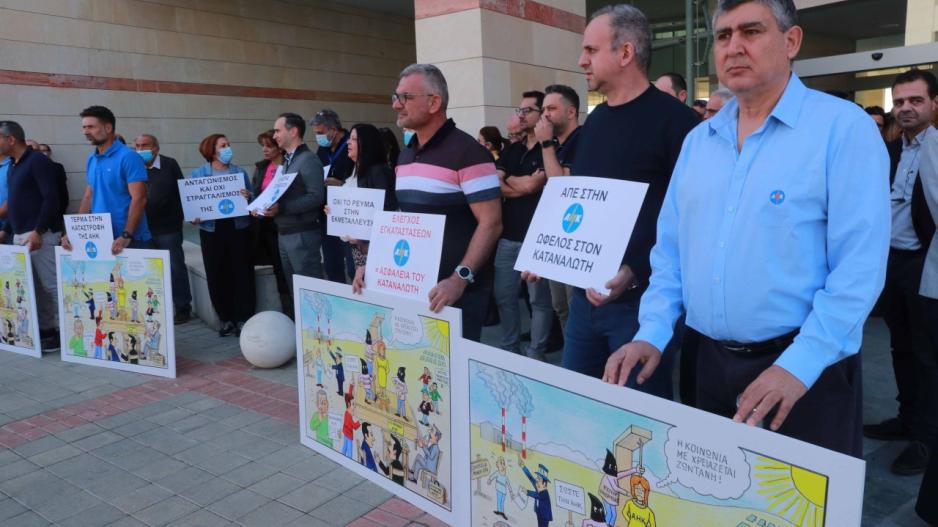
The three unions made public the day before yesterday their joint letter to the Board, the content of which is particularly strict and caustic.
The EPOPAI - OHO - SEK, SHDIKEK - PEO, and SEPAIK criticize, among others, the Chairman of the Board for "problematic and anti-institutional interventions carrying a risk of administrative decomposition for the EAC."
Claims are being made regarding "a series of particularly serious and highly alarming events, which harm the legality, prestige, and orderly operation of the Organization, disrupt the working environment, and cause conditions of institutional deviation."
"The case of this specific director, who claims to have political backing, is purely institutional, and the Board had an obligation to treat it as such," a leading union official commented to Brief.
Denials of Influence and Broadening Systemic Issues
"This is not the unique case that appears to have received 'political intervention'," the same union official claimed.
"There have been other political interventions in various matters recently that harm the prestige and credibility of the Authority," they observed, without specifying when and why these "political interventions" manifested.
Nevertheless, Giorgos Petrou, Chairman of the EAC Board, in an exclusive statement to Brief yesterday, argued that the facts are not exactly as presented in the letter.
"We have not provided cover for anyone, nor are we subjected to political interventions," Mr. Petrou remarked.
"The serious and responsible decisions of the EAC Board over the last two and a half years are taken on the basis of rationality and documentation, guided solely by the development and safeguarding of the well-understood interests of the Organization," the Authority's Chairman added.
Energy Supply Strain and Critical Infrastructure Delays
There is widespread concern among trade unions at EAC regarding the future of the Organization.
Speaking to Brief, leading union officials pointed out that it is only a matter of time before consumers experience unprecedented power outages if "serious, radical changes" are not made "yesterday."
They noted that causing even the slightest malfunction in any power generation unit will trigger power cuts.
"We do not have electricity adequacy. We do not have units that can cover potential breakdowns at this moment, especially if even higher temperatures occur," they noted.
It should be taken into account that energy storage installations have not been deployed in time.
The electrical interconnection, for right or wrong reasons, did not materialize, and the arrival of natural gas continues to face delays, resulting in a unit located at Vasilikos remaining idle.
"The situation is tragic and causes awe to the people of EAC, who experience the mountain of problems daily," the same leading union officials commented.
Indicative are the references made by the former Chairman of CERA, George Shammas, in articles published in the press regarding Cyprus's energy mix and power generation problems.
In his articles and interventions, he stresses that Cyprus lags dramatically in an integrated, long-term energy planning for a safe transition and adequacy.
The state, he claims among other things, has not yet drafted a comprehensive energy plan for electricity, natural gas, transport, and the economy, despite high prices.
Regarding the cost of electricity, according to Mr. Shammas, it remains unbearable for consumers.
He has repeatedly pointed out that the non-use of natural gas for power generation costs the Cypriot economy millions of euros annually.
He further supports the necessity of an energy transition and warns of the risks hidden by the lack of proper technical documentation in the system so that adequacy is combined with cost reduction for society.
Impending Labor Mobilization and the Taxpayer Burden
Leading officials from all three unions, EPOPAI, SHDIKEK, and SEPAIK, stated to Brief that their competent bodies will convene very soon to examine and evaluate developments to date.
Specifically, they will evaluate the commitments undertaken by the state through the Authority's Board, so that the Organization can effectively face the "mountain" of problems before it.
The workers at EAC feel strongly that the state does not delve seriously into solving vital problems plaguing one of the most critical essential services of the state.
"For us, taking dynamic measures is never an end in itself. We do not want to inconvenience the world. We are consumers too. But the rope has reached its limit. The price will be heavy, and the taxpayer will pay it," the same union officials stressed to Brief.