The 4 Key Factors Behind Erhürman’s Victory
From economic fatigue to identity politics — the data behind Erhürman’s unexpected triumph.
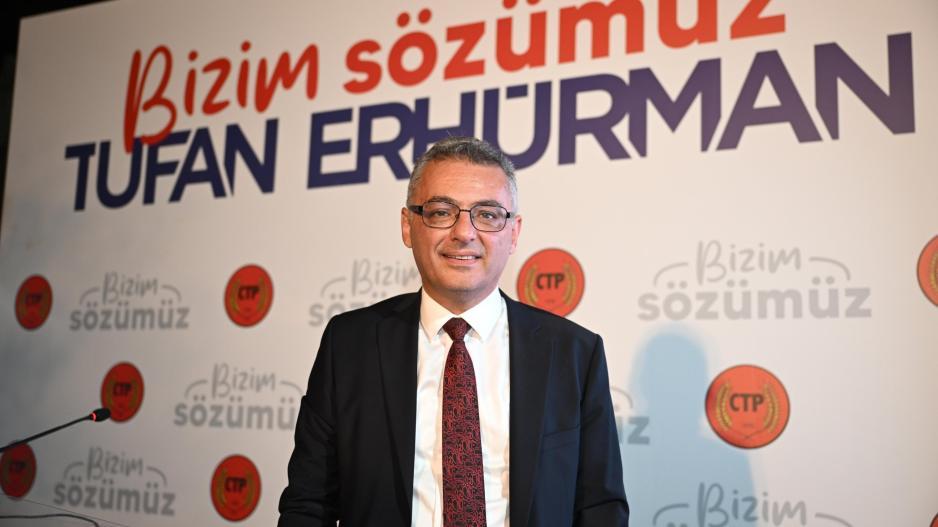
The victory of Tufan Erhürman represents “not just a change in leadership but a refocusing of Turkish Cypriot political identity,” according to a statement by the University of Cyprus. The statement highlights findings from a large-scale, door-to-door survey conducted with a representative sample of the Turkish Cypriot community (N=800), completed just days before the “elections” of October 19.
According to data from previous surveys by the University of Cyprus’s Centre for Field Studies (PAKEPE), there has been rising disillusionment with the two-state model promoted by the outgoing leader and Ankara between 2020–2025. Compared to 2020, support for a two-state solution has fallen by about 15 percentage points, while rejection of the status quo nearly doubled—from 20.8% to 36%.
In contrast, support for a bizonal, bicommunal federation (BBF) remained essentially unchanged at around 54% both before the 2020 and 2025 “elections.” When adding those willing to accept a BBF “if necessary,” overall acceptance rises to 71%, a rate similar to that found among Greek Cypriots in other PAKEPE surveys—making the BBF the only model supported by a clear majority in both communities.
The statement identifies four main factors behind Tufan Erhürman’s victory.
1. A Solution-Oriented Political Frame: Erhürman promoted “federal negotiations without a return to the status quo,” combining a clear commitment to UN parameters with pragmatic conditions reflecting frustration over failed negotiations—failures many Turkish Cypriots attribute to a perceived lack of political will for a solution on the Greek Cypriot side.
2. Economic Fatigue: Persistent inflation and the collapse of the Turkish lira undermined Ersin Tatar’s credibility. Around 16% of UBP voters from 2022 and 12% from 2020 shifted their support to Erhürman. The middle class, whose living standards deteriorated sharply, largely swung to the opposition.
3. Reaction Against Dependence on Ankara: Roughly 70% of respondents who wanted the new leader to “protect the secular character of the Turkish Cypriot community” said they intended to vote for Erhürman. Voters from both left and right—including figures associated with Serdar Denktaş—sought a more balanced relationship that safeguards Turkish Cypriot identity and autonomy.
4. Lack of Credibility in Tatar’s Governance: Erhürman was widely viewed as moderate, professional, trustworthy, and well-educated, appealing beyond his Republican Turkish Party (CTP) base to about 25% of the Democratic Party (DP) and supporters of other parties such as TDP and HP. Tatar, by contrast, was seen as divisive and reactionary. The CTP’s effective mobilization in the final days brought many left-leaning voters to the polls, while right-wing turnout remained low.

When asked about the most important issues affecting them, respondents cited: the economy (26.7%), the Cyprus problem (25.4%), corruption (16.1%), and the healthcare system (13.2%). The strong presence of the Cyprus issue suggests that voting choices were not driven solely by economic factors, but also by questions of identity, dignity, and political orientation.
“The victory of Tufan Erhürman represents not merely a leadership change, but a reorientation of Turkish Cypriot political identity,” the statement continues. “After nearly a decade of stagnation and deepening economic dependency, Turkish Cypriots chose a leader who promotes institutional reform, transparency, and renewed engagement with Greek Cypriots under a federal framework aimed at ending the status quo.”
The researchers note that voters sent a dual message: a reaffirmation of Turkish Cypriot autonomy and a reconnection with European values. With no major elections in Turkey, the United States, or Cyprus until 2028, a window of opportunity opens for meaningful diplomatic renewal. If properly utilized, this political shift could reinvigorate peace efforts and place Turkish Cypriot politics back on a pro-solution, forward-looking path.
The research team also identified potential “solution packages” for the Cyprus problem—variations of the Guterres framework—that could be acceptable to a majority of Turkish Cypriots. The team plans to release these findings in a forthcoming report, along with data on Greek Cypriot preferences.
The study was a multidisciplinary collaboration between researchers from the University of Cyprus (Professor Charis Psaltis, Dr Andreas Michael), the University of Warwick (Professor Neophytos Loizides), the Cyprus University of Technology (Dr Nikandros Ioannidis), Brandon University (Professor Allison McCulloch), the University of Kent (Professor Edward Morgan Jones), and the University of Essex (Dr Laura Sudulich). The project was carried out in partnership with sociologist and research lead Eliz Tefik of LIPA Consultancy and Ilke Dagli of the bicommunal organization SeeD, and funded through the Open Research Area 7/SSHRC program “Citizen Inclusion in Power-Sharing Settlements.”