Ireland Assumes EU Council Presidency Outlining Key Competitiveness And Security Pillars
Competitiveness, Values and Security the Irish EU Presidency Pillars, Ambassador Says
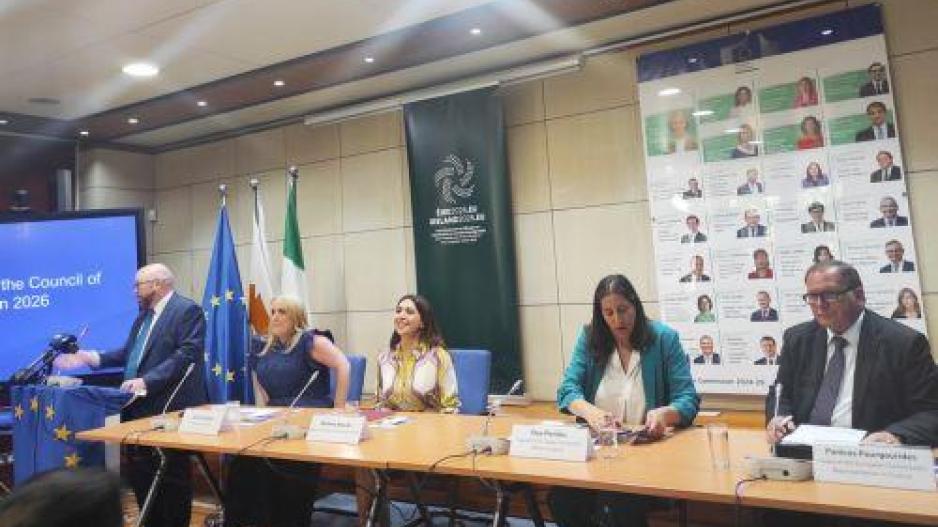
Irish Ambassador Sarah Hamilton presented Ireland's EU Presidency pillars—competitiveness, values, and security—at a handover event in Nicosia, where Deputy Minister Marilena Raouna reviewed Cyprus's successful, intense, and rewarding term.
Passing the EU Council Presidency Baton in Nicosia
The Irish EU Council Presidency programme is built around three core pillars, that is to say competitiveness, values and security, Irish Ambassador to Cyprus Sarah Hamilton said on Thursday, speaking at an event during which Ireland's priorities were presented and the Cyprus Presidency which concluded on June 30 was reviewed at the EU House in Nicosia.
On her part, Deputy Minister for European Affairs Marilena Raouna described the Cypriot Presidency as an "intense yet deeply rewarding experience" and reviewed its work in the areas of security and defence, migration, competitiveness, enlargement and the next Multiannual Financial Framework (MFF).
She also expressed confidence that Ireland would continue the shared effort towards a stronger and more autonomous European Union.
Ireland's Strategic Vision and Interinstitutional Support
Hamilton outlined the priorities of the Irish Presidency, saying its programme is built around three core pillars: competitiveness, values and security.
She reaffirmed the EU's support for Ukraine, highlighted enlargement as one of the Presidency's key priorities during its six-month term and said Ireland aims to promote a stronger and more united Europe under the Presidency's theme, “Strength with Unity.”
Head of the European Parliament Office in Cyprus Thea Pieridou said the rotating Presidency of the Council of the European Union is “much more than just an institutional milestone”, giving each Member State an opportunity to help shape Europe's agenda, build consensus and demonstrate its commitment to shared European values.
She said the role requires “leadership, commitment and an unwavering dedication to the European project.”
Referring to the Cypriot Presidency, Pieridou said Cyprus fulfilled the role “with professionalism, dedication and a genuine European spirit.”
She said the European Parliament had been “a close and committed partner” throughout the Cypriot Presidency, adding that interinstitutional cooperation lies “at the heart of the European Union's democratic decision-making process.”
Pieridou added that the European Parliament Office in Cyprus supported the Presidency by engaging with citizens, promoting dialogue on European affairs and highlighting the Parliament's legislative work.
Welcoming Ireland as it assumes the Council Presidency, she said the country has “a longstanding reputation for building bridges, fostering consensus and championing a strong, outward-looking Europe.”
She added that the European Parliament looks forward to working closely with the Irish Presidency to deliver tangible results for European citizens.
The Symbolic Handover and the New Trio Agenda
Head of the European Commission Representation in Cyprus Panicos Pourgourides likened the handover of the Presidency of the Council of the European Union from Cyprus to Ireland to a relay race, saying “the baton has passed seamlessly from Cyprus to Ireland.”
“Different runners, one lane, one shared direction and one common European ambition,” he said, stressing that while “every Presidency leaves its own mark,” each also serves “the continuity of the European project.”
Pourgourides said there was particular symbolism in “one island Member State handing the baton to another,” noting that in the European Union “geography never determines influence” and that “every Member State, regardless of size, has the opportunity and the responsibility to lead.”
Referring to the new Trio Presidency, Pourgourides said Ireland, Lithuania and Greece would build on the work of the Denmark–Poland–Cyprus Trio by advancing an ambitious European agenda.
Among the Trio's priorities, he said, is to “build on the significant progress achieved during the Cyprus Presidency,” particularly on enlargement and the next Multiannual Financial Framework, while advancing legislative work affecting more than 450 million EU citizens.
Pourgourides also congratulated Deputy Minister for European Affairs Marilena Raouna and the President of the Republic of Cyprus for the “excellent cooperation” throughout the Cypriot Presidency.
Reflecting on the Core Achievements of the Cypriot Term
Pourgourides described the Cypriot Presidency as “an exceptional six months” that were “frenetic at times, demanding, but also immensely rewarding.”
He noted that Cyprus hosted more than 50 high-level European Commission visits during the Presidency, including three by Commission President Ursula von der Leyen and three by High Representative and Commission Vice-President Kaja Kallas.
Deputy Minister for European Affairs Marilena Raouna said Cyprus' Presidency of the Council of the European Union had been “an intense and demanding responsibility” but also “a deeply rewarding experience”, describing it as “an extraordinary journey” for the country. “With humility, I believe we can now say that we fulfilled the responsibility we undertook on behalf of our European family,” she said.
On Ireland's assumption of the Council Presidency, Raouna said Cyprus was proud to pass on the baton, expressing confidence that Ireland would continue the shared effort towards “a stronger and more autonomous European Union.”
She noted that Cyprus understands “the importance of unity” first-hand as the last EU member state still affected by occupation, adding that the Irish Presidency's theme, “Strength with Unity”, resonates strongly with Cyprus.
Raouna said the Cypriot Presidency acted “with commitment, determination and a strong sense of responsibility”, placing the European Union's strategic autonomy at the heart of its agenda.
She said this objective shaped the Presidency's priorities and the informal meeting of EU leaders hosted in Ayia Napa and Nicosia, where discussions focused on energy security, European competitiveness, the One Europe, One Market roadmap, Article 42(7) of the Treaty on European Union and preparations for the next Multiannual Financial Framework.
Highlighting the Presidency's key achievements, Raouna pointed to progress on the SAFE instrument for security and defence, agreement on the 20th package of sanctions against Russia and the launch of work on the 21st package, as well as the Returns Regulation and the implementation of the Pact on Migration and Asylum.
She also highlighted progress on the Omnibus simplification packages, the reform of the Union Customs Code, the Council's negotiating position on the Electricity Grids Package, enlargement negotiations with Ukraine, Moldova, Albania and Montenegro, and major EU trade agreements with Mercosur, Mexico and Switzerland.
Raouna also pointed to the Council's first conclusions on affordable housing and described negotiations on the next Multiannual Financial Framework (MFF) as one of the Cypriot Presidency's biggest challenges. She said reaching a partial general approach marked “a decisive step” towards concluding negotiations by the end of 2026 and ensuring uninterrupted EU funding from 2028 onwards.
Implementing the Irish Roadmap Across Key Pillars
Irish Ambassador to Cyprus Sarah Hamilton outlined the priorities of Ireland's Presidency of the Council of the European Union, saying the Presidency begins at a critical time for Europe amid geopolitical uncertainty, economic challenges and rapid technological change.
Hamilton said the Presidency's theme, “Strength with Unity,” reflects the belief that Europe is strongest when it acts together. She said Ireland's programme is built around three priorities, competitiveness, values and security, aimed at building “a Europe that creates opportunity, protects its citizens and remains true to its fundamental values.”
She said the Presidency will focus on boosting Europe's competitiveness, advancing negotiations on the next Multiannual Financial Framework (MFF), and implementing the One Europe, One Market roadmap through regulatory simplification, a stronger Single Market, lower energy costs and support for the green and digital transitions.
Hamilton reaffirmed the EU's support for Ukraine and said enlargement would remain a key priority, with the aim of concluding accession talks with Montenegro and making substantial progress with Albania, Ukraine and Moldova. She added that the Presidency would ensure that the Union's core values remain at the heart of the Council's work.
On security, she said Ireland would prioritise stronger European defence cooperation, cybersecurity, efforts to counter hybrid threats and the fight against terrorism, alongside the full implementation of the Pact on Migration and Asylum and closer cross-border cooperation against serious and organised crime.