Media Pluralism in Cyprus Under Severe Pressure, Warns EU-Backed Report
Severe risks in Cyprus over ownership concentration, weak safeguards, political interference, and lack of inclusiveness.

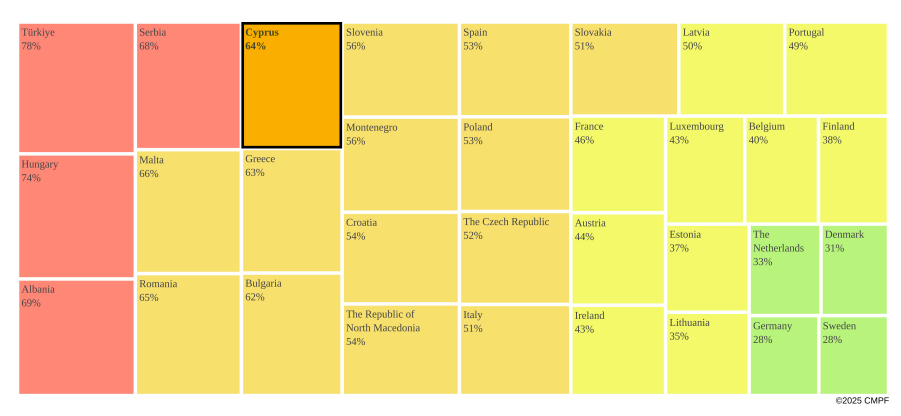
Cyprus faces some of the highest risks to media pluralism in the European Union, with serious concerns over transparency, ownership concentration, political influence, and inclusiveness, according to the 2025 Media Pluralism Monitor released by the European University Institute’s Centre for Media Pluralism and Media Freedom. The island ranks 26th out of the 32 countries assessed and is the 4th worst among EU member states, ahead only of Hungary, Malta and Romania. With an overall score of 64%, Cyprus falls into the medium-high risk category—just short of “high risk.”
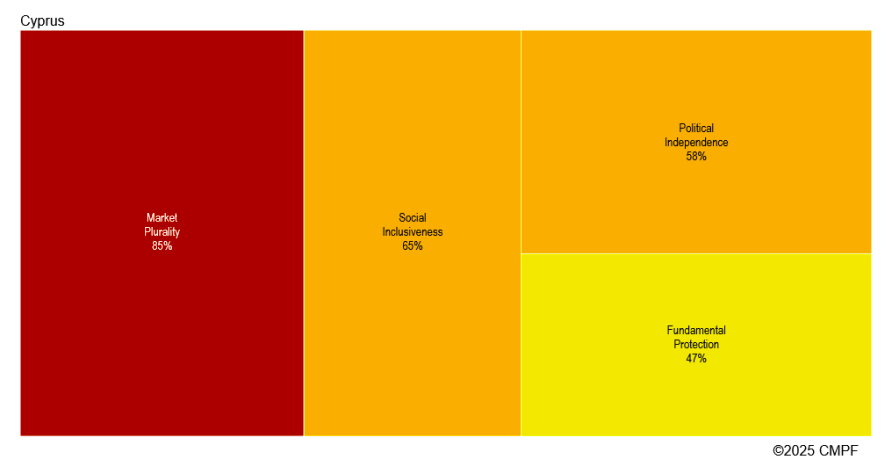
The MPM measures risks to media pluralism across four key areas: Fundamental Protection, Market Plurality, Political Independence, and Social Inclusiveness. Cyprus shows concerning results in all pillars, with Market Plurality at very high risk, Political Independence and Social Inclusiveness at medium-high risk, and only Fundamental Protection at medium-low risk.
The report finds that while Cyprus maintains a generally adequate legal framework for freedom of expression, fundamental gaps in implementation and new legislative attempts threaten to roll back protections. Draft laws aiming to regulate online communications and public assemblies sparked alarm among international watchdogs, with the OSCE warning of provisions that could “seriously violate media freedom.” Cyprus has also failed to establish effective protections for journalists and whistleblowers, with high-profile lawsuits—including strategic lawsuits against public participation (SLAPPs)—used to silence critics.
One of the starkest findings concerns market plurality, which the report ranks in the “very high risk” zone. Transparency obligations apply only to radio and television, leaving print and digital media ownership largely opaque. Recent legal changes have lifted almost all barriers to cross-ownership, enabling a wave of media concentration. With no reliable audience or financial data for much of the sector, the authors warn that Cyprus risks creating an oligopolistic media environment dominated by a handful of powerful interests.
The political independence of the media is also rated at “medium-high risk.” The absence of rules preventing politicians or state officials from owning media outlets allows conflicts of interest to persist, while the Cyprus News Agency remains heavily dependent on government funding and appointments. The report highlights systemic vulnerabilities at the public broadcaster RIK, where the governing board can be replaced by any incoming government, threatening editorial independence.
On social inclusiveness, Cyprus scores poorly. While minorities recognized by law have some access to public service media, unrecognized and marginalized communities are mostly excluded or represented negatively. Gender inequality also remains acute: few women hold leadership roles in media, and female experts continue to be underrepresented in news content. Meanwhile, despite growing concerns about online disinformation, Cyprus still lacks a national media literacy policy.
Overall, the authors of the report stress that media pluralism in Cyprus remains “under severe strain from opaque ownership, weak regulatory oversight, and persistent political and commercial pressures.” They call on authorities to urgently reform outdated media laws, strengthen transparency rules, safeguard journalistic independence from surveillance and lawsuits, and adopt effective measures for inclusivity and media literacy.
The findings come just months before the European Media Freedom Act enters into force across the EU in August 2025, setting stricter standards on transparency, editorial independence, and source protection. The report warns that Cyprus’s first draft transposition of EMFA notably omits key safeguards, raising doubts about the government’s commitment to align with European standards.