Nicosia Call for Action 2026: Urgent Strategy Outlined as Climate Footprint Expands
Conference Conclusions Show, Climate Crisis Has Growing Footprint on Cyprus as Temperatures Continue to Rise
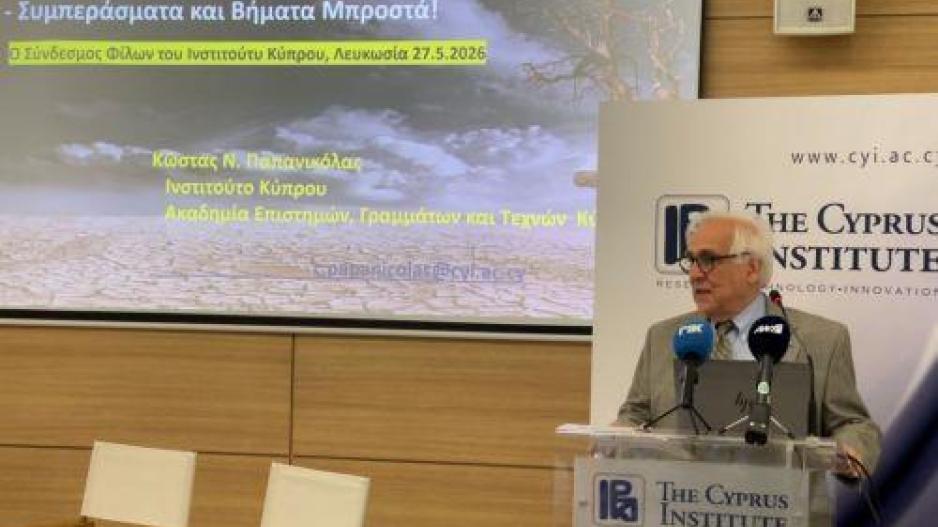
The need for immediate, collective and coordinated action in response to the climate crisis affecting the Eastern Mediterranean and the Middle East, one of the world’s most vulnerable regions, was highlighted during an event in Nicosia Wednesday, where the conclusions of an International Climate Conference were presented. The event was organised by the Friends of the Cyprus Institute Association. The Conference which took place in April, in the framework of the Cyprus EU Presidency, shaped the “Nicosia Call for Action 2026”.
Presenting the conclusions, the Chairman of the Conference Organising Committee and former President of the Cyprus Institute, Professor Costas Papanicolas, made a worrying observation, stating that “things do not look very optimistic, and this is clearly due to us and by us I mean the inhabitants of this strange planet.”
Particular attention was drawn to Papanicolas’ reference to scientific journal publications indicating strong signs that we are entering an El Niño phenomenon. ''The last major El Niño we experienced was in 2007, and if you remember, Cyprus faced serious water shortages that year. Therefore, if El Niño is confirmed, it is highly likely that we will experience a surge in temperatures'', he said.
Professor Papanicolas analysed the four main pillars of the action strategy defined by the “Nicosia Call for Action 2026.” The first pillar concerns empowering citizens and societies, with emphasis on investment in education, youth, women, and a socially just transition. The second pillar focuses on implementation-oriented actions, particularly scientific cooperation on energy transition, clean technologies, the circular economy, and reducing dependence on fossil fuels. The third pillar is related to strengthening governance and financing, highlighting the need for participatory governance models and better policy coordination. Finally, the fourth pillar focuses on strengthening partnerships through scientific diplomacy for the development of flagship cross-border projects at regional level.
Cyprus Institute Professor Panos Hadjinicolaou presented scientific data on temperature trends, stressing that the 10 warmest years on record have all occurred after 2015. “We have almost reached the 1.5 degrees Celsius threshold that the Paris Agreement suggests should ideally not be reached by the middle of the century. We are in 2026 and we have already touched 1.5 degrees Celsius of global warming compared to the pre-industrial era, around the mid-19th century, in terms of temperatures, which is the reference period used for comparisons,” he said. Referring specifically to Cyprus, Hadjinicolaou noted that they monitor and analyse the evolution of climate change in terms of temperatures using Meteorological Department data dating back to 1983. Using measurements from the Athalassa area in Nicosia as an example, he explained that since 2015, every year has been warmer than normal. ''There was a rise during the 21st century, a sharp jump. Now we seem to have reached a plateau, but at a high level, with every year in Nicosia being around 1.5 to 2 degrees Celsius warmer than normal'', he went on to say. The rise in temperatures is also reflected in the day-by-day analysis. According to Professor Hadjinicolaou, in 2025, red exceedances (warmer days) clearly dominated over blue downward deviations (cooler days). ''In fact, 245 days of the year recorded positive anomalies, as we statistically describe them, meaning warmer-than-normal days. Two-thirds of the days in 2025 were warmer than normal'', he noted.
Particular emphasis on the practical dimension of protecting cities and infrastructure from the impacts of climate change was given by former MP and former Commissioner for the Environment, Charalambos Theopemptou. “We are experiencing high temperatures. What are the problems? What condition are people’s homes in? What habits do we have? How do we build our cities and schools? All these require preparation,” he said. Theopemptou expressed strong concern because, as he stated, no one has seriously addressed the EU buildings policy, which foresees that from 2028 onwards all new buildings must be zero-emission buildings. “Does anyone know how to build a zero-emission building in Cyprus? Shouldn’t the government already be launching pilot projects and constructing two or three small buildings? Do we know how to carry out energy upgrades? To take an old building and turn it into a zero-emission one?” he asked.
According to former Parliamentarian, by 2050 all buildings in Cyprus will need to be zero-emission. “And if we calculate how many years remain until 2050, you will see that we should be carrying out energy upgrades on 16,000 buildings per year, while we are currently doing only 1,000'', he said.