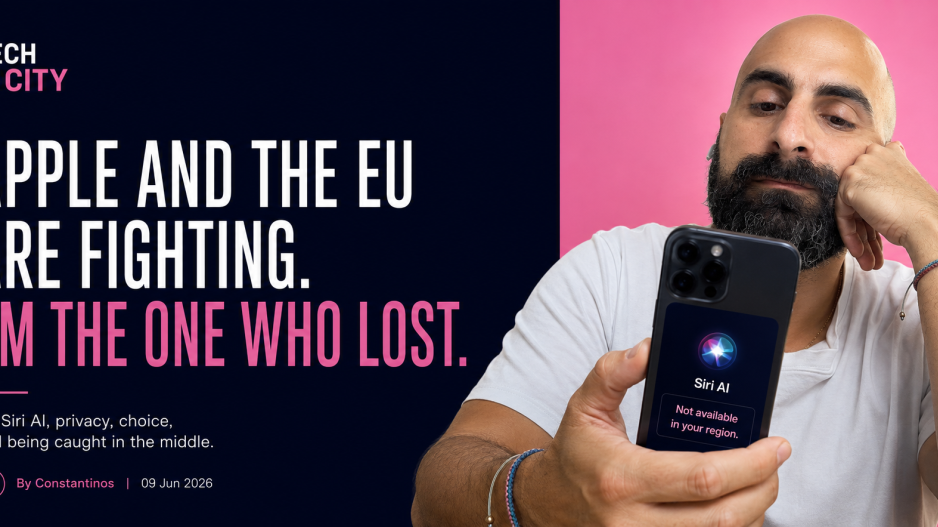
Apple and the EU Are Fighting And I’m the One Who Lost the Battle - Siriously
TL;DR
-
Apple finally built the Siri AI I’ve been waiting for.
-
EU iPhone users won’t be getting it.
-
Apple says it’s protecting my privacy.
-
The EU says it’s protecting my choice.
-
I seem to be very well protected.
-
Nobody asked what I actually wanted.
Apple and the European Union are fighting, and somehow I’m the one who lost Siri AI (and we all know I love a good AI assistant).
For years, I’ve defended Siri. Every time someone told me Google Assistant was smarter or ChatGPT was more useful, I’d become that annoyingly loyal Apple fan.
“Yes,” I’d say, “but I don’t need anything more than basic commands like turn on the lights.”
Then Apple finally did it.
At WWDC 2026, it unveiled the Siri I’ve been refusing to say I wanted. One that actually understands context, remembers conversations, and finally feels like an intelligent assistant instead of an expensive kitchen timer with confidence issues.
If I’ve been a bit judgmental with Siri for a while now even though she’s running my home.
But then Craig Federighi told me I couldn’t have it. On stage. At WWDC 26. And I felt like a kid standing in front of an ice cream truck with coins in hand, watching everyone else get served while being told, “not for you.”
And it’s not because my iPhone can’t run it. Not because Siri AI isn’t ready. Because Apple and the European Union are having a beef and I’m suddenly… a vegetarian?
Apple says the Digital Markets Act forces it to give rival AI assistants deeper access to the iPhone than it’s comfortable with. Apple proposed what it calls a Trusted System Agent, a system that would let competitors interact with iOS without exposing everything. The European Commission rejected that proposal.
The Commission, however, says the law doesn’t stop Apple from launching Siri AI at all. According to Brussels, delaying the feature is entirely Apple’s decision.
I feel like both sides have a point, but somewhere along the way the clarity got lost and so did the impact on the people actually waiting for the feature.
Here’s what I can’t stop thinking about. Both sides insist they’re doing this for me. Apple says it doesn’t want to compromise my privacy.
The EU says it doesn’t want Apple locking competitors out of my phone. Those are both reasonable positions.
But somewhere between Cupertino and Brussels, I feel like the dog in the middle of a breakup standing by the door with the leash in my mouth waiting for a walk. While both sides argue about who loves me more.
Nobody asked whether I’d rather have Siri AI now with Apple’s proposed safeguards, or wait indefinitely while two institutions argue over who cares about me more.
Apparently, my opinion wasn’t required. And that’s what bothers me. Not that regulators regulate. Thank God they do.
Without the EU, companies as powerful as Apple, Google and Meta would face far less scrutiny than they should. The Digital Markets Act exists for good reasons, and history has shown that Big Tech doesn’t usually volunteer to play nicely.
But good regulation should improve the experience of the people it’s trying to protect.
Right now, mine has become: “You can’t have the feature.”
Apple doesn’t escape criticism either. Privacy has become one of the company’s strongest selling points, but it’s difficult not to notice something.
EU users are getting Siri AI on Mac. EU users are getting Siri AI on Vision Pro. Just not on iPhone. So naturally, my brain asks a very annoying question.
If this is purely about privacy, why does privacy apparently behave differently depending on which Apple product I’m holding?
Maybe there’s a perfectly technical explanation. But Apple hasn’t explained it particularly well, which isn’t very Apple.
This whole thing reminds me of being stuck between two friends after they’ve fallen out.
One tells you their version. The other tells you theirs. Both insist they’re right. Both insist they’re looking out for you.
Meanwhile, you’re quietly wondering whether anyone remembers you only wanted to have dinner without the drama.
That’s how Siri AI feels. Can I just have the feature?
I couldn’t help but wonder…
When did protecting the user become something that happens without the user?
Maybe Apple is right. Maybe the EU is right. Maybe they’re both partly right. But from where I’m standing in Cyprus, none of that changes the outcome.
The Siri I’ve been waiting fifteen years for exists.
And somehow, I’m still waiting.
Not because the technology isn’t ready. Because the argument is.
And in that argument, the one person everyone claims to protect is the only one left outside the room, still waiting to be let in.