OpenAI Strikes Billion-Dollar Deal with AMD
A five-year alliance will unleash AMD’s powerful MI450 chips in OpenAI’s data centers, igniting a new battle for AI supremacy.
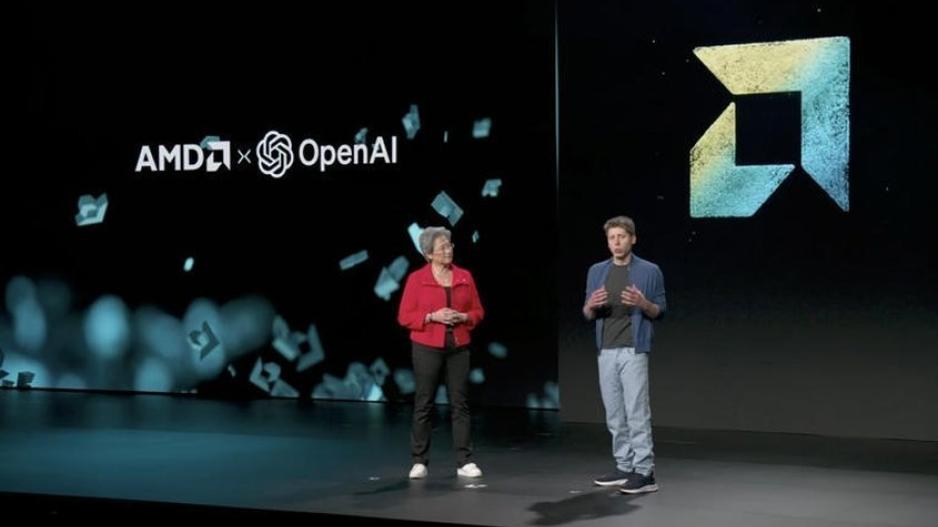
OpenAI and AMD have announced a five-year, multi-billion-dollar agreement to build and operate advanced AI data centers powered by AMD’s next-generation processors. The partnership marks AMD’s most ambitious move yet to challenge Nvidia’s dominance in the artificial intelligence chip market, where Nvidia still holds more than 70% of the share.
According to the released details, OpenAI has committed to securing 6 gigawatts of computing power through AMD’s upcoming MI450 chips, set to roll out in 2026. The acquisition will occur either directly through OpenAI or via its cloud computing partners.
AMD CEO Lisa Su stated that the deal is expected to generate “tens of billions of dollars” in new revenue over the next five years. OpenAI will also receive stock options for up to 160 million AMD shares—around 10% of the company—upon achieving certain growth milestones and share price targets.
Following the announcement, AMD’s stock surged more than 25% in pre-market trading on Monday.
The New Challenger to Nvidia
The agreement is seen as AMD’s biggest breakthrough in its bid to rival Nvidia’s supremacy in AI semiconductors. While AMD processors are already prevalent in gaming, PCs, and servers, the company has so far struggled to gain a foothold in the high-end chip market powering advanced AI models.
OpenAI plans to use the MI450 chips primarily for inference operations—the real-time computations that allow applications like ChatGPT to respond to user requests instantly. The rising demand for large language models has dramatically increased the need for such computing capacity.
“It’s hard to describe how difficult it has become to secure enough compute,” admitted OpenAI CEO Sam Altman, emphasizing that “we want everything to move fast—but that takes time.”
Redrawing the AI Landscape
Su and Altman described the deal as a “strategic alliance” binding the two companies in a shared path of growth, deepening their interdependence within the rapidly expanding AI industry. “It’s a win-win partnership. OpenAI’s incentives are directly tied to AMD’s success—and vice versa,” said AMD’s chief executive.
Although Nvidia remains the preferred chip supplier for most AI developers, it now faces growing pressure from multiple fronts:
-
Cloud giants like Google and Amazon are developing their own chips.
-
OpenAI has already signed a $10 billion agreement with Broadcom to create its own semiconductors.
-
Nvidia is preparing to launch its new Vera Rubin chip in 2026, which will deliver more than twice the power of the current Grace Blackwell generation.
Mega Deals and Fears of an AI Bubble
OpenAI plans to start using 1 gigawatt of AMD’s new chips in the second half of 2026, gradually scaling across its data centers.
This agreement joins a growing list of OpenAI’s mega-deals in 2025:
-
A $300 billion deal with Oracle for 4.5 gigawatts of computing power.
-
A $100 billion investment from Nvidia for joint data center development.
Altman remains determined to secure all necessary computing infrastructure to “win the race toward artificial superintelligence (ASI).”
However, the massive wave of investments has sparked concerns about an emerging “AI bubble.” Analysts warn that the enormous spending by OpenAI, Meta, Alphabet, and Microsoft on chips, data centers, and energy infrastructure mirrors the scale—and risk—of the industrial booms of the 19th century.
For AMD, the deal represents an opportunity to become a central player in the AI hardware ecosystem. For OpenAI, it’s another decisive step toward solidifying its position at the heart of the artificial intelligence revolution.
As Sam Altman remarked, “We’re entering a phase where the entire industry needs to work together—and everyone stands to benefit.”