Unions Mobilize Hundreds of Thousands in France’s Biggest Strikes in Years
Nearly one million demonstrators take to the streets across France.
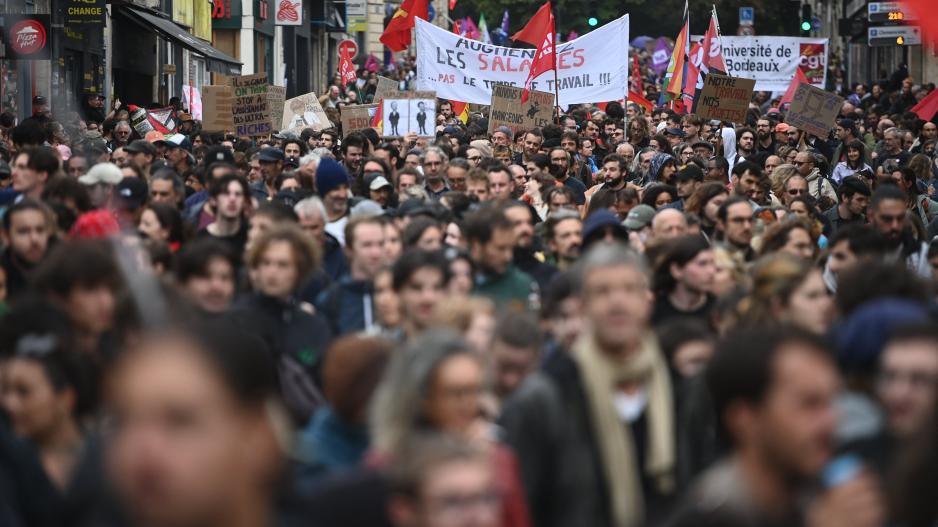
France was brought to a near standstill on Thursday as teachers, railway staff, pharmacists, hospital workers, and farmers joined one of the country’s largest strike movements in recent years. The nationwide protests target government plans for deep budget cuts, with unions demanding more investment in public services, higher taxes on the wealthy, and the reversal of a controversial pension reform.
The Interior Ministry estimated that up to 900,000 demonstrators would take to the streets in more than 250 planned rallies across the country, including major gatherings in Paris, Marseille, and Nantes. In the capital alone, police expected between 50,000 and 100,000 participants, warning of possible violence from fringe groups. Around 80,000 police and gendarmes were deployed nationwide.
Public transport faced severe disruptions, with metro lines and regional trains heavily affected, while many schools closed as roughly a third of primary teachers walked out. Pharmacies across France also shuttered, after their union warned that up to 98% of outlets would join the strike. Blockades were reported at high schools in Paris and Amiens, and in Marseille, police used tear gas to disperse attempts to shut down the headquarters of shipping giant CMA-CGM.
The wave of mobilization marks the first time since mid-2023 that France’s major unions have united in mass action. The last comparable demonstrations erupted when President Emmanuel Macron pushed through an unpopular pension reform raising the retirement age to 64.

The unrest comes as Macron’s newly appointed prime minister, Sébastien Lecornu, faces his first major test just days into office. Lecornu was named last week after parliament ousted François Bayrou over his proposed €44 billion austerity plan. While the new premier has promised a “break” with past policies, he has yet to clarify whether he will abandon Bayrou’s planned spending freezes and cuts to social programs.
France’s fiscal deficit stood at nearly twice the EU’s 3% limit last year, and public debt has climbed to 114% of GDP. Credit ratings agency Fitch downgraded France’s sovereign rating last week, citing political instability. Opposition parties on the left and far right have warned Lecornu that continuing Macron’s 'pro-business' policies could trigger his downfall.
Union leaders say their members’ anger is real. “We are asking for fair contributions from the richest and an end to harsh budget cuts,” said Perrine Morel of the CFDT, speaking on public radio. Student protesters in Paris carried banners reading “Tax the rich,” underscoring a growing sense of frustration across generations.
With parliament fragmented, Lecornu must now present a new 2026 budget plan within weeks—one that both addresses EU fiscal pressures and calms the social crisis erupting in the streets.