The Airlines Winning the Cyprus Bet and the New Flight Map
How 54 Airlines, 165 Destinations, and the Competition for Every Available Aircraft Are Changing Cyprus's Position in the European Aviation Market.
-
Cyprus's airports recorded a historical record in 2025 with 13.75 million passengers, contributing approximately 789 million euros to the local economy.
-
The market has diversified significantly, as 54 airlines now connect the country with 165 destinations, reducing dependence on a few air carriers.
-
The United Kingdom remains the dominant market, while Poland records rapid growth and Germany gradually recovers its share.
-
Shortages of available aircraft in the European market intensify competition, making it critical to maintain Cyprus's attractiveness for new investments.
-
A key challenge for the future is strengthening connectivity during the winter months, aimed at further boosting economic competitiveness.
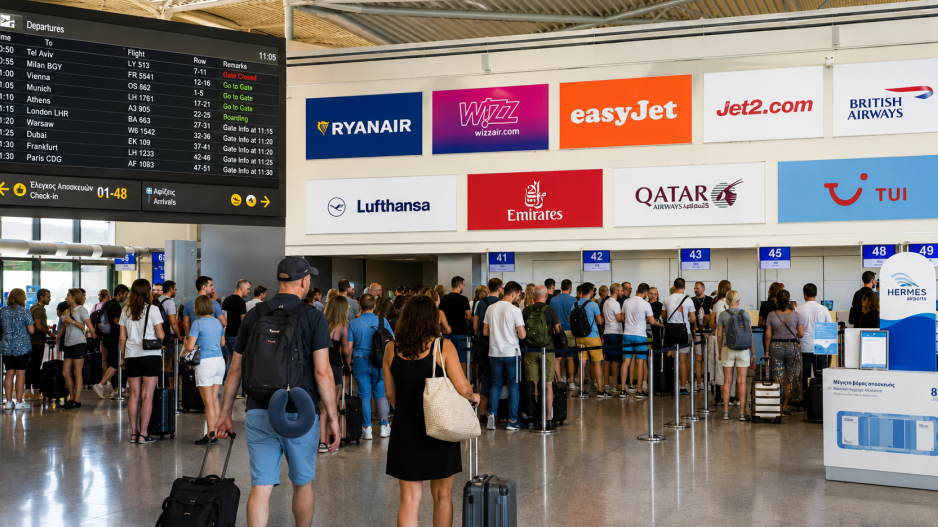
The picture of Larnaca and Paphos airports has changed noticeably within a few years. New destinations are constantly added to departure and arrival boards, more airlines are claiming market share, and options for passengers are greater than during any other period. Behind this development lies a market growing in a particularly demanding European environment, where every new route is evaluated against strict financial criteria and every available aircraft constitutes a valuable operational resource.
Cyprus currently possesses the largest air connectivity network in its history. According to the latest figures from Hermes Airports, the two international airports serve 54 airlines connecting the country to 165 destinations in 42 countries. This represents a network that could hardly have been imagined a decade ago, when options were clearly limited and the market depended to a far greater extent on a few air carriers and specific tourism markets.
The numbers acquire even greater significance considering the conditions currently prevailing in European air transport. The largest aircraft manufacturers face significant delays in deliveries of new aircraft, several companies are forced to revise their schedules due to engine maintenance issues, and fleet availability remains constrained across the entire European market. The result is that airlines choose with even greater care where to deploy each aircraft and which routes can yield the highest return.
This is precisely what makes the position Cyprus has attained particularly important. The country is not competing solely against neighboring destinations, such as the Greek islands or Malta. It is claiming investments from the very same airlines that simultaneously evaluate opportunities in Spain, Portugal, Croatia, Italy, and other Mediterranean markets. An airline's decision to maintain or strengthen its presence in Cyprus means that, after evaluating dozens of parameters, it considers that this specific market can support profitable growth.
Interest is not limited to tourism. A country's connectivity now constitutes a key competitiveness indicator for any economy. It affects the attraction of investments, the operation of multinational enterprises, the hosting of international conferences, the growth of higher education, and the ability of local businesses to maintain closer contact with foreign markets. The existence of more direct flights reduces travel time, lowers travel costs, and increases a country's appeal as a location for establishing businesses and organizations.
The footprint of aviation on the Cypriot economy is also reflected in the figures from Hermes Airports. In 2025, Larnaca and Paphos airports served more than 13.75 million passengers, a performance marking a new historical record. Total economic activity directly and indirectly connected to the operation of the two airports is estimated to have reached approximately €789 million, confirming that air transport is one of the most important growth drivers for the Cypriot economy.
A Market No Longer Dependent on a Single Player
The most significant change recorded in recent years concerns not just the increase in passengers or available destinations, but primarily the structure of the market. The era when one or two companies almost exclusively shaped the landscape of Cypriot aviation has passed. Today, the market is characterized by greater diversity, with low-cost carriers, legacy airlines, and large network carriers operating to serve different passenger categories and distinct markets.
This diversification functions as a stabilizing factor. It reduces dependence on the decisions of a single company and limits the risk of the country's connectivity being significantly impacted in the event of a carrier's network restructuring. It also creates conditions for fiercer competition, which translates into more options and often more competitive fares for passengers.
Low-cost carriers played a major role in this evolution by systematically investing in the Cypriot market. Their expansion did not merely increase the number of available seats. It opened new direct connections to cities that until a few years ago were not on the route maps of Cypriot airports and contributed to broadening the tourist season by attracting visitors outside traditional peak months.
Wizz Air and Ryanair changed the balance
No other development influenced the Cypriot market more than the expansion of Wizz Air and Ryanair. The two airlines pursued different strategies, but ultimately shaped today's aviation landscape to a large extent.

Wizz Air chose to invest in Larnaca, establishing an aircraft base and gradually developing an extensive network toward Central and Eastern Europe. The company announced at the start of 2025 that it had already carried more than nine million passengers to and from Cyprus, a figure that reflects the scale of its presence in the country. This growth was linked to adding new routes and strengthening markets that, until a few years ago, had limited participation in Cypriot tourist traffic.
Ryanair concentrated its activity primarily in Paphos, playing a decisive role in boosting the airport and expanding direct connections to the United Kingdom and other European markets. This strategy gave Paphos a different dynamic and reinforced its role as one of the country's main tourism gateways.
The two airlines do not only compete against each other. They compete daily against dozens of other European destinations for the utilization of the same aircraft fleet. This means that maintaining and expanding routes to Cyprus cannot be taken for granted. It requires consistent demand, a competitive environment, and growth prospects that justify continued investment.
Britain Continues to Determine Developments
No market influences the Cypriot aviation industry more than the United Kingdom. Despite significant changes in Europeans' travel habits in recent years, Britain continues to be the largest source of passengers and tourists for Cyprus, maintaining a role that extends far beyond the limits of the summer holiday season. The relationship between the two countries rests on decades of strong economic, social, and family ties, creating steady demand for air travel throughout the year.
The importance of this specific market is also reflected in the network's scope. Direct flights operate from Cyprus's two airports to London, Manchester, Birmingham, Bristol, Liverpool, Leeds, Glasgow, Edinburgh, Belfast, and several other British cities. Few European countries of Cyprus's size possess such an extensive network of connections with a single market.
The competition among the airlines themselves is also of particular interest. British Airways maintains a presence via Heathrow and Gatwick, easyJet, Jet2, TUI, and Ryanair serve different market segments, while several other carriers add seasonal routes depending on demand. Each targets a different audience: some focus primarily on package tourism, others on Cypriots and Britons traveling frequently between the two countries, while full-service carriers serve a significant number of business travelers and passengers continuing their journey via international connections.
Hermes Airports revealed in May 2026 that approximately 30 daily arrivals from the United Kingdom were taking place at Larnaca and Paphos, with an average seat load factor of around 92%. This figure explains why this specific market continues to serve as a benchmark for every airline considering its presence in Cyprus.
Poland Evolved From a Supplementary Market to a Key Player
Very few markets demonstrated such rapid growth as Poland. A decade ago, options were limited and most flights focused on Warsaw. The picture is now completely different. Direct connections cover several major Polish cities, while airlines are gradually increasing available capacity as demand remains high.
This development was not driven by a single factor. The entry and expansion of low-cost carriers opened new possibilities, tourism organizations invested more in promoting Cyprus, and Polish travelers began selecting the country more frequently for holidays beyond the summer months. The market acquired longer duration and stability, an element especially important for airlines seeking high load factors for more months of the year.
The figures presented by Hermes Airports are telling. In May 2026, approximately nine daily arrivals were recorded from Poland, with an average load factor reaching 93%, the highest percentage among the major markets publicly presented. These numbers explain why several companies continue to invest in this specific market and are evaluating new connections to Cyprus.
The case of Poland is also particularly interesting for another reason: it proves that the Cypriot market can grow significantly when new direct routes open. The increased demand did not necessarily pre-exist; it was created gradually through better connectivity and easier access for travelers.
Germany Is Gradually Regaining Ground
The German market follows a different path. Although it remains one of the largest European economies and possesses significant travel momentum, its presence in Cyprus did not have the same intensity as other countries in previous years. That picture began to change gradually through the reinforcement of direct connections and the entry of new carriers.

The launch of Discover Airlines flights to Larnaca further strengthened the Lufthansa Group's presence in the Cypriot market, offering more options both for leisure travelers and for passengers using Frankfurt as an international connecting hub. The importance of this specific market is not limited to arrival numbers; Germany is one of Cyprus's most important commercial partners, and strengthening air connectivity facilitates business contacts as well as investments.
Israel Remains the Most Demanding Market
Geographic proximity makes Israel one of the most important markets for Cypriot airports. Flights between the two countries operate daily and serve tourism, business travel, family visits, and short trips.
However, this market exhibits a characteristic not seen with the same intensity in other countries. Geopolitical developments can directly impact airline schedules, leading even to temporary route suspensions. This reality demands constant adaptation from both airlines and tourism authorities.
Despite the difficulties, Israel continues to be a market of strategic importance for Cyprus. The short flight duration, frequency of routes, and close economic ties between the two countries maintain high carrier interest, even during periods of heightened uncertainty.
Major International Hubs Offer Much More Than a Direct Flight
The number of flights is not always the most critical criterion for evaluating a market. Certain routes acquire special value because they connect Cyprus to the world's largest aviation networks.
Daily flights by Emirates to Dubai and Qatar Airways to Doha allow passengers to continue their journey to hundreds of destinations in Asia, Africa, and Oceania via a single transit stop. A similar role is played by connections to Frankfurt, Munich, and other major European hubs, where passengers gain access to extensive connecting networks.
The value of these connections is not reflected solely in the number of travelers landing in Cyprus; it also concerns the ease with which a Cypriot enterprise can reach international markets, conduct business trips, or host partners from every corner of the globe.
How a New Route Is Decided Before Appearing on the Departure Board
When an airline announces it will launch flights to Larnaca or Paphos, the decision has previously gone through a long evaluation process. Airlines examine dozens of markets simultaneously, and every new route is called upon to prove that it can perform better than a competing destination. Demand is only one of the criteria. Equally important are seasonality, growth prospects, airport charge levels, hotel occupancy, the presence of major tour operators, and the ability to maintain satisfactory fares throughout the season.

The process begins many months before the first flight. Executives from airlines, airports, tourism authorities, and destination promotion organizations maintain continuous contact at international exhibitions and specialized conferences. Data regarding passenger traffic, market prospects, load factor percentages, opportunities for cooperation with travel organizations, and commercial performance projections for each new route are presented. The final decision is not made based on a single meeting, but following months of negotiations and data analysis.
Hermes Airports has invested significantly in this process through its participation in international forums such as the CONNECT conference, where airports and airlines meet to discuss new partnerships and potential connections. New routes are not typically announced at such events; however, many of the discussions that later lead to new flights to Cyprus begin there.
The Biggest Challenge Today Is Not Demand, but Aircraft
The European aviation market faces a reality today that could hardly have been predicted a few years ago. Demand for travel remains strong, but several airlines are unable to grow their networks at the pace they would like because they lack a sufficient number of aircraft.
Delays in deliveries of new aircraft from major manufacturers, combined with problems experienced with specific engine types, have significantly restricted fleet availability. Many carriers have been forced to postpone launching new routes or reduce frequencies on existing ones until their fleets are bolstered.
This circumstance makes Cyprus's position even more critical. When an airline decides to assign an aircraft to Larnaca or Paphos, it essentially chooses the Cypriot market over dozens of other European destinations competing for that same investment. Maintaining and expanding existing connections thus carries greater value than during periods when fleet availability was abundant.
Winter Will Determine the Next Phase of Growth
The main challenge for all Mediterranean tourism markets is no longer the summer. Most airlines can fill their aircraft during peak months. The real objective is maintaining high load factors from November through March.
Cyprus has made progress in this direction. The rise in short-break travel, growth in sports tourism, hosting of international conferences, and expansion of the digital nomad market have all contributed to broadening the tourist season. Retaining more direct flights during the winter months has become a key priority for both the aviation industry and the tourism sector.
The success of this effort will not be judged solely by the number of new routes, but primarily by how many of them remain active on a year-round basis. Airlines constantly evaluate route performance and do not hesitate to adjust their schedules when financial results fall short of expectations.
The Next Battle Will Be Fought Over Connectivity Quality
Discussions surrounding aviation often focus on total passenger numbers. While this metric remains important, it alone is insufficient to capture the complete picture of a market.
The quality of connectivity is equally critical. Having more direct flights to major economic centers, strengthening daily frequencies, increasing business travel options, and securing access to international aviation hubs directly influence the competitiveness of the Cypriot economy. Every new connection facilitates export-oriented businesses, strengthens foreign investment attraction, and renders the country more appealing to companies seeking a regional base in the Eastern Mediterranean.
The challenge in coming years will not merely be increasing the number of destinations, but reinforcing connections that generate the highest added value for the economy while maintaining airline presence in an environment where competition among European destinations grows increasingly intense.
Cyprus enters this new period from a position of strength. A network of 54 airlines, 165 destinations, and connections to 42 countries provides a solid foundation for the next growth phase. The real test begins now: maintaining this momentum will depend on the country's ability to remain attractive to airlines, expand demand beyond summer months, and continuously enhance its position in a steadily more competitive European market.