Cyprus Drops Anchor on Financial Crimes
First-Ever National Anti-Fraud Strategy Unveiled
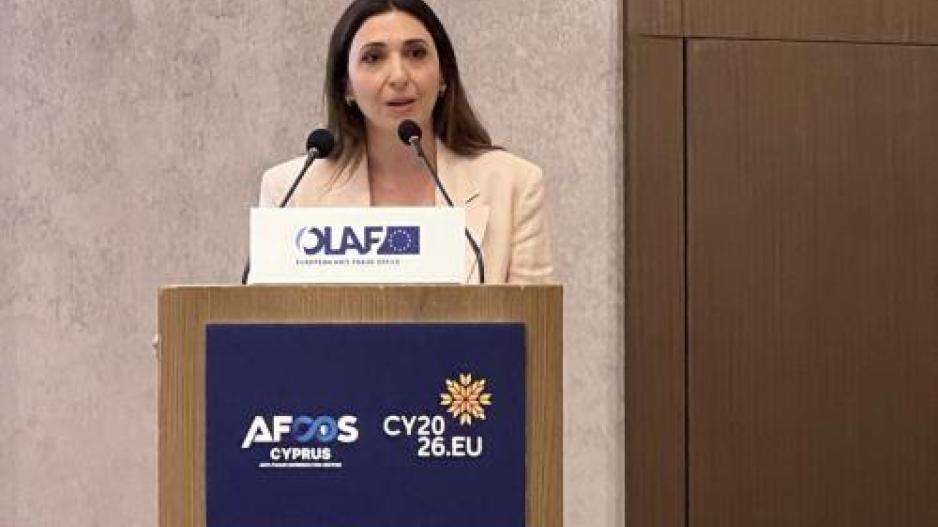
Cyprus on Wednesday formally launched its first National Anti-Fraud Strategy for 2026–2031 during the 4th OLAF Expenditure Conference held in Agia Napa, in the Famagusta district, a key event held under the island’s Presidency of the Council of the European Union.
Addressing delegates, EU Affairs Deputy Minister, Marilena Raouna, underscored the strategy’s role in strengthening the protection of EU funds and aligning national efforts with the European anti-fraud architecture.
She said that today’s launch "is both an achievement and a beginning. An achievement, because Cyprus now has, for the first time, a single national anti-fraud strategy with a very clear implementation horizon. And a beginning, because the real value of the Strategy will lie in its execution, in coordination, in follow-up, in institutional ownership, and in the practical results it delivers over the next years."
Raouna said that the Cyprus Presidency is in "full gear to continue pushing through more important deliverables. Negotiations", she added, are culminating on a number of key files, including "discussions on the future of the anti-fraud architecture and the negotiations for the next Multiannual Financial Framework of the EU".
From the beginning, she added, the Cyprus presidency has been about "translating vision and strategic goals into tangible, measurable results", adding "our work is constructed around an overarching vision, of a more Autonomous, Union", a "Union that is strong from within, and at the same time, open to the world. For Cyprus it is absolutely clear that a stronger, more resilient Union, is a Union of values".
She explained that strategic autonomy does not mean isolation. "It means the capacity of the Union to act. To effectively finance its priorities. And to protect its funds. All while remaining open, outward-looking and credible. In the midst of remarkable geopolitical and geoeconomic shift, our predictability and reliability as a Union is one of our greatest assets," Raouna stated.
Outlining the "five overarching priorities" of the Cyprus EU Presidency, she said all are relevant and consistent with the objectives of the EU Anti-Fraud Strategy. These are about "security, autonomy through security, defence readiness and preparedness", "autonomy through competitiveness", a "more autonomous Union that is open to the world" by fully leveraging its tools and by deepening strategic partnerships and trade relations, noting that Cyprus, because of its geographical position, is a reliable bridge of cooperation and dialogue amongst all its neighbours. The fourth priority places citizens in the center of its "vision for a Union of values that leaves no one behind" and the last priority is a "long-term budget that actually becomes an effective vehicle for an autonomous Union".
The 2028–2034 MFF will be the backbone of the Union’s future action, said Raouna, noting that "its credibility will depend not only on political choices, but also on the strength of the governance and anti-fraud systems that support it".
Referring to Cyprus' first National Anti-Fraud Strategy for the Protection of the European Union’s Financial Interests for the period 2026–2031, endorsed by the Council of Ministers a few days ago, she said it establishes, for the first time, a single national framework that covers both expenditure and revenue, and spanning the main sectors through which Cyprus receives and manages EU funding: Cohesion Policy, the Common Agricultural Policy, the Common Fisheries Policy, Migration and Home Affairs, and the Recovery and Resilience Facility.
The first National Anti-Fraud Strategy, Raouna added, has been developed with the support of the OECD and with financial support from the European Union, and it is accompanied by a five-year action plan with concrete measures, responsible authorities, monitoring indicators and reporting arrangements.
Concluding, she said "the protection of the European Union’s financial interests is inseparable from the protection of the public interest itself" and that "Cyprus is fully committed to that responsibility".
In his speech, European Anti-Fraud Office’s (OLAF) Director-General Petr Klement said that working together is the key, noting that "we can, and should, go faster and deeper in coordinating not only what we do but also how we do it. We should strive towards the highest common denominator, learning from the best practices of our peers to improve standards across the board".
We owe, he said, to European taxpayers, to the citizens whose money we protect, to consistently strive to do the best we can. "Protecting EU expenditure in the years to come will be our shared responsibility, and engagement at every level will be the key to success", he noted.