EU Unity and Cyprus Security Take Center Stage at Nicosia Finance Summit
Cyprus Stability a European Concern, Pierrakakis Says, as Belgian Minister Stresses EU Unity
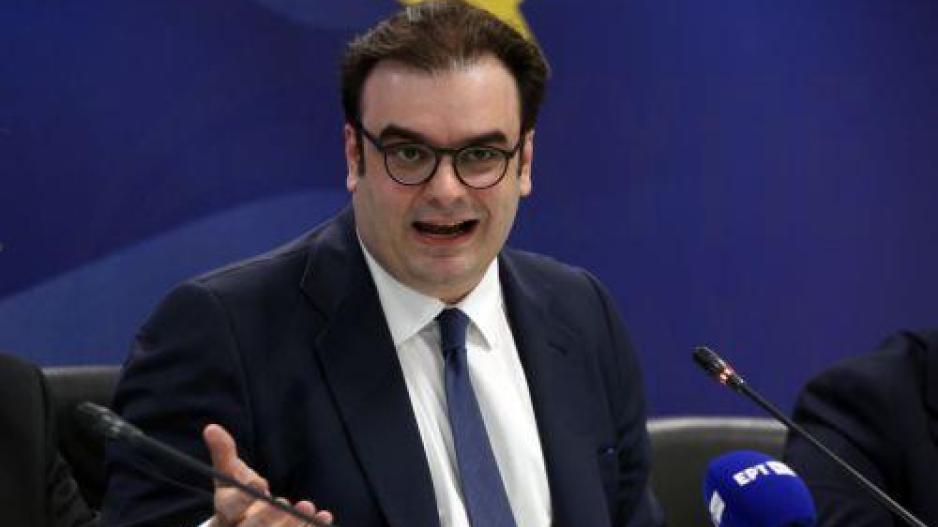
“The security and stability of Cyprus is a matter for the whole of Europe”, Eurogroup President and Greek Minister of National Economy and Finance, Kyriakos Pierrakakis, said speaking in Nicosia on Friday ahead of the Informal Meeting of EU Finance Ministers and Central Bank Governors.
In a doorstep statement, Pierrakakis expressed his satisfaction at being in Cyprus, describing the country as “a benchmark for stability and security in the Eastern Mediterranean” and noting that it “has proven capable of turning crises into opportunities and continuously upgrading its economic and geopolitical role”.
He further stressed that Cyprus plays a “strategic role in a region of heightened geopolitical complexity”, adding that its stability is closely linked with broader European interests and priorities.
Referring to the European economic outlook, he said that the latest European Commission forecasts show “downward revisions to growth and upward revisions to inflation,” while stressing that Europe remains “within a positive growth environment”, despite mounting stagflationary pressures. “Resilience is the key word for Europe”, he added.
He also noted that the current economic environment requires “careful balancing of fiscal support and long-term sustainability”, warning that excessive or poorly targeted interventions could undermine fiscal stability across member states.
Pierrakakis added that Europe is already addressing the evolving economic challenges, highlighting that measures inspired by the 2022 experience must remain “temporary, targeted and tailored” in order to support citizens and vulnerable groups without creating fiscal imbalances.
At the same time, he warned that geopolitical tensions and energy pressures should not be allowed to escalate into a fiscal crisis, stressing the need for “surgical interventions” and close coordination among EU member states.
He pointed out that markets remain sensitive to uncertainty, adding that volatility in bond markets reflects the fragility of the global environment and the importance of maintaining investor confidence.
On the sidelines of the Nicosia meeting, the Eurogroup President said that housing policy and the digital euro are also on the agenda. He noted that housing, although “not a core competence of the European Commission”, is central to social cohesion and economic stability, calling for the exchange of best practices among member states.
Regarding the digital euro, he described it as an issue of “Europe’s financial sovereignty” and a key element in strengthening the international role of the single currency, adding that it forms part of the EU’s broader institutional and strategic planning with a 2029 horizon set by the European Central Bank.
He also suggested that the digital euro could enhance the resilience of Europe’s payments infrastructure and reduce dependence on external financial systems.
He concluded that Europe is facing a challenging environment, but not stagnation, reiterating that “we are in positive growth territory” and that the priority is to further strengthen resilience.
“In a period of uncertainty, Europe’s strength lies in coordination, discipline and unity”, he added, calling for continued cooperation among member states to safeguard stability and growth.
Belgian Deputy Prime Minister and Minister of Budget Vincent Van Peteghem also struck a similar tone, saying it was “very good to be here in Cyprus”, especially after the Ιnformal Μeeting had to be postponed earlier in the year.
He added that it was important “to show solidarity to Cyprus but also especially to show our unity”, noting that a range of key issues, including the economic situation and housing, are on the agenda in Nicosia.
Referring to broader geopolitical and economic challenges, Van Peteghem said: “We have of course already lost time on an important discussion on energy support that we would have had, but of course we will need to look and check as well the impact that it has on our inflation and our economy and our economic growth in general.”
On fiscal policy, he cautioned against broad escape clauses for national measures, stating that “opening a national escape clause or a general escape clause to this kind of measures is difficult”.
On housing, he acknowledged that competence largely lies at national or regional level, but stressed that it is an issue that cannot be ignored at European level, given concerns among younger generations about affordability.
Van Peteghem also referred to transatlantic trade relations, saying recent agreements provide “predictability and stability”, but that the EU must stay ready to respond to any unilateral changes.