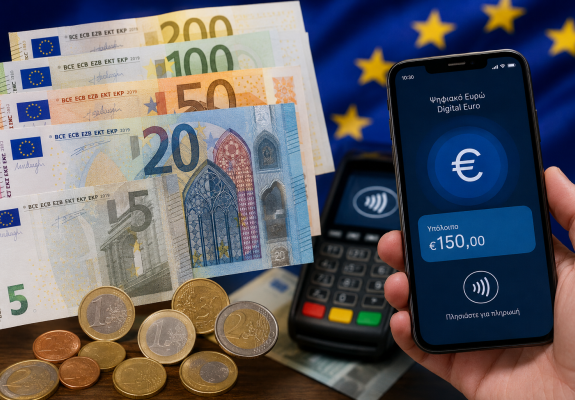
The Euro Is Changing in Cyprus as Well: New Banknotes and Digital Payments in Our Daily Life
What Is Changing in Banknotes, Where the Digital Euro Stands, and What These Developments Mean for Consumers and Businesses in Cyprus.
-
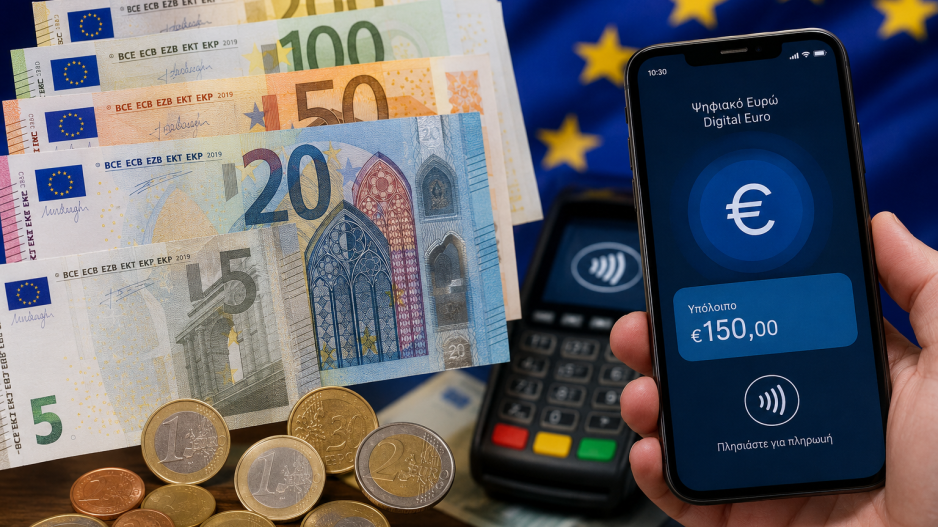
The European Central Bank is planning new banknotes with upgraded security features, whose final design is expected in early 2027.
-
The digital euro is being promoted as a complementary means of payment and not as a cryptocurrency, with the relevant legislative process still underway.
-
Physical cash is not going to be abolished, as today's banknotes will continue to circulate alongside the new digital solutions.
-
Cyprus is preparing for the transition, with domestic payment providers participating in the pilot testing of the digital euro in the second half of 2027.
From the neighborhood bakery to the kiosk, the supermarket, and hotels, the euro remains the primary medium of transactions in Cyprus. Payments with cards and mobile phones are steadily increasing, yet cash continues to change hands daily in thousands of transactions. The common currency is now entering a period of major changes, with new banknotes in the design phase and the digital euro moving forward through the European legislative process.
The two developments are often presented as one, but they are different projects. The new series of banknotes is a planned renewal of physical money, featuring a new appearance and more modern security features. The digital euro, on the other hand, has not yet been put into circulation, nor has a final decision been taken on its issuance. It is being designed as an additional payment method alongside cash, cards, and mobile applications.
For Cyprus, these changes have direct significance. The new series of banknotes will be made available in the Cypriot market when its production is completed, with the Central Bank of Cyprus taking over its management and distribution. The digital euro, if approved, will also be available to Cypriots through banks and other licensed providers. The transition will not happen overnight, and citizens will not need to abruptly change the way they pay.
New Banknotes Are Not Coming in 2027
One of the biggest questions concerns when the new banknotes will appear in citizens' wallets. In recent weeks, reports mentioned that the new series would circulate within 2027. This picture, however, is not confirmed by the official planning of the European Central Bank. The next major step is the completion of the selection of the banknotes' final design, which is expected by early 2027. From that point on, a time-consuming process of technical testing, production preparation, and gradual distribution to national central banks will follow. To date, no start date for their circulation has been announced.
For citizens, this means that the banknotes currently in use will continue to circulate normally for several more years. Their replacement will not happen overnight. When a banknote becomes worn and returns to the Central Bank of Cyprus via a commercial bank, it will be checked, and if it no longer meets the standards, it will be withdrawn and replaced by a new one. This process is constantly applied in the Eurosystem and allows for a smooth transition to each new series without affecting transactions.
The denominations are not changing. The new series will include banknotes of €5, €10, €20, €50, €100, and €200. The €500 banknote is not going to return to production. Its issuance was discontinued in 2019, as European authorities deemed that it was used disproportionately often for moving large sums of money in the context of illegal activities. This, however, does not mean it has lost its value. Any €500 banknotes still in the possession of citizens or businesses continue to be legal tender and can be used in transactions or exchanged through national central banks without any time limit.
The biggest difference of the new series will not only be its appearance. The European Central Bank aims to integrate more advanced security features to make counterfeiting even more difficult, increase the durability of the banknotes so they remain in circulation for more years, and improve the tactile elements to make recognition easier for visually impaired individuals. At the same time, the goal is to produce them using more environmentally friendly processes, reducing the overall environmental footprint of their life cycle.
Beyond technical features, the new banknotes will also acquire a different identity. For the first time since the introduction of the euro, the concept of anonymous windows and bridges is being abandoned. The two themes selected for the final phase of the competition are European culture and nature, featuring rivers and birds that highlight the continent's biodiversity. The final choice will be made by the European Central Bank after the completion of the evaluation process.
The Unseen Role of the Central Bank of Cyprus

Behind every banknote that comes out of an ATM or ends up in a business's cash register, there is a process that very few people know about. The Central Bank of Cyprus does not print banknotes, but it is responsible for ensuring that those circulating in the market are genuine, safe, and in good condition. Every day, it receives banknotes from commercial banks, checks them with specialized systems, withdraws those that are worn, and replaces them with new ones. In this way, it is ensured that the cash used daily by citizens and businesses meets the standards of the Eurosystem.
The latest available data from the Central Bank show that tens of millions of banknotes pass through its checks every year. Those deemed unsuitable are withdrawn from circulation and destroyed, while those meeting the specifications return to the market through banks. At the same time, counterfeit banknotes are also detected, which constitute a very small percentage in relation to the total volume of cash moving in the economy. The use of increasingly advanced security features has contributed significantly to limiting counterfeiting throughout the Eurozone.
Another element that often causes confusion is the amount appearing on the balance sheet of the Central Bank of Cyprus for banknotes in circulation. This item does not show how much cash is currently in the Cypriot market. It constitutes an accounting allocation of the share corresponding to Cyprus in the total banknotes of the Eurozone, according to the rules of the Eurosystem. Simply put, there is no mechanism that can calculate how many banknotes are inside the country's borders at any given moment.
The reason is that banknotes travel constantly. A €20 note used in the morning at a café in Nicosia may, a few days later, be in a shop in Athens or Barcelona via a traveler. The same happens in reverse, as millions of banknotes enter Cyprus daily from visitors, businesses, and banking transactions. This free circulation is a key feature of the euro and one of the reasons it functions as a truly common European currency.
Therefore, the renewal of banknotes is not done only for aesthetic reasons. It aims to maintain citizens' trust in the common currency, strengthen protection against counterfeiting, and ensure that cash will continue to be used safely for many more years. At the same time, however, Europe is preparing a second major change, this time not in the wallet but on the mobile phone screen. This is the digital euro, which aspires to become another payment option for European citizens.
What Is the Digital Euro and Why It Will Not Replace Cash
If the new banknotes represent one side of the changes being promoted by the European Central Bank, the digital euro is the other. This is a project that is still under development and has not been implemented. Its goal is not to create a new currency, but to offer citizens another way to use the euro in their daily transactions.
The biggest misunderstanding is that the digital euro will function like cryptocurrencies. In reality, it has nothing to do with them. It will not be traded on markets, its value will not fluctuate, and it will not be an investment product. A digital euro will always have exactly the same value as a euro banknote or coin. The difference will only lie in the way it is used.
In practice, the consumer will not need to learn a new way of paying. Instead of opening their wallet to take out cash or using their debit card, they will be able – once the system is put into circulation – to pay with digital euros through a special application or another solution offered by banks and licensed providers. The experience is expected to look quite similar to today's contactless payments.
A simple example shows how it could work. A father in Paphos wants to send money to his son studying in Nicosia. Today, he can make a bank transfer or use a payment application. With the digital euro, he will be able to transfer the amount directly to his child's digital wallet. The recipient will immediately be able to use the money to pay for his coffee, shop at the supermarket, or buy a bus ticket, without changing currency or requiring a different process.
The same could happen in a small business. A customer buys bread from a bakery in Larnaca. Today, they can pay in cash or by card. In the future, there may be a third option, the digital euro. For the customer, the transaction will be completed within a few seconds. For the professional, the key requirement will be for the payment to be fast, secure, and low-cost, which is the subject of discussions still ongoing in the European Union.
The European Central Bank has repeatedly clarified that the digital euro is not designed to abolish cash. Banknotes and coins will continue to circulate and be accepted in transactions. The philosophy is to have one more payment option, so that each citizen uses the one that serves them best, whether it is cash, a card, or the digital euro.
Several important details, however, remain open. It has not yet been decided what the maximum amount of digital euros a citizen can hold will be, nor have all the rules for offline payments and the operational framework for businesses been finalized. These decisions will be taken within the framework of the European legislative process, which is still underway.
What the Changes Mean for Cypriot Businesses

For a small business in Cyprus, the greatest anxiety is not whether the customer will pay in cash, by card, or with the digital euro. What interests the professional is whether the payment will be completed quickly, safely, and without high costs. This is also the reason why European negotiations are closely monitored by banks, merchants, and professional bodies, as several details about the operation of the digital euro remain open.
The preparation, however, is already moving forward in Cyprus as well. The European Central Bank selected Bank of Cyprus Public Company Limited and JCC Payment Systems Ltd among the payment service providers that will participate in the pilot phase of the digital euro. The trial period is expected to start in the second half of 2027 and last for twelve months, during which the beta version of the digital euro will be tested in a controlled environment. This participation does not mean that the digital euro has been approved or is about to be put into circulation, but constitutes part of the Eurosystem's preparation for its potential issuance. The Central Bank of Cyprus announced that it will work closely with the two Cypriot providers and the ECB within the framework of the pilot process.
For a bakery, a kiosk, a café, or a small retail shop, daily life is not expected to change drastically. If the digital euro is put into circulation, it will be added as another payment option alongside cash and bank cards. The customer will choose the method that serves them, while the entrepreneur must be able to accept the transaction in a simple and reliable way.
This development also presents particular interest for tourism, one of the most important pillars of the Cypriot economy. Every year, millions of visitors make purchases and payments in hotels, restaurants, shops, and recreation venues. A unified European payment instrument could make transactions even easier for those traveling within the Eurozone, without changing the currency they use.
At the same time, businesses are waiting for the final rules on the cost of accepting payments to clear up. The level of commissions, technical requirements, and merchant obligations are issues that continue to be discussed at the European level. These decisions will largely affect the rate at which the new payment medium will be adopted by the market.
Equally important is the fact that the digital euro is not designed to replace existing solutions. Businesses will continue to accept cash and bank cards, while the new system, if it proceeds, will function complementarily. For most professionals, the transition is expected to be gradual, as the acceptance of any new technology depends on whether it facilitates the daily operation of a business and offers a real benefit to both the merchant and the consumer.
A Change That Will Happen Gradually
If someone opens their wallet today, they would hardly realize that the euro is in front of its biggest change since its introduction. The banknotes we use will continue to circulate normally for several more years, while the digital euro has not yet received the final "green light" to move from design to practice. This means that, at least for now, nothing changes in the way citizens pay for their daily purchases.
What is changing is the preparation for the future. The European Central Bank is investing in new banknotes with stronger security features and greater durability, while simultaneously examining how a digital form of the euro could function to complement cash and not replace it. At the same time, the European Union is called upon to complete the final legal framework, while the ECB has already passed to the stage of preparing the pilot application, selecting the payment service providers that will participate in the tests of the beta version of the digital euro from the second half of 2027.
For Cyprus, these developments do not constitute a distant European discussion. They concern the daily life of citizens, the operation of businesses, tourism, the banking system, and the way millions of transactions are carried out every year. The Central Bank of Cyprus will continue to ensure the smooth circulation of cash, while cooperating with the ECB and the selected Cypriot payment service providers within the framework of the pilot phase of the digital euro.
The only certainty today is that the euro is not changing character. It remains the common currency of the Eurozone countries and will continue to exist both in banknotes and coins and, if the European process is completed and the final decision is taken, in digital form. The changes will come gradually, and most citizens will probably perceive them not from a major announcement, but when they get a new banknote in their hands or when they acquire one more option to pay for their coffee, shopping, or bill. Then they will realize that the euro remains the same currency, but adapts to the needs of a changing economy.
What Is Changing From Today Until the Coming Years
Today (July 2026)
-
Today's banknotes and coins circulate normally throughout the Eurozone.
-
The €500 banknote remains legal tender, even though it is no longer issued.
-
The digital euro has not yet been finally approved and is not used in daily transactions.
By early 2027
-
The European Central Bank is expected to complete the selection of the final design for the new series of banknotes.
-
Simultaneously, the European legislative process for the digital euro continues.
Second half of 2027
-
The launch of the 12-month pilot phase (beta) of the digital euro is planned with the participation of selected payment service providers from across the Eurozone, including Bank of Cyprus Public Company Limited and JCC Payment Systems Ltd.
-
The pilot testing will take place in a controlled environment and does not mean that the digital euro is being put into circulation.
The next stage
-
Technical testing, production, and preparation for the gradual circulation of the new banknotes will follow.
-
The European Central Bank will announce the schedule for their availability when preparation is completed.
-
For the digital euro, the completion of the European legislative process and the taking of the final decision for its issuance will be required beforehand.
In the years that will follow
-
Today's and the new banknotes will circulate in parallel for a long period of time.
-
If the digital euro is finally approved, it will be added as one more payment option alongside cash and bank cards.
Timeline
-
July 2026: Today's banknotes circulate, while the legislative process for the digital euro continues.
-
By early 2027: The European Central Bank (ECB) will select the final design of the new banknote series.
-
Second half of 2027: The launch of the 12-month pilot phase (beta) of the digital euro is planned with the participation of selected payment service providers, including Bank of Cyprus Public Company Limited and JCC Payment Systems Ltd.
-
After the completion of the design: Testing, production, and gradual preparation for the circulation of the new banknotes will follow.
-
In the future: If the European legislative process is completed and the final decision is taken, the distribution of the digital euro will begin.
-
Transition period: The old and the new banknotes will circulate in parallel, while cash will continue to constitute legal tender.
Fact Check
-
✔ Are the new banknotes circulating in 2027?
No. By then, the selection of their final design is expected to be completed. Their production and circulation will follow at a later stage.
-
✔ Is the €500 banknote being abolished?
No. It is no longer issued since 2019, but remains legal tender and fully retains its value.
-
✔ Is cash being abolished?
No. The European Central Bank has repeatedly stated that banknotes and coins will continue to circulate.
-
✔ Is the digital euro like Bitcoin?
No. It is not a cryptocurrency or an investment product. It will be a digital form of the euro issued by the Eurosystem.
-
✔ Has the digital euro been finally approved?
No. The relevant legislative process is still underway. Meanwhile, the ECB is proceeding with the preparation of the pilot phase, which will start in the second half of 2027 with the participation of selected payment service providers, including Bank of Cyprus Public Company Limited and JCC Payment Systems Ltd.