From Ruins to Rebirth: Cultural Heritage Champion Tasoula Hadjitofi Calls for Global Justice and Unity at Artsakh Conference
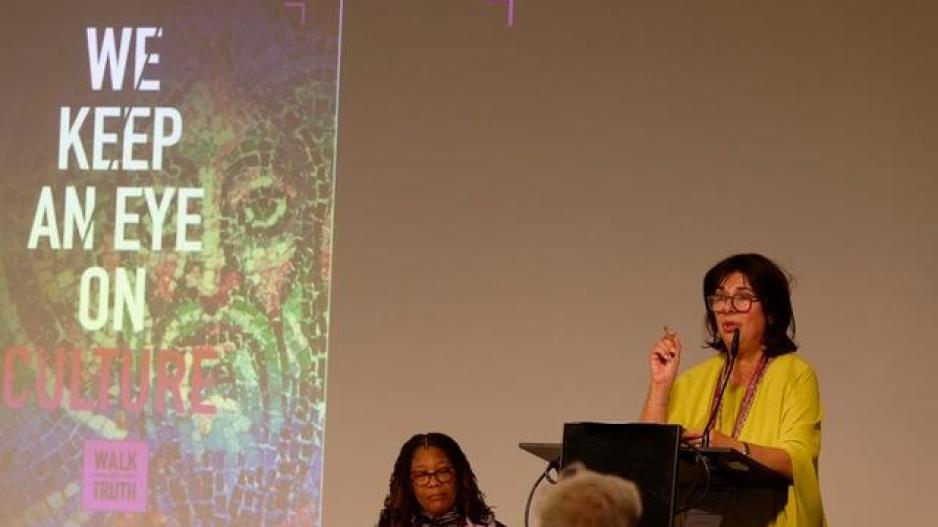
In an electrifying and emotional keynote address at the international conference Freedom of Religion | Preservation of Armenian Religious, Cultural, and Historical Heritage in Artsakh/Nagorno-Karabakh, cultural heritage defender and founder of Walk of Truth and the author of the memoir, The Icon Hunter, Tasoula Hadjitofi, delivered a searing appeal for the international community to treat cultural destruction not as collateral damage — but as a human rights crisis.
Hadjitofi’s speech, delivered on May 28, 2025, was not just a speech. It was a call to conscience, to collaboration, and to concrete legal action.
Drawing from her own journey as a refugee from Famagusta, Cyprus, she spoke of identity stolen, prayers silenced, and churches turned to ruins — but also of justice achieved, communities unified, and hope reborn. Her story — once a lone voice against international art trafficking — has become a global movement demanding the right to return, rebuild, and remember.
To me, those icons were not art. They were refugees—like me,” she told the audience. “They are not meant to be entombed in museums, traded in auctions, or debated in journals. They are prayers made visible. Dignity carved in wood. Memory made sacred.
Culture Crime Watchers Worldwide (CCWW): The conference, organized by the World Council of Churches (WCC) and the Protestant Church in Switzerland, brought together religious leaders, human rights defenders, legal experts, international prosecutors and displaced communities to address the crisis of cultural cleansing of Armenian religious and historical sites following the 2020 war in Artsakh/Nagorno-Karabakh, and the displacement of over 120,000 ethnic Armenians.
With her unmistakable voice of conviction, Hadjitofi linked the devastating cultural destruction in Artsakh to broader patterns of heritage erasure — from Cyprus to Iraq, Syria, Tibet, Palestine, and Ukraine — and pointed to a common cause among all displaced peoples and faith communities.
"The diaspora is not disconnection. It is a global archive of resilience,” she declared. We are not ghosts of history. “We are the guardians of memory and the builders of a just future”.

Hadjitofi believes that churches and religious leaders must be empowered to act, not only as spiritual guardians but also as legal advocates for their cultural heritage, defining the road forward. Not only to mourn what was lost, but to fight for its return. She called for the establishment of clear legal mechanisms to allow churches and rightful owners of religious heritage to access European and international courts, with or without the cooperation of their respective governments.
Through the Walk of Truth and the newly established Hadjitofi Foundation, she is mobilizing civil society — including police, lawyers, academics, historians, journalists, civil rights leaders and activists — to work together as Culture Crime Watchers and become a network of whistleblowers to document looted heritage, influence legal reform, and rebuild sacred sites in collaboration with affected communities. She introduced the role of the public, an ambitious initiative to unite displaced peoples with CCWW across borders in a joint mission to:
-
Share legal tools and case precedents
-
Create a global database of looted and displaced cultural heritage
-
Launch a Cultural Restoration Fund to support litigation and reconstruction
-
Empower communities to reclaim and rebuild their heritage, both spiritually and physically
“Churches are not just bricks. Icons are not just pigments. Cemeteries are not just stones,” she said. “They are the anchors of identity and the mirrors of our humanity. When a community rebuilds its church—it rebuilds its soul.”
A Human Right to Belong: Hadjitofi stressed that cultural heritage is not a luxury—it is a human right, protected under international law yet ignored by occupying powers, corrupted by procedural injustices or sidelined by bureaucratic inertia. She urged the international community to breathe life into the treaties meant to protect humanity’s shared legacy.
“Treaties are paper. They have no breath. No pulse. Unless we, the public, give them life.”
With unwavering emotion, she shared how her beloved hometown of Famagusta, remains sealed behind barbed wire, her church locked, her grandfather’s grave unreachable.
I want to go home. Not just geographically—but spiritually, culturally, and legally,” she said, pausing. “And I ask you — not just for Cyprus — but for all our forgotten sanctuaries — will you walk with me?
The audience — visibly moved, many in tears — rose to a standing ovation. Her closing message, echoing both the pain of the past and the promise of unity, resonated far beyond the walls of the conference hall:
“Let us use the ruins of the past to build our future. Let us become builders of peace and reconciliation through our monuments. And may our roots hold us firm, and our wings carry us far—until we all find our way home.”
The WCC and the Protestant Church in Switzerland echoed Hadjitofi’s call, reaffirming their commitment to cultural and religious freedom as essential to human dignity and global justice.
“Treaties are paper. They have no breath. No pulse. Unless we, the public, give them life.”
With unwavering emotion, she shared how her beloved hometown of Famagusta, remains sealed behind barbed wire, her church locked, her grandfather’s grave unreachable.
“I want to go home. Not just geographically—but spiritually, culturally, and legally,” she said, pausing. “And I ask you — not just for Cyprus — but for all our forgotten sanctuaries — will you walk with me?”