Alexandra Cousteau: The Ocean’s Future Is Still Worth Fighting For
The Oceana Senior Advisor Discusses Her Family Legacy, the Urgent Pressures Facing Our Seas, and Why the Future of Ocean Protection Must Be Built Around Recovery.
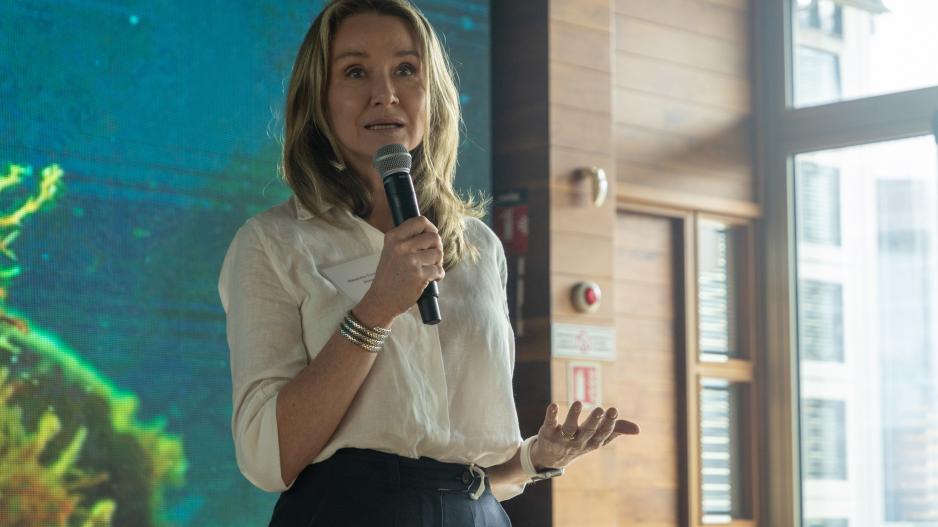
For generations, the Cousteau name has been synonymous with pioneering planetary exploration. But where Captain Jacques-Yves Cousteau originally demystified the underwater world to foster global conservation, his granddaughter, Alexandra Cousteau, is executing a vastly different mandate. As a filmmaker, National Geographic Explorer, and Senior Advisor to international advocacy giant Oceana, she argues that baseline conservation is no longer sufficient. Speaking exclusively with FastForward, Cousteau outlines why the rapid warming of the Mediterranean demands an aggressive commercial and ecological shift toward active restoration. From navigating the implementation of the historic 2026 High Seas Treaty to capitalizing on localized marine initiatives in Cyprus, she delivers a compelling blueprint for shifting corporate and policy focus away from managing environmental decline and entirely toward engineering absolute marine abundance.
Growing up as the granddaughter of Jacques-Yves Cousteau, how did your family legacy shape the way you see the ocean, not only as an ecosystem, but as something deeply personal?
The ocean was never a place we visited. It was where we were from. I was four months old the first time I was held in the water, and I grew up understanding the sea less as a subject of study than as something alive, generous, powerful, and deeply ours to care for.
My grandfather’s great gift was making that intimacy available to everyone. He brought people into the presence of a world that had always been there but had never been truly seen. He gave the ocean a face, and in doing so, gave people a reason to love it.
What I carry forward from that inheritance is a different charge. Love and protection were where the story began. They are not where it ends. The ocean I grew up beside is not the ocean my children are inheriting. The work of my generation is not simply to defend what remains. It is to restore what has been lost, to rebuild abundance, not just hold the line against its disappearance.
In your role as Senior Advisor at Oceana, what would you say are currently the biggest threats facing our oceans globally, and which of these concern you the most personally?
The ocean faces pressures that reinforce one another: overfishing and destructive fishing practices, habitat destruction, pollution in all its forms, and a sea that is warming faster than many ecosystems can adapt to. I have seen this in the water across the world, and I have sat with fishers on opposite sides of the planet who describe the same quiet unraveling: fewer fish, changing seasons, and a sea that no longer behaves the way their parents and grandparents told them it would.
These pressures cannot be separated. A degraded habitat is less resilient. An overfished sea recovers more slowly from warming. Pollution weakens the systems that marine life depends on. The ocean is weakened together, and it has to be restored together.
What troubles me most is the shifting baseline: the way each generation inherits a slightly emptier sea and comes to accept it as normal. That is how abundance disappears without anyone choosing to let it go. The antidote is not despair. It is the knowledge that the ocean still knows how to recover when we give it the chance.
The Mediterranean is such an important part of life for countries like Cyprus. From your perspective, what are some of the key environmental challenges currently affecting the Mediterranean Sea specifically?
The Mediterranean is one of the most intensely pressured seas on Earth, and one of the most consequential. It is warming rapidly. It is heavily used for fishing, shipping, and tourism. Pollution concentrates within it because it is nearly enclosed. What enters does not simply disappear, and what happens in one corner eventually affects the rest.
For a country like Cyprus, these are not abstract environmental concerns. The sea is woven into food, culture, memory, livelihoods, and identity. Rising sea temperatures, invasive species, declining fish populations, degraded posidonia beds, plastic pollution, and pressure on coastal habitats are already changing the Mediterranean people grew up beside.
And yet the Mediterranean is also a place where restoration can become visible and meaningful within a human lifetime. Protect the habitats that anchor the ecosystem, end the most destructive fishing practices, reduce the pollution that smothers the seabed, and the sea begins to recover. The goal cannot be to manage decline more gently. It must be to rebuild abundance, beauty, and resilience with enough urgency that the next generation inherits something richer than what we received.
Many people feel overwhelmed when discussing environmental issues. What are some realistic, everyday actions individuals can take that genuinely make a difference in protecting our seas and oceans?
Almost everything we do on land eventually finds its way to the ocean. What we eat, how we move, what we buy, what we waste, and what we tolerate from the people who govern us all have a downstream consequence in the sea. That is not a cause for guilt. It is an invitation to recognize that we are already connected to the ocean, whether or not we live near it.
There are concrete choices that matter: refusing unnecessary single-use plastics, buying seafood more thoughtfully, reducing waste, and supporting small-scale fishers who work with the sea rather than against it. These actions are real, and they help build a culture of care.
But personal choices alone will not restore the ocean. The bigger lever is collective. It is supporting the organizations and leaders fighting for stronger laws, better enforcement, and real protection in the water. It is asking harder questions of governments and businesses. It is refusing to treat the ocean as someone else’s domain. The sea makes life on this planet possible. Once enough people understand that, it becomes much harder for any system to treat it as expendable.
Through your work, you collaborate with governments, organizations, and global leaders. Do you feel the world is moving quickly enough when it comes to ocean protection, or are we still underestimating the urgency of the crisis?
There is real progress, and I want to name it before I qualify it. The High Seas Treaty entered into force in January 2026, creating the first global legal framework for protecting biodiversity in international waters — the waters beyond any single nation’s jurisdiction. That took decades of negotiation and real political will. It matters.
The harder truth is that progress in the room and progress in the ocean are two different things. We are fluent in commitment and still learning the language of delivery. Plastics treaty negotiations remain difficult and unresolved. Deep-sea mining remains an open question and a test of whether governments will choose precaution over the next extraction opportunity.
These are not abstract policy debates. They are choices about whether the ocean will be treated as a living system or as the last frontier for depletion.
The solutions exist. The science is clear. What remains is the courage to act at the speed and scale the moment requires, and the accountability to follow through after declarations are made.
You’ve spent years communicating ocean advocacy to broad audiences. How important is storytelling in environmental activism, especially today when attention spans are shorter and misinformation spreads quickly?
Story is one of the few things that reliably moves people. Data can inform a decision; it rarely ignites one. We understand the science of the ocean crisis with considerable precision, but that understanding has not, on its own, been enough. What science cannot do is tell people where they belong in the story, what role is theirs to play, or what future is still available if they choose it.
My grandfather understood this intuitively. He did not simply release scientific information into the world. He brought people into the presence of a living sea and trusted that presence to do the work argument could not. He was right. Intimacy is more durable than information.
The challenge now is that the story cannot stop at grief. The ocean is in trouble, and that must be said clearly. But a story built only on loss produces despair, and despair is not an organizing principle. People stay in motion when they can see something worth moving toward: seas coming back to life, communities rebuilt around abundance, and a future that is genuinely worth wanting.
If you could leave younger generations with one message about humanity’s relationship with the ocean, what would you want them to remember most?
The ocean is not separate from them. It is woven into who they are: into the air they breathe, the food that reaches their table, the climate that shapes every living thing on this planet. We did not evolve apart from the sea. We belong to it in a way that runs deeper than affection or even dependence.
I would also want them to know that recovery is not a romantic wish. It is a demonstrated fact. The ocean has an extraordinary and still underestimated capacity to heal when we stop doing harm and give it room to work.
I would not want to pass on fear. I would want to pass on a task: to restore what has been lost, rebuild abundance where depletion has taken hold, and leave behind an ocean fuller than the one we found.
Decline is not inevitable. It is a condition, and conditions can be changed. The ocean is alive, we are part of it, and bringing it back is the most hopeful work I know.