The First Woman on a Men’s Team Bench
Marie-Louise Eta Makes History as The First Woman on a Men’s Football Team Bench in Germany
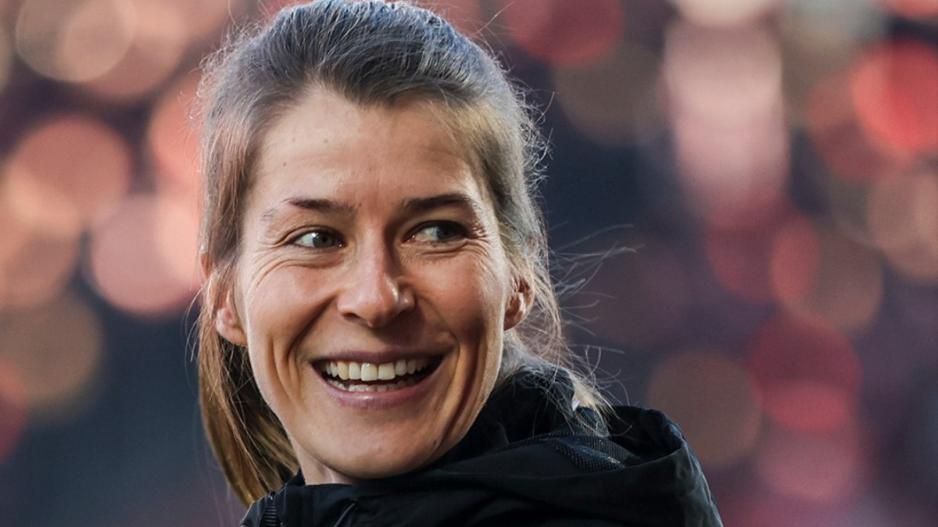
At 34 years old, Eta found herself on the Union Berlin bench during one of the club's most demanding periods. At a moment, where every decision would affect its route in the Bundesliga, the team was seeking stability and guidance at a moment.
The selection of Marie-Louise Eta for the technical leadership was not a symbolic or promotional move, but a decision based on sporting criteria. She was already familiar with the club's environment, having worked within its ranks, and had proven she could perform at a high level. Despite the initial surprise it caused the general public, the move was considered an expected evolution within the club.
Before finding herself in the spotlight, Eta had already carved out a significant path in football. As a player, she reached the pinnacle of Europe with Turbine Potsdam and achieved international success with the German youth national team.
Her transition to coaching was not merely a "second career" but a conscious choice to remain in the sport in a rather different, but still equally demanding role. By working with academies and developmental teams, she gained something that is not easily taught: a deep understanding of the game and the ability to manage people.
-
As a player: She played for years in Germany as a midfielder, highlighted by winning the UEFA Women's Champions League in 2010 with Turbine Potsdam.
-
League Success: She won three consecutive GKey milestones in Marie-Louise Eta’s career
-
German Bundesliga titles (2009–2011).
-
International: She was crowned a World Champion with the German U20 National Team in 2010.
-
Club Career: She also played for clubs such as Hamburger SV, BV Cloppenburg, and Werder Bremen, where she served as captain.
Eta has clarified many times that she does not wish to be treated as an "exception" or a symbol, but as a professional. This stance is perhaps her most powerful message. In a field where women are often judged by different criteria, she emphasizes that it is the actual work that counts.
The rise of Marie-Louise Eta was not met with exclusively positive reactions. Social media, through stereotypical comments and skepticism, questioned her ability to stand out. However, Union Berlin’s unwavering support towards Eta, points out that professional competence remains the primary criterion.
The club’s Sporting Director called the negative comments "shameful" and "irrational," emphasizing that her selection was based solely on ability and experience. "We are talking about an extremely capable professional," he noted, making it clear that the club supports her fully.
Marie-Louise Eta’s presence on the bench of a men's team highlights the gradual shift regarding traditional roles in football. This development strengthens the conversation around equality and the re-evaluation of stereotypes that have characterized the sport for years.
At the same time, she serves as a reference point for women active in or interested in sports, underlining that while changes are not immediate, a more open and inclusive framework is gradually taking shape.