Breakpoint: Professor Philippos Patsalis’ Journey From Discovery to Global Biotech Success
From Lab to Legacy: How a Cypriot Breakthrough Reached 40 Countries
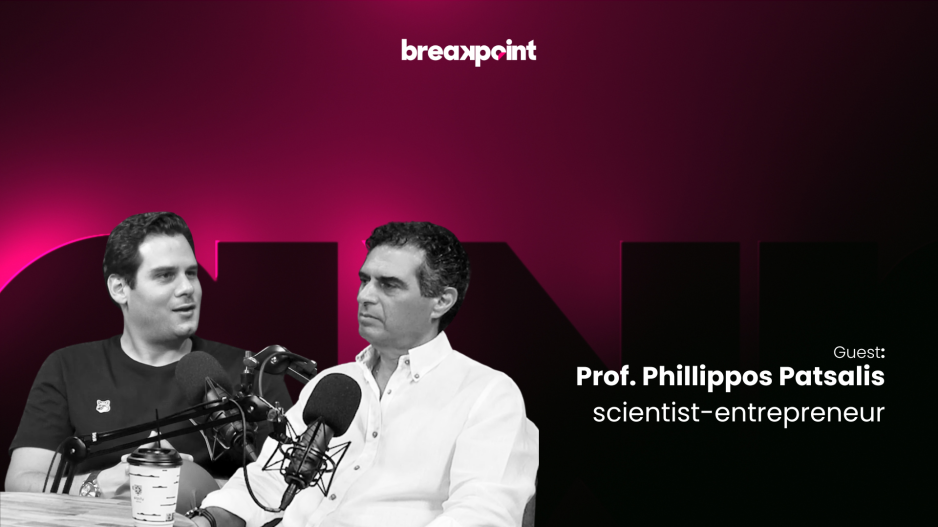
In my recent interview with Professor Philippos Patsalis, a leading figure in the field of genetic medicine and biotech entrepreneurship, I had the opportunity to explore a story that exemplifies what it means to build global impact from a small national base. His journey is a case study in execution, strategic vision, and the power of combining scientific excellence with entrepreneurial discipline.
From the outset, Professor Patsalis was clear about his motivation. Science, for him, was never about theory in isolation. His academic trajectory took him through postdoctoral research in New York and was always geared toward translational research. The goal was to convert scientific discovery into practical value for society.
That mindset led to one of the most important milestones in his career. For years, the global medical community viewed non-invasive prenatal testing as an impossible target. Professor Patsalis and his team, working out of the Cyprus Institute of Neurology and Genetics, delivered a breakthrough. The discovery was published in Nature Medicine, received international media attention, and was named one of the top ten scientific breakthroughs of the year.
Crucially, the team secured patents early. From the beginning, they treated the discovery not only as a contribution to science but also as a launchpad for a commercially viable application.
This was the genesis of NIPD Genetics. While research teams at Stanford and Cambridge secured significant funding to commercialize similar discoveries, Professor Patsalis and his team built from scratch with only €2.5 million. What followed was one of the most successful biotech growth stories to emerge from Cyprus.
In fewer than ten years, NIPD Genetics grew to a team of over 300 scientists. It established international operations, licensed its technology in over 40 countries, and delivered localised implementation support to leading markets including Germany and Japan. The business model combined robust IP with scalable service delivery and deep investment in scientific talent.
Professor Patsalis credits the company’s success not only to scientific insight but to the strength of Cyprus’ academic talent. Despite resource constraints, the team outperformed competitors in execution and delivery. As he put it, “Cypriot scientists are world class. What we lack in scale, we make up for in capability.”
Eventually, a major international group acquired the company. It was one of Cyprus’ most notable biotech exits. For Professor Patsalis, the decision to sell was guided by mission, not profit.
Bringing a scientific product to global scale requires infrastructure, regulatory access, and marketing muscle that only large multinational players can provide. “If your aim is to make a real difference,” he explained, “you have to be willing to pass the baton.”
The emotional cost, however, was significant. He stayed on for two years post-acquisition, but ultimately stepped down. “You can accept your own mistakes. You can fix them. But when you are no longer responsible for the direction of something you built — and you see decisions you would not have made — it becomes very difficult to remain.”
The process was challenging, both professionally and personally. Yet he views the outcome as necessary. “It is the only way to scale impact globally. You owe that to your science, your people, and your shareholders.”
Professor Patsalis’ contribution extends far beyond the company he founded. In 2013, he initiated the strategy that led to the formation of Cyprus’ Research and Innovation ecosystem. As Chair of the National Council for Research and Innovation, he helped develop the framework that gave rise to the Deputy Ministry of Research, the role of Chief Scientist, and the reformation of national funding structures.
Cyprus today still invests less than 1 percent of its GDP in research and innovation, but the system has taken shape. The strategy is clear, the governance model is aligned with international best practice, and participation is growing across age groups and industries. The terminology of innovation, once unfamiliar, is now part of mainstream discourse in both the public and private sectors.
Professor Patsalis is optimistic, but measured. The system is still in its early stages. More investment is needed. More risk-taking is required. But the trajectory is clear. “The engine has started,” he said. “And this generation is not thinking about safety. They are thinking about scale.”
As our discussion closed, I asked Professor Patsalis what stayed with him most throughout this journey. He recalled a line from a Greek song that had been with him for decades — "To pelagos einai vathy" — the sea is deep. Innovation, for him, is a constant crossing of that sea. Not linear, not comfortable, but necessary.
His story offers a practical lesson for any founder, policymaker, or investor: excellence is not about geography. It is about execution, consistency, and the willingness to think long term in a system that favors short-term wins. And when the time comes to scale, it requires the discipline to step aside and let your idea find its full potential — even if that means letting go.