EU Unites in Limassol to Boost Pressure on Russia and Tackle Regional Crises
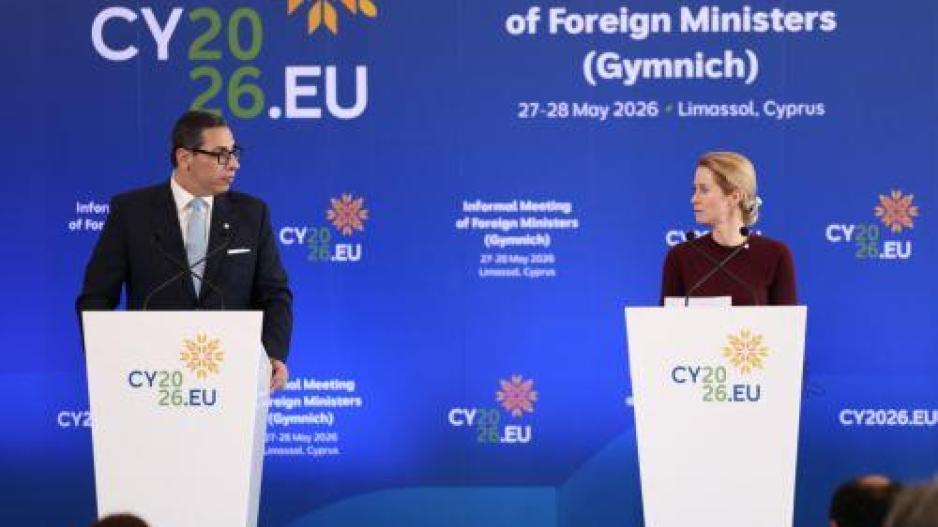
Following an informal Gymnich meeting under the Cyprus EU Presidency, EU High Representative Kaja Kallas declared strong unity in defending European interests and supporting Ukraine. The high-level talks in Limassol, which also featured ministers from India and Saudi Arabia, addressed critical security challenges across Ukraine, Gaza, Lebanon, and the Strait of Hormuz.
There was a strong unity today to defend European interests, to support Ukraine and put more pressure on Russia said Kaja Kallas, EU High Representative for Foreign Affairs and Security Policy following the Gymnich that took place in the coastal city of Limassol, under the Cyprus EU Presidency.
The informal Ministerial Council was also attended by India’s External Affairs Minister Subrahmanyam Jaishankar and the Foreign Minister of Saudi Arabia, Prince Faisal bin Farhan Al Saud. EU Ministers discussed Ukraine, Gaza, Lebanon and the crisis in the strait of Hormuz and Commissioner Kallas circulated a paper outlining Europe’s key demands toward Russia, including respect for international agreements and the sovereignty of neighbouring states.
Speaking during a joint press conference with Cyprus Foreign Affairs Minister Constantinos Kombos, Kallas said that they had very open discussions, in the presence of India and Saudi Arabia Ministers. She noted that it was good to hear their views on the regional crisis, adding that this was very eye-opening for the EU "to see what more can we do together".
Kallas said that the situation in Hormuz is dangerous, pointing out that any first base agreements between US and Iran must be followed by deeper talks and other political issues for regional security. ''The EU can contribute with technical expertise when it comes to nuclear talks for example. The EU is helping to protect the freedom of navigation in the region, including through operation Aspides'', she said.
Regarding Lebanon she said that a return to full-scale war is a real possibility. The Ministers also discussed Gaza and West Bank.
Commenting on Ukraine, Kallas said that Russia still shows no genuine interest in peace. She said that they had really thorough discussions on what concessions Europe should ask from Moscow and what our red lines are. "And one thing is very clear, Europe will never be a neutral mediator between Russia and Ukraine because we are on Ukraine's side and we are depending our own core security interests'', she pointed out.
She also noted that Russia must stop sabotage operations, cyberattacks and action interference airspace violations across Europe, limiting Ukraine's military while which directly threatening European security. ''The bottom line is this. Europe has valid demands to ensure that any peace is lasting and the ministers asked me to take this work forward'', she noted.
In his statements Cyprus Minister Kombos said that they had a very honest discussion about the principles that should guide EU's position on Ukraine, based on the paper that was prepared by Commissioner Kallas. ''And we are carrying forward our intention and will to increase the pressure on Russia'', he said.
Both Commissioner Kallas and Minister Kombos replied to questions by the press following their initial statements. On Russia Kallas noted that there should be also concessions on the Russian side, pointing out that the EU is defending the interests of Europe and the interests of Ukraine because Ukraine is also in Europe. She also said that it is clear that all their efforts have to be also complementary to US efforts. ''And the Ministers were also very clear about this. They're not coming in instead of the United States, but we are actually addressing issues that they haven't been addressing in these talks," Kallas said.
Replying to a question about the paper that was circulated by the EU, the Cyprus Minister said that the paper includes very specific principles, clarifying that we are not in the stage of negotiation as of yet. "The EU has not positioned itself as a mediator. It has taken a clear position, but because it affects its security interests and other things'', he said. On the issue of a mediator, Kallas said that it is very important that we push Ukraine and Russia to talk to each other ''because there are so many issues which only they can decide and nobody else''.
Replying to a question about Hormuz Kallas referred to the Aspides operation currently underway saying that this is a defensive operation and once the hostilities are over they are willing to recruit the ships and escort the ships out of the Strait. On the same issue Minister Kombos said that after the end of the war, we need to take care of the markets as well because it looks like the markets will not be back to normal where they were before the war any time soon.
Kallas was also asked about Article 42(7) of the Treaty on European Union. Kallas said that what is the end goal is to come up with sort of a manual how we can use this 42(7), pointing out that we have different scenarios, ie a scenario where you have a NATO member that is also a European member attacked or a scenario where a European member that is not a NATO member is attacked.