How the World’s Media Read Erhürman’s Win—and the Renewed Hopes for Cyprus Talks
From “policy switch” to “gamechanger,” the world press reads the vote as a moderate turning point for the Cyprus issue.
When Tufan Erhürman swept to victory in the 19 October leadership election in the Turkish Cypriot community, global newsrooms quickly framed the result as more than a domestic political shift. Across Europe and the United States, headlines converged on one idea: the return of moderation—and the possible revival of United Nations–led reunification talks after years of deadlock.
>>After Erhürman’s Victory, What’s Next for the Cyprus Issue?<<
From Brussels to Washington and Paris, coverage highlighted the scale of the result, the symbolic break from Ankara’s preferred candidate Ersin Tatar, and the cautious optimism that the new leadership might reintroduce dialogue to the long-divided island.

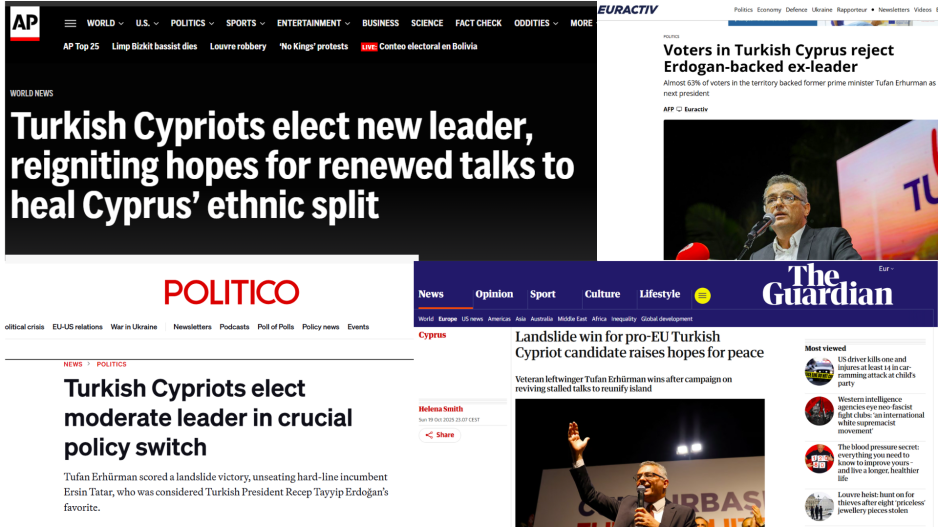
In its analysis, Politico Europe headlined the story “Turkish Cypriots elect moderate leader in crucial policy switch”, calling Erhürman’s landslide an “unprecedented victory” that could “revive hopes for talks on the reunification of the divided island.” The piece stressed that Erhürman’s win—by 62.8% to 35.8%—marked “a significant policy shift after years of pro-Turkey dominance,” while underlining his pragmatic approach: maintaining coordination with Ankara yet favouring UN-backed federal negotiations.
Reuters struck a similar note, describing a “major policy shift in the conflict”. Its report highlighted the potential for a new opening after “years of stagnation” and quoted President Nikos Christodoulides’ message of congratulations and readiness to resume peace talks.
Both outlets noted Erhürman’s emphasis on impartial leadership, as well as Turkey’s prompt but carefully worded congratulations, reiterating its two-state position.
The Guardian’s coverage was perhaps the most emphatic. Under the headline “Landslide win for pro-EU Turkish Cypriot candidate raises hopes for peace”, the paper portrayed Erhürman as a secular, pro-European leader and suggested his victory could “inject renewed vigour into the deadlocked peace process.” The Guardian also captured a broader social sentiment, describing celebrations in the north, particularly among younger voters frustrated by isolation and eager for a European future. It called the election a “rejection of isolationism and religious nationalism” and a “turn towards Europe.”

In Paris, Le Monde framed the result bluntly: “Opposition candidate Tufan Erhürman elected president.” The paper called it “a setback for Ankara” and noted that the opposition leader’s victory signalled a desire for greater autonomy from Turkish domestic politics. It also reported strong reactions from Turkey’s political spectrum—Erdoğan’s congratulatory message on one side and nationalist anger on the other.
Euractiv, meanwhile, captured the essence of the European view in its headline “Voters in Turkish Cyprus reject Erdogan-backed ex-leader.” Its coverage emphasised that the electorate had turned away from Ankara’s candidate and toward a “federal, Europe-facing model,” while still noting Erhürman’s attempt to reassure Turkey that coordination on foreign policy would continue.
Even The Financial Times underlined the geopolitical signal with the headline “Pro-reunification candidate wins north Cyprus election.
The Associated Press (AP) led with similar titles: “Turkish Cypriots elect new leader, reigniting hopes for renewed talks to heal Cyprus’ ethnic split.” Its coverage linked Erhürman’s election to the possibility of reviving negotiations on a bi-zonal, bi-communal federation under UN auspices. The AP noted that Erhürman had harshly criticised Tatar’s refusal to engage in formal talks, calling it a “costly loss of time.” It also flagged the geopolitical and economic stakes of a possible settlement, from energy cooperation to regional interconnectivity. Still, it cautioned that Ankara’s influence and the question of security guarantees would remain the “hard edge” of any future process.