From Hashtags to Power Vacuums: How Nepal’s Youth Rewrote the Political Script
Monitoring the Effects of Worldwide Political Instability.
Nepal’s latest political rupture did not begin in Parliament, a party headquarters, or even a street corner. It began online, in the loose, fast-moving spaces where young Nepalis have spent years airing grievances that few in power bothered to hear. What followed was not merely a protest cycle, but the fastest collapse of state authority Nepal has seen since the end of its monarchy.
For decades, Nepal’s political system functioned as a closed loop. Power rotated among a familiar set of leaders, coalitions reshuffled, governments fell and rose, yet the faces at the top remained largely unchanged. Since the return of multiparty democracy in 1990, the country has cycled through prime ministers at a dizzying pace, without ever placing a woman in the role. That pattern broke in September 2025, when former chief justice Sushila Karki was sworn in as Nepal’s first woman prime minister, heading an interim government born out of chaos rather than consensus.
The circumstances that led to her appointment were extraordinary. What started as youth-led demonstrations against corruption escalated into nationwide unrest that left dozens dead, key state institutions in ruins, and the authority of the ruling class in tatters. The speed of the collapse shocked even seasoned observers of Nepali politics.
Oftentimes, when the subject of political corruption comes up in a conversation the phrase “what do young people do about it?” is all but certain to make an appearance.
“Back in my day, we…”
Criticism from older generations towards young people and their inactivity in the face of adversity is quite common. However, that was not the case in Nepal, as the 2025 protests were instigated and carried out by young adults and teenagers, thus being named “The Gen Z protests”.
The political establishment had grown accustomed to protest. Nepal is no stranger to demonstrations, strikes, or street pressure, and successive governments learned to treat public anger as background noise rather than a warning signal. Coalition politics after the 2022 elections reinforced this complacency. The country’s three dominant parties, the UML, the Nepali Congress, and the Maoists, continued to trade power among themselves, reinforcing patronage networks that extended from ministries to state bodies, professional associations, and parts of the media.
What this leadership failed to grasp was how profoundly disconnected it had become from a population where more than half is under thirty. While internet access expanded rapidly and social media platforms became central to daily life, economic conditions remained stagnant. Job creation lagged far behind demographic growth, youth unemployment soared, and outward migration became a rite of passage rather than an exception. Every day, thousands left the country in search of work, while those who stayed watched displays of elite privilege circulate freely online.
By 2025, corruption scandals were no longer abstract allegations but recurring headlines. High-level figures were implicated in procurement fraud, infrastructure embezzlement, immigration bribery schemes, and cooperative finance collapses that wiped out life savings. For young Nepalis, these scandals formed a continuous narrative of impunity. The sense that the system was rigged was no longer ideological; it was personal.
Against this backdrop, the government’s decision to ban two dozen social media platforms in early September proved catastrophic. Officially framed as a regulatory move to curb “undesirable content,” the ban was widely interpreted as an attempt to silence criticism, particularly a viral online campaign mocking political dynasties and elite entitlement.
Rather than dispersing dissent, the blackout concentrated it. Informal chats turned into coordination hubs, and protest plans spread rapidly across encrypted messaging apps and platforms the government struggled to control. Calls to demonstrate circulated widely, amplified by activists and civil society figures who framed the moment as a test of democratic accountability.
When protests erupted in September, the atmosphere was initially closer to a civic gathering than a riot. Students arrived in uniforms, slogans mixed with music, and demonstrators pledged to keep the movement peaceful. The symbolism was unmistakably global, drawing from pop culture references that resonated with a generation raised online and politically awakened through screens.
The turning point came with the state’s response. As crowds swelled and security forces failed to contain them, authorities escalated rapidly from crowd control tactics to live ammunition. By nightfall, teenagers lay dead, images of bloodied uniforms spreading across the internet. What had begun as an anti-corruption rally transformed overnight into a nationwide revolt against state violence.
So, where did these protests leave Nepal and the world?
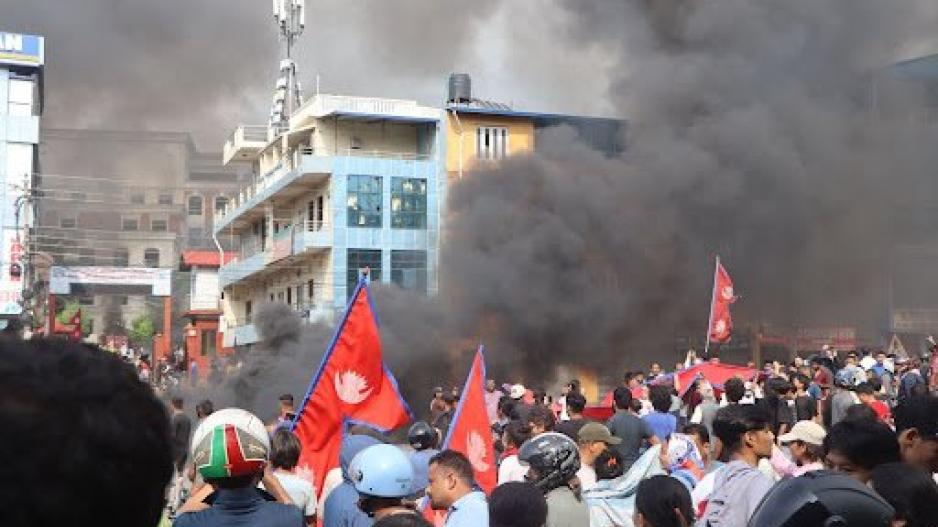
The days that followed saw a level of destruction unprecedented in Nepal’s recent history. Party offices, ministries, courts, and even the prime minister’s residence were attacked. Administrative buildings burned not only in Kathmandu but across the country. The unrest was chaotic and often contradictory, blending genuine rage with opportunistic violence, but its message was unmistakable: the state had lost its moral authority.
Within forty-eight hours, the government effectively ceased to function. The army was deployed to restore order, and Prime Minister Khadga Prasad Sharma Oli resigned amid mounting pressure. The political system, already brittle, cracked under the weight of public fury.
In the vacuum that followed, an unprecedented experiment unfolded. Thousands of young Nepalis participated in an online vote to select a figure they believed could lead the country through the crisis. The process was messy, improvised, and entirely outside Nepal’s constitutional framework, but it reflected a deeper truth: legitimacy had migrated from institutions to networks.
The protests revealed the sheer scale of youth alienation, but they also exposed its internal contradictions. Nepal’s young population is not a monolith. Urban activists, diaspora voices, and rural youth often articulate different priorities, and ideological coherence remains elusive. While figures like Kathmandu mayor Balen Shah enjoy immense popularity, concerns persist about personalization of power and democratic accountability.
There are also deeper structural debates simmering beneath the surface. Some protesters question the federal model enshrined in the 2015 constitution, viewing provincial governments as inefficient and costly. Others warn that dismantling federalism would reignite long-standing grievances over representation and inclusion, particularly in marginalized regions.
What is clear is that dismantling corruption will require more than a change of faces. It demands reform of bureaucratic systems, enforcement mechanisms, and political culture itself. Calls for merit-based appointments, term limits, and direct elections for executive positions reflect a desire to rebuild trust from the ground up.
Every generation in the country’s modern history has challenged authority. None has yet succeeded in reshaping it for the long term.
This time, the challenge is not just to overthrow a government, but to build something that can outlast the moment that made it possible.