The Biology Bet: Why Cyprus Must Out-Work Silicon Valley
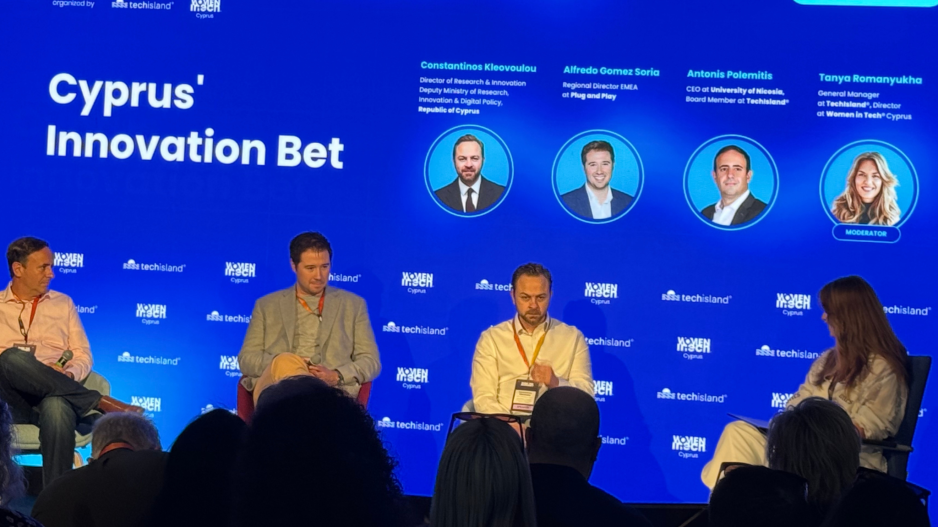
Tanya Romanyukha, General Manager at Techisland and Director at Women in Tech Cyprus, moderated the panel by framing the real-world implications of recent strategic shifts for local startups, researchers, and students. She drove the discussion around unpacking the practical impact of the national AI infrastructure and the Pharos AI factory, while highlighting how modern founders leverage AI, no-code, and agent-based workflows to build MVPs in days rather than weeks. Emphasizing ecosystem maturity, she underscored the importance of shifting the "brain drain" narrative and exploring how Cyprus can better leverage its mature corporate sector for startup acquisitions, partnerships, and early-stage venture capital.
Konstantinos Kleovoulou, Director of Research & Innovation at the Deputy Ministry of Research, Innovation & Digital Policy of the Republic of Cyprus, provided an inside look at the physical capabilities, timelines, and origins of the nation's emerging computational ecosystem. He explained that a strategic Silicon Valley visit by the President revealed a critical domestic gap in high-capacity computing, which previously forced local entities to rely on foreign providers introducing risks regarding data sensitivity, digital sovereignty, and budget predictability. To address this, Cyprus has deployed a two-fold infrastructure strategy: first, upgrading the old edge architecture at the Cyprus Institute's National Supercomputing Facility with state-of-the-art Nvidia GPUs to create an onboarding and testing environment for local industry, academia, and government; second, launching the PHAROS project as an "AI Factory" antenna to connect the local ecosystem directly to Europe's wider network of High-Performance Computing (HPC) facilities. This system is currently being calibrated and validated with Nvidia's help, with plans to officially open to the public on a competitive pilot basis around July 2026. This rollout is underpinned by a strategic Nvidia partnership focused on three pillars: hardware optimization through the donation of cutting-edge Grace Hopper experimental chips; expanding research capacity by pairing international Nvidia engineers with local talent (beginning with a core climate modeling case study); and ecosystem enablement via a "train-the-trainer" approach with the Nvidia Deep Learning Institute to upskill local developers through future AI days, boot camps, and hackathons.
Alfredo Gomez Soria, Regional Director EMEA at Plug and Play, discussed the strategic reasoning behind expanding the world's largest innovation platform to Cyprus and shared the evolving expectations for modern tech startups. He cited the country's clear vision, high-quality human capital coming out of local universities, the repatriation of diaspora through targeted brain-gain initiatives, and a unique geographic position capable of bridging critical innovation corridors to the MENA region, Central Asia, and Europe. However, he noted a significant disconnect between domestic research and development spending relative to GDP growth, tasking the private sector and tech industry to aggressively improve this metric over their new three-year program. This program targets six key sectors: energy, maritime, AI, gaming, fintech, and industry-agnostic workflows, and has already generated immense early traction with 150 startup applications, 92% of which are based in Cyprus, with an ultimate goal to finalize and announce their first local investment by the end of 2026. Addressing shifting startup dynamics, he emphasized that the traditional "pre-seed" runway has largely vanished due to AI efficiencies, meaning that modern investors now expect founders to arrive with a functional MVP and early traction from day zero. To successfully support these teams, he stressed that small ecosystems require active Corporate Venture Capital (CVC) frameworks, calling on local corporate entities to evolve past legacy mentalities, engage in consolidation, and provide vital exit opportunities for early VCs.
Antonis Polemitis, CEO at the University of Nicosia and Board Member at Techisland, delivered a forward-looking, highly critical assessment of where the innovation ecosystem must position itself for the 2030s and the cultural shifts required to get there. He introduced the "Biology Bet," arguing that standard cognitive tasks and general-purpose robotics will eventually be fully automated in massive global data centers, meaning Cyprus must instead focus on space- and region-based complexities that cannot be replicated remotely: biology, lifespan, and longevity. To lead this charge, he highlighted the UNIC Evolve platform, a €100 million investment on a pathway to €1 billion, which establishes a joint Greece-Cyprus research platform pairing Cyprus’s domestic ICT strength with a massive new Life Sciences and Genomics campus in Athens to access larger patient and participant cohorts. This initiative aims to unlock the unique Mediterranean advantage, positioning the region's most viable future AI chain in precision medicine, preventative analysis, and the deep biochemical sequencing and characterization of the Mediterranean diet. Acknowledging that individual startups cannot afford million-euro gene sequencers or proteomics machines, he detailed UNIC's scale-driven hard infrastructure partnerships with Purdue University, EKDA (Greece's top research center), and Pure Health/Hellenic Healthcare Group, the latter granting access to 13,000 hospital beds to effectively build the largest university hospital network in the world. Finally, he issued a call for a radical cultural shift, delivering a blunt critique of the local relaxed work mindset ("senastiva") and insisting that Cypriot founders must adopt the aggressive, high-velocity work ethic of Silicon Valley to compete against the world's most driven talent. He concluded by challenging domestic mindsets, urging founders to stop treating Cyprus as an end market and to recognize it instead as a launchpad to a unified European market of 500 million people from day one.
Ultimately, Cyprus stands at a critical generational crossroads where comfort must give way to relentless ambition. The infrastructure is being laid, the capital is moving, and the regional blueprint for deep biotech dominance is officially on the table. However, matching global innovation requires matching global intensity; tools alone will not suffice. The island's future founders must internalize this systemic wake-up call, shatter their domestic borders, and finally pick up the pace to win.