What the Next Generation of Stem Talent Wants From Cyprus
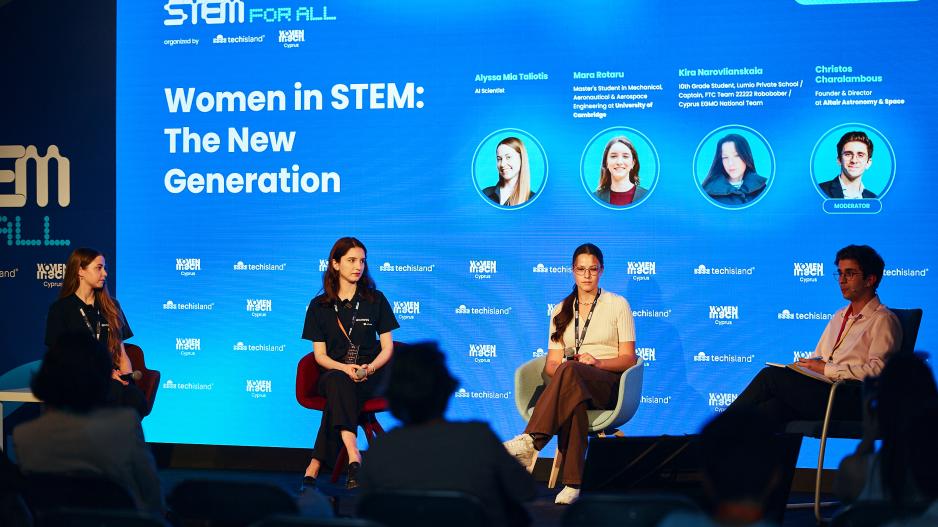
At Doers Summit Limassol 2026, one conversation stood out for looking beyond today's headlines and focusing on the people who will shape tomorrow's technology landscape.
Among the packed agenda of discussions on innovation, entrepreneurship, and artificial intelligence, the STEM For All stage, curated by TechIsland® and Women in Tech® Cyprus, offered something different: a glimpse into how the next generation of scientists, engineers, and technology leaders view the future.
The panel brought together young women already making their mark in STEM, from robotics and aerospace engineering to artificial intelligence and data science. While their backgrounds varied, a common theme emerged throughout the discussion: technology may be evolving rapidly, but the skills that will matter most are still deeply human.
Artificial intelligence was inevitably at the centre of the conversation.
For Kira, a robotics student representing Cyprus in international competitions, AI has become a powerful learning tool, helping her develop skills and access knowledge that might otherwise have been unavailable to her.
For Mara, who’s currently completing her Master's degree in Mechanical and Aerospace Engineering at the University of Cambridge, the technology is already reshaping higher education.
Universities are no longer debating whether students should use AI. Instead, the expectation is that they will use it effectively, producing work of a higher standard and engaging with increasingly complex challenges.
Meanwhile, Alyssa, an AI scientist working at the forefront of machine learning research, offered a perspective that resonated strongly with the audience: while AI can accelerate execution, it cannot replace understanding.
The technology may provide answers, but deep expertise, critical thinking, and the ability to solve ambiguous problems remain essential. In many ways, the rise of AI is not lowering expectations of future talent. It is raising them.
Another recurring theme was the growing importance of interdisciplinary thinking.
The careers being built by today's STEM students no longer fit neatly into traditional categories. Engineering increasingly overlaps with artificial intelligence. Mathematics intersects with machine learning. Scientific research relies on advanced computing and data analysis.
As a result, future professionals will need to navigate multiple disciplines rather than operate within a single area of expertise.
The discussion suggested that success will depend not only on technical knowledge, but also on the ability to connect ideas across different fields and continuously adapt as technology evolves.

The conversation also explored the realities of being a woman in STEM.
While all speakers acknowledged that progress has been made, particularly through initiatives designed to encourage female participation, they agreed that representation alone is not enough.
Access, visibility, and opportunity remain critical.
For young women considering careers in science and technology, seeing people with similar backgrounds succeed can be transformative. Equally important is creating educational and professional environments where talent can develop regardless of gender.
What stood out was the optimism shared across the panel. The focus was not on barriers, but on possibilities.
Perhaps the most interesting discussion for the local audience centred on Cyprus itself.
All three speakers expressed confidence in the talent emerging from the island, but also highlighted the importance of creating the conditions that allow that talent to thrive.
The conversation touched on infrastructure, research opportunities, innovation ecosystems, and the need to think bigger about Cyprus' future role in technology.
Several speakers pointed to the growing number of technology companies establishing a presence on the island and the opportunities this creates for young professionals. At the same time, they stressed that continued investment in education, innovation, and high-value career opportunities is essential if Cyprus wants to retain talent and attract more of it back home.
The message was clear: the challenge is no longer whether Cyprus can produce talented people. It is whether the country can create an environment ambitious enough to match their potential.

The discussion also highlighted the importance of supporting future STEM talent early.
Among the panellists were Mara and Alyssa, both participants in the Exness Scholarship Programme, an initiative that supports students pursuing academic and professional careers in STEM-related fields.
As Cyprus continues to position itself as a growing technology and innovation hub, programmes that invest directly in education and talent development are becoming increasingly important.
Applications for the latest round of the Exness Scholarship Programme remain open until 30 June, offering another opportunity for aspiring STEM students to pursue their ambitions and contribute to the next chapter of Cyprus' innovation story.
If the discussion at Doers Summit demonstrated anything, it is that the future of technology will not be defined solely by artificial intelligence or emerging tools. It will be defined by the people capable of using them to solve meaningful problems.
And judging by the voices heard on the STEM For All stage, that future is already taking shape.