Asteroid Passed Close to Earth Without Raising Concerns
2026 JH2 Came Within 85,000 Kilometers of Earth, but Scientists Confirmed There Was No Risk of Impact.
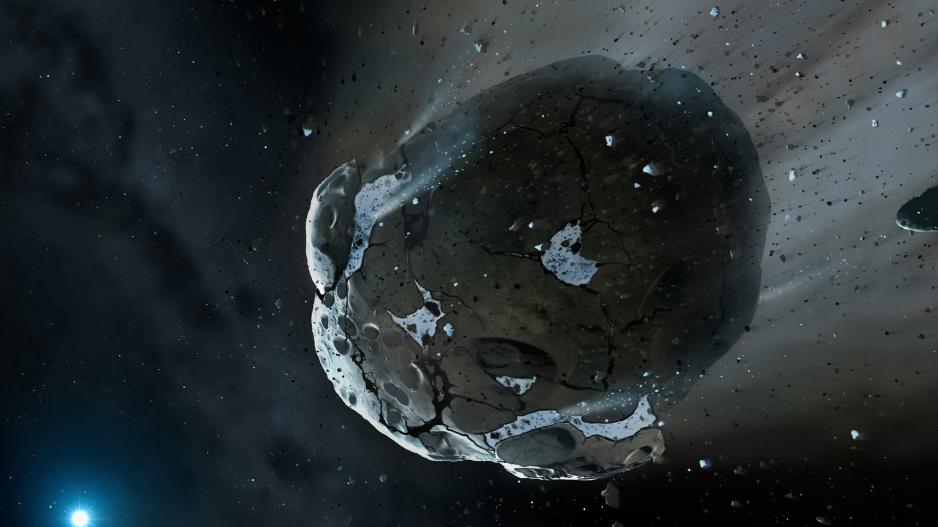
The European Space Agency (ESA) had announced that during the early hours of Tuesday, May 19, an asteroid measuring between 14 and 30 meters would pass close to Earth.
Scientists noted that the asteroid would approach within 85,215 kilometers of the planet. Due to both its size and proximity, it was classified as a potentially hazardous object, as an impact of that scale could devastate an entire city.
In 2013, a meteor measuring around 20 meters exploded over Chelyabinsk, Russia, at an altitude of approximately 20 kilometers. The blast released energy estimated at 440-500 kilotons, roughly 30 times more powerful than the Hiroshima bomb, shattering windows across hundreds of buildings and injuring more than a thousand people.
Had the object reached the ground and been primarily composed of iron, scientists estimate it could have created a crater more than 200 meters wide, destroying buildings and sparking fires across a large surrounding area.
ESA had also stated that 2026 JH2, discovered only on May 10, would make its closest approach at around 1 a.m. Greek time, which it did.
Simulations had already shown there was no threat to Earth.
There was never any reason for concern. Although the asteroid was roughly the size of one or two school buses and passed relatively close to Earth, much closer than the Moon, experts stressed that these kinds of flybys are fairly common.
“This type of close approach happens relatively often, nearly twice every year,” explained Juan Luis Cano, head of ESA’s Planetary Defense Office.
2026 JH2 simply passed by Earth, specifically over South Africa, without entering the atmosphere.
The asteroid belongs to a group known as the “Apollo” class, whose members orbit the Sun on paths that intersect Earth’s orbit. It was only visible through telescopes measuring at least 20 centimeters.
An astronomer told CNN that asteroids roughly the size of 2026 JH2, described as “car-sized objects,” pass between Earth and the Moon almost every week. Modern detection systems used by space agencies are now sensitive enough to identify these objects much more effectively than in the past.
At the same time, simulations continue to show that humanity faces no asteroid extinction threat over the next century.
Source: news247.gr