Culture as the Catalyst for Sustainable Public Sector Transformation
Insights from the EY Cyprus Panel Discussion
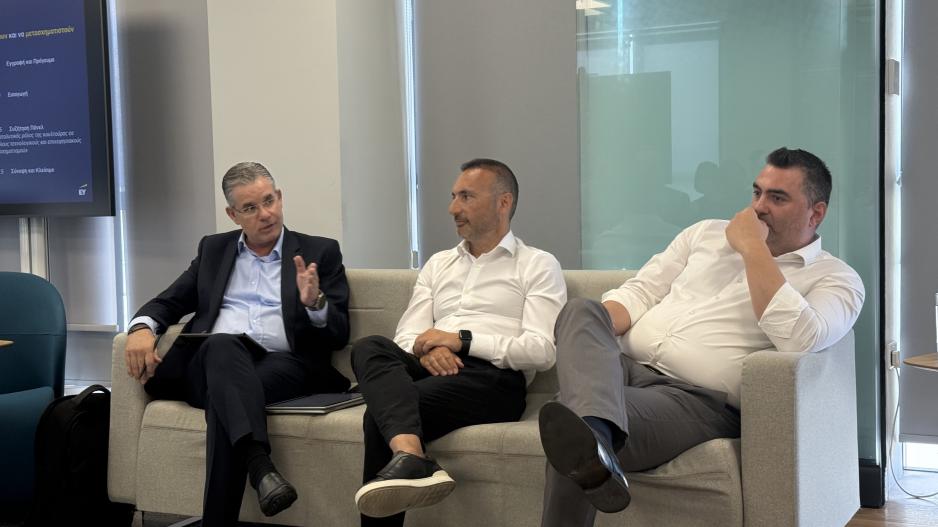
At a breakfast event and discussion hosted by EY Cyprus “The Public Sector in the Transformation Era”, representatives from across Cyprus' public and semi-public sector gathered to explore a topic that sits at the heart of lasting institutional transformation: culture. The panel, moderated by Panayiotis Thrasyvoulou, Partner and Head of People Advisory Services at EY Cyprus, featured three public sector leaders: Andreas Neocleous, CEO of Cyta, Adonis Yiasemides, General Manager of the Electricity Authority of Cyprus (EAC) and Constantinos Parmaklis, General Manager of the Nicosia District Organization of Local Government (EOA). In the audience, there were representatives from c. 30 departments and organisations of the extended public sector of Cyprus.
While each panellist offered unique insights and experiences, the session delivered a unified message: true transformation in the public sector doesn’t start with systems or digital tools; it starts with people.
In practice, this means that transformation will only take root and thrive, if the cultural fabric of the organization is ready to absorb it. Culture is the foundation on which meaningful, sustainable change is built. As moderator Panayiotis Thrasyvoulou, Partner and Head of People Advisory Services at EY Cyprus, noted, no amount of investment or planning will deliver results unless people embrace the change, and that requires cultural alignment.
This was clearly echoed by all three organizations. Cyta, which has already seen significant success in its transformation efforts, credits its cultural shift toward performance and accountability as a major turning point. CEO Andreas Neocleous emphasized that their most impactful change wasn’t technical, but rather a cultural realignment, via the implementation of different mechanisms that helped shift employee focus toward contribution, improvement, and shared responsibility. He regards the organisation’s new performance management system as the most significant change that Cyta ever implemented.
In the case of EAC, General Manager Adonis Yiasemides confirmed the importance of internal culture. While there is a typical interpretation of organisational transformation as the adoption of AI and other digital tools, Yiasemides stressed that without a meritocratic and accountable culture, the adoption of such technologies within the organisation would suffer.
For EOA, formed through the consolidation of 14 municipal bodies, the fact that 85% of employees chose to stay was a cultural success itself. According to General Manager Constantinos Parmaklis, the ability to retain staff through uncertainty and change reflects the trust and continuity that culture provides.
Across all cases, it became clear that culture is not the byproduct of change; it is the enabler. Without this foundation, transformation efforts are unlikely to take root.
Vision: Change That Serves the People
While internal systems and strategies matter, the broader goal of public sector transformation is to better serve the people of Cyprus. This target must remain at the core of any change initiative, supporting a transformation.
Neocleous was careful to point out that transformation in the public sector needs to be tailored, pragmatic, and rooted in service to the community, cautioning against importing private-sector practices wholesale. “Public sector transformation needs careful balance. You adopt best practices, but you also shall respect what the system can absorb.” For Cyta, building a shared culture, rather than enforcing top-down mandates, has been essential to employee engagement and long-term competitiveness.
Yiasemides added that for EAC, the challenge is not merely adopting tools but fostering a culture that supports new ways of thinking, working, and evaluating success. This is an example of transitional and transformational cultural change: moving from long-standing traditions to new behaviours that question underlying assumptions. It requires trust, leadership alignment, and consistent reinforcement.
For Parmaklis, the vision is even more foundational. EOA represents a structural overhaul that could set the stage for a more integrated and efficient model of local governance. But beyond structural efficiency, the end goal is to blend tradition with innovation in a way that strengthens trust and delivers practical improvements to the lives of citizens.
As the session made clear, transformation must be more than operational. The real measure of success is whether institutions are becoming more adaptive, empathetic, and effective in serving their communities.
Mechanisms That Shape and Support Culture
If culture is the heart of transformation and vision is the compass, then mechanisms, like performance management systems, leadership involvement, and governance alignment, are key tools for its success.
One such tool is performance management. At both Cyta and EAC, leadership has actively sought to upgrade performance management with more rigorous, targeted systems. Cyta is also about to implement new financial rewards systems, and internal promotion structures that reward contribution and adaptability. These have helped shift the organization's foundation from a traditional, hierarchical model to one driven by accountability, transparency, and continuous improvement. Initiatives like these, although very common in the private sector, are major milestones in the public sector of Cyprus. These shifts not only improve motivation but also challenge long-standing assumptions about how progress comes about in public organizations.
Leadership also plays a pivotal role. Neocleous emphasized that cultural shifts must be led, not imposed. At Cyta, this meant building buy-in across departments and adjusting pacing to match the system’s capacity to absorb change.
Similarly, Yiasemides noted that the success of any system, be it AI or performance management, depends on trust and mutual respect between leadership and staff. Alignment between boards and the executive leadership is also integral in steering an organisation forward, with a unified vision, supported by shared values and a commitment to continuous improvement.
Parmaklis, leading a new organization still defining its identity, highlighted the importance of aligning central government and local structures. Without coordination and accountability at all levels, even the best reforms stall. As challenges like dual accounting systems and slow hiring processes show, leadership alignment must extend across institutional boundaries.
Each panellist recognized that cultural change isn’t a single event. It’s a continuous, evolving process. Cultural dynamics within public organizations can be integrated, differentiated, or fragmented. That’s why initiatives must be flexible and iterative, designed with room to learn and adapt over time. Transformation without cultural alignment is bound to fail.
Organizational culture in the public sector is especially complex. It may consist of dominant values (integration), various subcultures (differentiation), or fragmented ideologies. This complexity makes it harder, but not impossible, to design and implement sustainable change.
What’s needed is a nuanced, long-term approach. Culture is not static. It shifts in response to leadership, external pressures, and internal dynamics. As such, transformation must be treated as a journey, not a destination. One that requires clear vision, strong leadership, cross-functional collaboration, and an understanding of the culture you're working within.
A Shared Lesson: Start with Culture, Sustain with People
For organizations across the public and semi-public spectrum, the road to digital and operational excellence begins with cultural readiness. At EY’s panel discussion, it became clear that tools and systems are merely enablers. The real engine of change is the shared mindset, values, and assumptions that define how an organization thinks, feels, and functions. Transformation begins from within. And culture is not a support mechanism; it is the transformation’s enabler.