Cyprus and India to Sign Joint Declaration Today – Strategic Focus Areas Revealed
The new Joint Declaration sets the stage for deepened cooperation in energy, security, innovation, and investment.
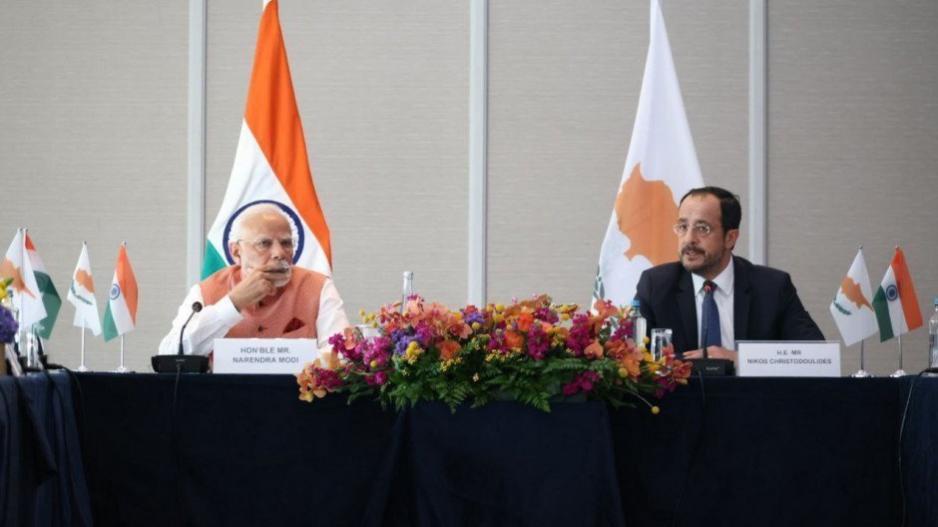
Cyprus and India will sign a Joint Declaration of Partnership today, Monday, marking a significant milestone during the official visit of Indian Prime Minister Narendra Modi. According to a government source, the signing of the Joint Declaration, which will define the comprehensive strategic relationship between the Republic of Cyprus and India, represents a “historic and substantial development.”
“This is a decisive step toward further deepening bilateral relations, recognizing the mutual strategic value placed by both nations, and establishing the institutional framework for systematic, multi-dimensional, and medium-term cooperation,” the source added.
According to government sources, the development reinforces the Republic of Cyprus’s role as a reliable partner in the Eastern Mediterranean and highlights opportunities for trilateral and multilateral collaborations in areas such as energy, defense, investments, digital technologies, and the green transition.
Through this Joint Declaration, Cyprus and India express their intention to jointly navigate the evolving geopolitical and geoeconomic landscape, focusing on peace, stability, and sustainable development.
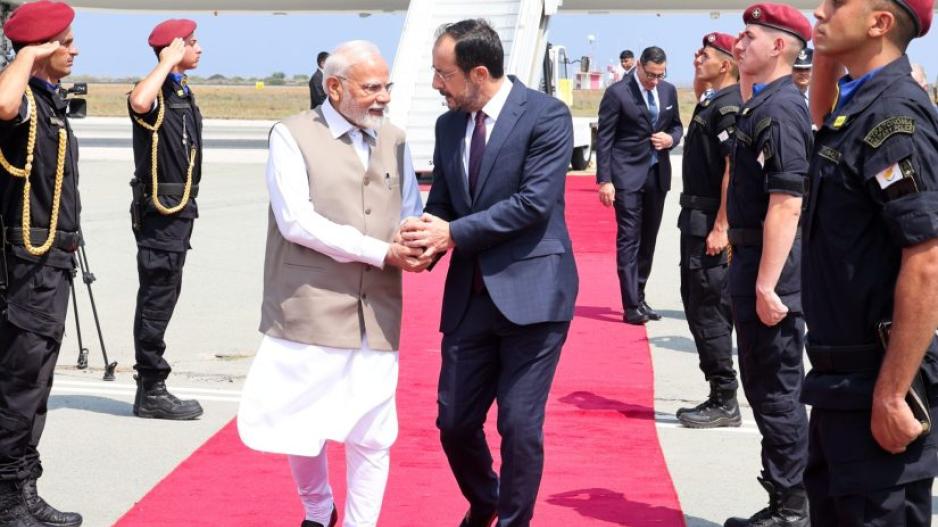
Speaking on Sunday, President of the Republic Nikos Christodoulides highlighted the significant mutual investment opportunities between Cyprus and India, calling Prime Minister Modi’s visit “historic.”
Prime Minister Modi, in turn, described Cyprus as a long-standing and trustworthy partner of India and welcomed the establishment of the India-Cyprus-Greece Business and Investment Council. He called it an “excellent initiative that could become a significant platform for economic cooperation.”
During a roundtable discussion with business leaders held in Limassol, attended by both leaders, President Christodoulides noted that Modi’s visit marks the beginning of an unprecedented strategic relationship between the two countries, which share common values and principles.
The President also expressed his deep sorrow and sincere condolences—on behalf of himself, the Government, and the people of Cyprus—to the Indian people for the tragic air accident and loss of life.
He emphasized that Cyprus, as the southeasternmost part of the European Union, is a beacon of stability in the turbulent Eastern Mediterranean region. Regarding EU-India relations, he mentioned that a new path for collaboration has opened following the visit of the College of Commissioners to India in February.
Praising Prime Minister Modi’s leadership and transformative governance, President Christodoulides called him a leader of change and a driver of India’s remarkable transformation.
He added that Modi’s visit underscores India’s commitment to future-oriented cooperation with Cyprus in areas such as security, technology, artificial intelligence, innovation, energy, connectivity, and more.
President Christodoulides further emphasized that Cyprus views India not only as a strategic partner but also as a global power shaping the future of technology, connectivity, and sustainable development.
“Cyprus is the 8th largest source of foreign direct investment in India, while India is among the top ten foreign investors in Cyprus,” he noted—an already solid foundation for expansion.
He also cited initiatives such as the India-Middle East-Europe Economic Corridor (IMEC), where Cyprus could serve as the first point of entry into Europe. This, he said, is a vision for smart infrastructure and networks that can act as catalysts for prosperity and stability.
He highlighted that business communities in both countries are interested in mutual investments in sectors like digital innovation and hospitality, with many more opportunities in defense technology, natural resource management, infrastructure, agri-tech, film, and cybersecurity.
In conclusion, President Christodoulides stated that Modi’s visit opens new horizons in bilateral cooperation.
Prime Minister Modi reiterated that there is unlimited potential to enhance relations between the two countries. He acknowledged Cyprus as a long-standing, trusted partner and noted the substantial investments Cyprus has made in India, while many Indian companies have chosen Cyprus as a gateway to Europe.
Currently, bilateral trade stands at $150 million, but “the real potential of our relationship is much higher,” Modi stated.
As the world’s fastest-growing emerging economy, India has improved not only the ease of doing business but also business confidence, he added.
Today, 50% of global digital transactions are conducted in India via the Unified Payments Interface (UPI). Countries like France have adopted the UPI system, and discussions with Cyprus regarding its implementation are underway.
Modi also mentioned that Cyprus is a popular tourist destination among Indians. India, which is actively developing and managing tourism hubs, sees mutual benefit in close cooperation between travel agencies of both countries.
He referenced the recent agreement between India and the United Kingdom for an ambitious free trade deal and India’s commitment to finalizing a Free Trade Agreement with the European Union by the end of the year.
Closing his remarks, Prime Minister Modi welcomed the formation of the India-Cyprus-Greece Business and Investment Council, calling it an “outstanding initiative that could become a key platform for economic collaboration.”
The roundtable discussion, attended by both leaders, also featured input from key economic and business stakeholders from Cyprus and India. Following the event, President Christodoulides hosted a private dinner for Prime Minister Modi at the same venue.