Cyprus Signs Landmark Agreement for First Large-Scale Energy Storage Systems
Energy Storage Projects Will Help Improve Renewable Energy Management, Says Damianos
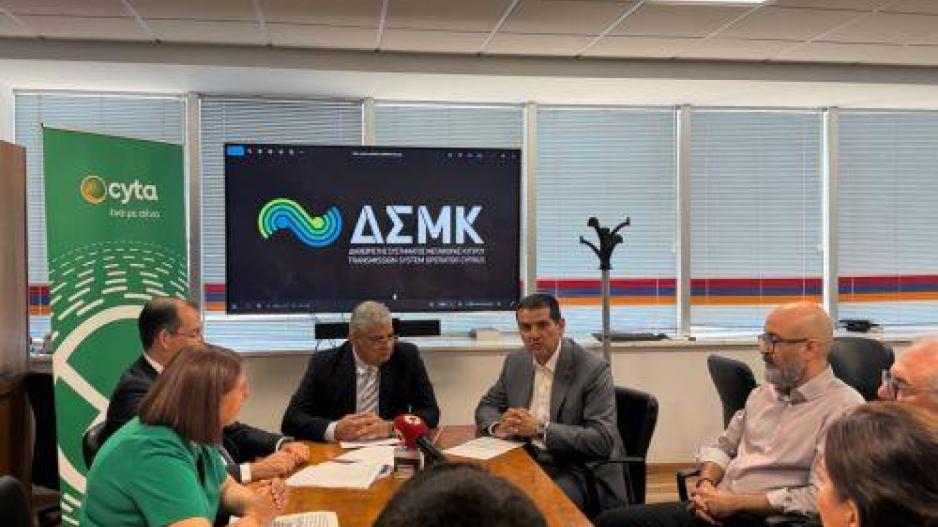
Energy Minister Michael Damianos hails the new TSOC and CYTA partnership as a decisive step toward upgrading Cyprus' grid, slashing green energy curtailment, and lowering citizen electricity costs.
Grid Modernization and Strategic Cooperation
Energy storage projects will significantly contribute to improving the management of renewable energy generation, reducing curtailment of renewable energy, and enhancing the stability of the system said on Tuesday the Minister of Energy, Commerce and Industry, Michael Damianos, following the signing of an agreement between the Cyprus Transmission System Operator and CYTA for the supply and installation of the first large-scale energy storage systems in the country’s power grid.
In his remarks following the signing of the agreement, Damianos said that this is a project of great importance, marking a decisive step toward upgrading and modernizing the country’s energy system.
“With its implementation, we are entering a new phase aimed at strengthening the resilience and reliability of our country’s power grid. Energy storage projects will contribute significantly to improving the management of renewable energy generation, reducing curtailment of renewable energy, and enhancing the stability of the system,” he continued.
He added that the energy transition is a complex process, with successive implementation stages and technical challenges that require time, consistency, and close cooperation among all stakeholders, noting that in this context, the project signed today represents a significant step in the overall strategy for energy storage.
Congratulating TSOC for designing and promoting this project, as well as CYTA for undertaking the implementation of this important agreement, the Minister noted that “cooperation among public organizations is the foundation for the successful implementation of projects that promote the public interest and the achievement of our national energy and climate goals.”
“I would like to assure you that we are moving forward with the implementation of our plans not only for energy storage, as well as, more broadly, for the green transition, which will contribute significantly to further increasing the penetration of renewable energy sources and creating a more efficient, reliable, and less polluting electricity system,” he concluded.
Infrastructure Locations and Funding Strategy
For his part, the Executive Director of the Cyprus Transmission System Operator, Stavros Stavrinos, said that this project stems from Decision 217/2025 of the Cyprus Energy Regulatory Authority, issued on June 18, 2025, which directs the operator to implement energy storage systems at three different existing transmission substations.
He added that funding for the storage systems is expected to be provided by the European Cohesion Policy Program Thalia 2021–2027 and, to this end, the operator is in constant contact and collaboration with the Control Directorate of the Ministry of Transport, Communications, and Public Works, which acts as an intermediary body.
As part of the project, Stavrinos continued, a 40 MW and 80 MWh energy storage system will be installed at the Athalassa substation in the Nicosia district, and two 40 MW - 160 MWh energy storage systems will be installed at the Anatoliko and the Free Industrial Zone substations, in the districts of Paphos and Larnaca, respectively.
“These three locations have been selected to maximize the benefits of operating these storage systems. Specifically, the selected substations to which these systems will be connected allow us to connect them directly to the transmission system, which, in addition to the significant benefits of energy storage, allows for the seamless provision of the necessary reserves to the power system without restrictions, for the benefit of the entire system,” he further explained.
Balancing High Renewable Penetration
He added that the system effectively contributes to improving energy flows in the power grid, alleviating congestion problems that might arise during peak hours, at the same time not affecting existing renewable energy projects, for which the schedule remains as planned, while the interconnection projects have already been included and registered in the ten-year transmission system development plan and are currently under construction.
He also noted that the penetration of electricity from renewable energy sources during periods of high demand currently exceeds 60% for several hours, and on a half-hourly basis, it even reaches 70% during certain periods of the year. “This means that today we are enabling the operator to meet 70% of Cyprus’ final demand during certain hours, which I believe is an achievement we should acknowledge and 60% of the demand for many hours of the year,” he noted.
According to Stavrinos, the installation of storage systems owned by the operator will help manage the power system more effectively and increase its resilience to sudden and unpredictable fluctuations in renewable energy generation, while also reducing curtailment of renewable energy generation.
“Installed photovoltaic capacity has now exceeded 1,040 MW, while Cyprus’ average demand stands at 650 MW; managing this requires flexibility resources, just as with previous systems. In addition, storage systems serve as an additional tool for the operator to ensure the systems’ ability to meet reasonable demand, which is the operator’s exclusive responsibility under the law,” he noted.
Advanced Technology and Private Investment
He also described as very important the fact that one of these systems will feature grid-forming technology, which, he said, also marks the introduction of advanced technologies into Cyprus’ electricity system, noting that “this technology was developed to assist isolated systems, such as ours, and still poses a major challenge for our organization.”
He further said that with this project, the operator is not hindering the development of similar systems by private investors; on the contrary, the development of autonomous systems by private investors is being promoted in parallel, and some of these projects are already underway, with the operator having issued connection terms for standalone systems with a total capacity of 60 MW and energy of 190 MWh, these applications being at a fairly advanced stage.
“Our conclusion is that all storage projects are welcome and necessary to achieve European and national targets for renewable energy penetration, and at the same time they will significantly limit cuts to green energy and, consequently, pollution. Of course, the expected outcome will be the benefit to citizens resulting from a reduction in the cost per kilowatt-hour, alongside an improvement in the system’s performance indicators,” he concluded.
He added that implementation of the project is set to begin immediately, noting that an eight-month period is anticipated before the systems go live.
Technological Reform and Consumer Benefits
CYTA Board Chair Maria Tsiakka, in turn, noted that through an open and transparent process, the organization is undertaking a significant technological project that will bring substantial benefits to citizens, contribute to the country’s technological reform, and support sustainable development.
“It also reaffirms the credibility our organization has earned in managing complex and intricate projects and taking on critical infrastructure for our country. Our participation also reflects CYTA’s active role in initiatives that create real value for the economy,” he added.
“I, too, would like to assure you that, with consistency, expertise, and close cooperation with all stakeholders, we will work to meet the timelines for the successful completion of the project, which will meet the needs of Cypriot households,” concluded Tsiakka.