It Was Never Humans vs. Machines - It Was Always About Getting Our Time Back
Long before anyone worried that a machine might take their job, most workers already felt they were losing their day to work that didn’t matter. In a nationwide U.S. survey conducted by Ipsos for Eagle Hill Consulting in January 2025, 68 percent of employees said they regularly spend their time on low-value, inefficient tasks (eaglehillconsulting.com, March 2025) - not because the work is difficult, but because it isn’t the work they were hired to do. The frustration, in other words, predates the algorithm. People wanted their time back before AI ever offered to give it.
That is the quiet backdrop to AI Expo Cyprus, held in Larnaca from July 4 to 6, 2026. Of the roughly sixty speakers across three days, four arrived at the same reframe without coordinating with one another: the tired “AI versus humans” debate is the wrong question. The more useful one is the one who ends up doing the tedious share of the work and who gets the time that’s left over.
Is AI actually replacing people, or is it renegotiating who does what? The question sounds abstract until you sit through four talks that each answer it from a different angle - one on machine learning design, one on emotional AI, one on hard data from a real corporate transformation, and one on what stays valuable in a person once content becomes free. None of the four describes a fight. All four describe a handoff.
Sebastian Niehaus, CEO of Needlestack Technologies, opened his talk, “When AI Comes First, the Solution Often Comes Last,” with a warning aimed at his own industry’s habits. “AI is not always the answer,” he said. “For a well-defined problem, machine learning is often the better engineering choice, because the objective, inputs, and evaluation criteria are already clear.” That is a contrarian position to take at an AI conference, where most vendors reach for the largest, most general model first. Niehaus’s point was narrower, and he was careful to say it wasn’t anti-AI: “Should you avoid AI? No. Just not for every problem.” The decision about which kind of intelligence - narrow and purpose-built, or broad and general - gets deployed for a given problem is still a human one. The machine doesn’t choose its own scope. Someone chooses it for the machine.

Aletia Trakakis, co-founder of Kakushin, pushed the same idea into more personal territory. Her system, MERI, powers a dementia-care companion called DementiaBuddy, and her argument was that most “empathetic AI” isn’t empathetic at all - it’s classification, a label slapped on a sentence. “Real empathy isn’t ‘you are sad,’” she said. “It’s ‘you seem quieter than usual.’” That distinction, she argued, is a “delta from a baseline,” which requires the system to hold a specific person’s history rather than a generic mood chart. Describing an earlier, unrelated conversation with an AI, she said what struck her wasn’t the answer but the patience behind it: “It didn’t rush. It didn’t perform. It didn’t wait for its turn to talk. It just stayed in the conversation.” A system built to notice a change still needs a human to act on what it notices - which makes it a tool for attention, not a replacement for it.

Tony Jacobs, co-founder of Unplain Media, brought the data that makes the reframe hard to dismiss as wishful thinking. Drawing on his own experience leading an AI transformation inside an IT company - research he later explored in his Durham University Business School dissertation - he showed how chat and email response times dropped sharply following automation, while customer satisfaction improved dramatically, with Net Promoter Score moving from -50 to +18. Rather than presenting AI as a story of replacement, Jacobs argued that success depended on how organizations managed the human side of change. He then contrasted this with IKEA, where 8,500 call-center employees were reskilled into areas such as interior design, digital sales, relationship-building, and complex problem solving instead of being made redundant. Finally, he pointed to Meta as an example of a different path, where layoffs affected thousands of employees as part of a broader AI-driven restructuring. He staged the skeptic’s objection himself before answering it: “That would have KILLED employee morale! Bet you waved goodbye to retention AND revenue!” His own case study suggested otherwise, but only where AI was introduced as a handoff rather than a headcount exercise. Same technology, different outcomes, depending entirely on what the company chose to do with its people.

Andrea Gémesi, a business communication expert and self-leadership coach, made the human side of that choice explicit. Her framing: the Industrial Revolution devalued physical strength and made thinking valuable; the internet made information free and made judgment valuable; AI is now making content free. So what becomes valuable next? Her answer was curiosity, empathy, and self-awareness. “AI rewards curiosity,” she said. “The better your questions, the better the answers… Curiosity combats certainty. AI can generate very convincing answers, but curiosity reminds us to ask, ‘Is this the whole picture?’” She handed the room a set of prompts built to interrogate the person typing them, not just the tool answering: “Challenge my thinking. What assumptions am I making? What perspectives haven’t I considered?”

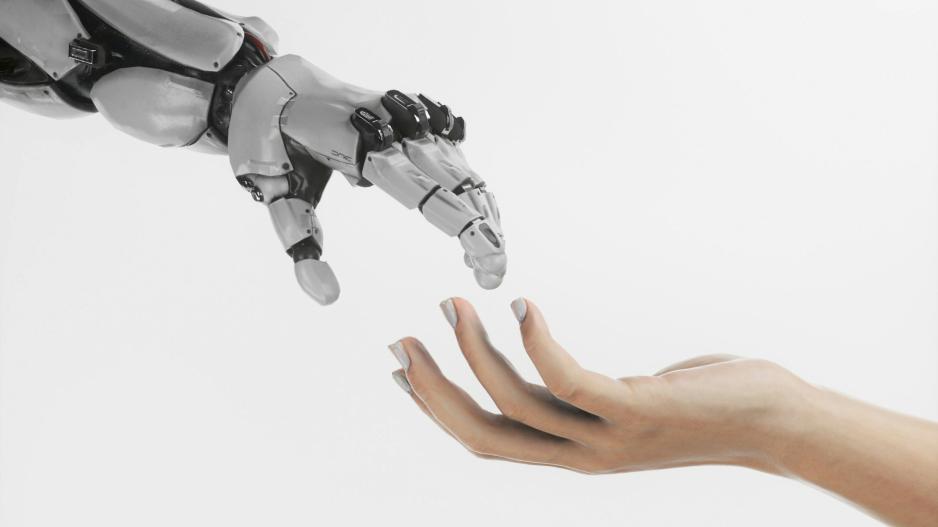
Put the four together and a single throughline appears. Niehaus keeps the choice of tool with the human. Trakakis keeps the act of noticing, and acting on it, with the human. Jacobs shows what a company gains when it treats AI as a handoff rather than a cut, and what it loses when it doesn’t. Gémesi names exactly what a person should spend their freed-up time getting better at. None of this is automatic. Jacobs’s own numbers prove that identical technology can produce opposite outcomes, depending on how deliberately a company manages the transition.
The 68 percent of the day that Eagle Hill’s survey found workers losing to low-value tasks was never really a technology problem. It was a question of who gets the tedious share of the job and who gets what’s left over. AI didn’t invent that imbalance. What these four talks suggest, cautiously, is that it might finally be a tool for correcting it - provided the people running the handoff remember that the point was never to win the argument with the machine. It was to get the time back.
The AI Expo Cyprus was organized by EMS Events.