Pension Cuts Ruled Out: What the President Told Trade Unions
Clear Position on Hourly Minimum Wage
- What Changes in the Employment Strategy for Third-Country Workers
- Thoughts on Government Covering the Supplementary Pension
The unanimous reaction of social partners regarding the possibility of reducing high pensions, within the framework of pension system reform, left the government with no room even to negotiate the issue.
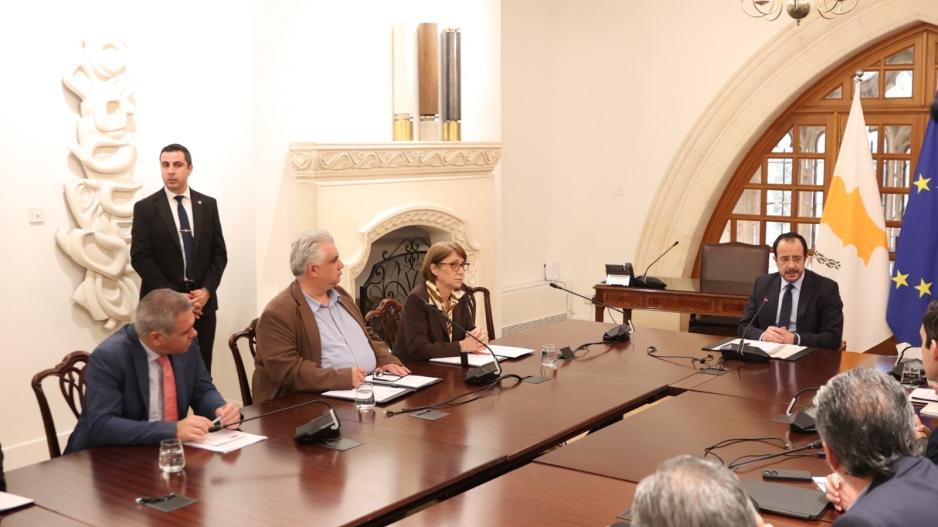
Yesterday’s meeting between President Christodoulides and the leadership of the trade union organizations SEK, PEO, and DEOK definitively closed the chapter, even though it had been one of the scenarios put forward by the actuary of the International Labour Office.
Marinos Mousiouttas, Minister of Labour, had already prepared the ground the previous day, stating that the possibility of reducing high pensions was merely a scenario and not a government proposal.
He clarified that there are several scenarios under discussion, which would be examined with the two social partners.
Yesterday, after the meeting between the three organizations and the President, Mr. Mousiouttas was clear on the controversial issue:
“There is no longer any scenario for pension reductions on the table of consultations regarding pension reform.”
“Our intention,” he said, “is to improve pensions, and this will result from the first phase of the reform, which concerns the Social Insurance Fund.”
The Minister added that the scenario has been set aside. “We remain focused on scenarios that do not involve any reduction of acquired rights for any pensioner. We will find ways to resolve it,” he said.
According to Brief sources, the President also reacted negatively to the scenario of reducing any category of pensions and assured the leaders of the three trade unions that no such decision would be taken.
Statements by the Minister and union leaders indicate that differences of opinion remain regarding the inclusion of provident funds in the first phase of pension reform.
Mr. Mousiouttas stressed that the government will proceed with the first phase of the reform, which, as he said, includes the first pillar, namely the Social Insurance Fund.
He explained that “it is not out of caprice that we say the second pillar cannot proceed simultaneously. What we have said is that, as a government, we can provide the general framework of what we mean by the second pillar, as well as a timetable for its implementation.”
He reiterated that the government’s goal is to implement the first phase of pension reform from January 1, 2027.
Union leaders made it clear that pension reform should not, and would not be beneficial if, implemented in a fragmented manner.
They stressed that it is imperative that the second pillar of pension benefits, the provident funds, not be excluded from the overall planning.
It is worth noting that the President indicated that the government intends, within the framework of pension reform, to strengthen the supplementary pension, a move welcomed by the unions.
It is also noted that within the first phase of the reform, the formula prepared by the actuary for the gradual reduction of the 12 percent deduction will proceed, as reported yesterday by Brief.

The Introduction of an Hourly Rate in the Minimum Wage
A key point of yesterday’s meeting at the Presidential Palace was the government’s positive stance toward the long-standing demand of trade unions to establish an hourly rate for the minimum wage.
This is an issue on which employer organizations take the opposite view.
OEB and the Cyprus Chamber of Commerce and Industry argue that a maximum national working schedule should not be imposed, which, they claim, effectively amounts to setting a maximum working hours limit.
According to the two employer organizations, each sector regulates working hours based on customary practices or sectoral agreements.
They note that institutionalized working hours should not fall under a general determination.
However, Andreas Matsas, Secretary General of SEK, Sotiroula Charalambous, Secretary General of PEO, and Stelios Christodoulou, President of DEOK, stated after their meeting with the President that he acknowledged the need for the minimum wage to be linked to an hourly rate.
The three union leaders said they expect the President to implement what he himself recognized as a necessary step forward.
Employment Strategy and Increased Inspections
There was also extensive discussion about the need for better regulation of the strategy concerning the employment of third-country workers.
The unions stressed that unfair competition between workers and businesses must be eliminated.
Specific complaints were also presented to the President against a small number of employers who, according to the unions, violate the institutional framework established by the Council of Ministers.
Brief sources indicate that President Christodoulides encouraged the Minister of Labour and the Director of the Department of Labour to strengthen the Inspection Department in order to increase checks aimed at combating undeclared work.
The unions also raised the issue of extending collective agreements, in line with the relevant EU directive, emphasizing that the institution is weakening and that the impact on the economy will be negative.
According to the union leaders, the President acknowledged that the state, through public procurement, can play a specific role in supporting collective agreements.
The meeting also included discussion on the need to implement the “Ergani 2” software, which, as stated, will better regulate the labour market by preventing unilateral interventions in workers’ rights and benefits.