The Space Economy Is Taking Off
Satellites, Artificial Intelligence, and Billions in Investments Are Turning Space Into Critical Infrastructure.
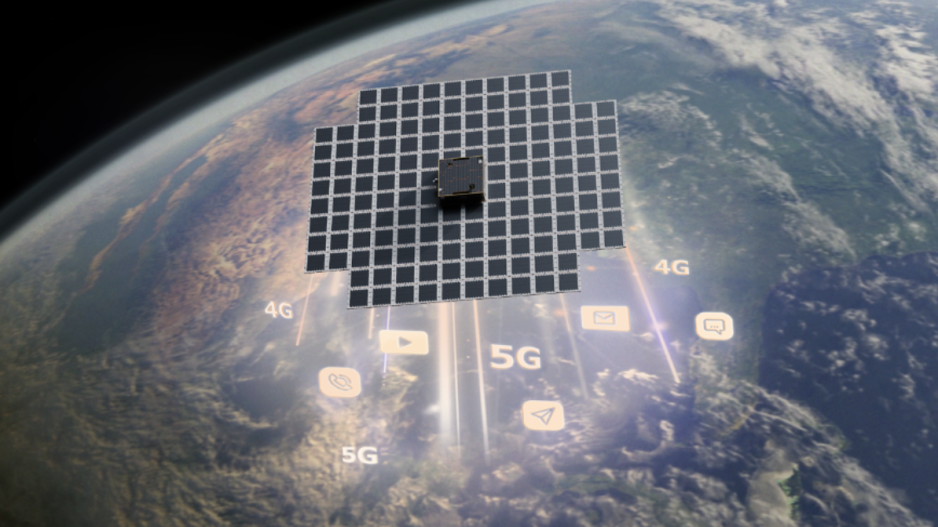
One of the most strategically important environments of the 21st century is emerging in the region of space up to 2,000 km in altitude, as defined by NASA, also known as Low Earth Orbit (LEO).
This region forms the backbone of global navigation, telecommunications, defense, and worldwide connectivity, while attracting massive investment.
LEO satellites, due to their relative proximity to Earth, offer faster response times, lower launch costs, and higher communication speeds. Unlike satellites in higher orbits, they do not remain fixed over one point on Earth and often operate in constellations to maximize global coverage.
Higher orbits, such as Medium Earth Orbit (MEO) and Geostationary Orbit (GEO), host long-established satellite infrastructure but are subject to stricter operational constraints.
In 2025, investments in the sector exceeded $45 billion, marking a sharp increase from $25 billion in 2024, according to Space IQ, a report tracking startup activity and investment trends in the space economy.
“Access to orbit is becoming a strategic advantage, much like ports, cables, or energy networks on Earth,” said Carlos Moreira, CEO of Swiss cybersecurity and semiconductor company Wisekey, speaking to CNBC.
The most visible example of this shift is the rapidly expanding satellite network of Elon Musk. His rocket company, SpaceX, already operates the Starlink satellite constellation, which now includes more than 9,500 satellites in orbit.
The company plans to expand this network by adding thousands more satellites. SpaceX has also proposed an even more ambitious project: a system of orbital data centers powered by solar energy, which could eventually include up to one million satellites.
But SpaceX is not alone. Just this week, Nvidia unveiled a new platform aimed at bringing artificial intelligence computing into orbit. The system is designed to support orbital data centers, geospatial intelligence, and autonomous space operations.
“Space computing, the final frontier, has arrived,” said Jensen Huang at the company’s GTC 2026 conference in San Jose. This approach could transform orbital data centers into discovery tools and spacecraft into autonomous navigation systems, he added.
Amazon LEO, previously known as Project Kuiper, plans to launch more than 3,000 satellites into low Earth orbit. Earlier this year, the Federal Communications Commission approved the future launch of an additional 4,500 satellites. Meanwhile, Blue Origin, founded by Jeff Bezos, is expected to launch more than 5,000 satellites by the end of 2027.
In Europe, the OneWeb LEO satellite network operated by Eutelsat currently consists of more than 600 satellites. While it operates on a smaller scale for now, France aims for the company to eventually compete with Starlink and has committed €1.35 billion in investment, becoming its largest shareholder with a stake of around 30%.
China has also submitted plans for more than 200,000 satellites across 14 constellations.
The scale of these planned launches represents a fundamental shift in how space will be used, governed, and commercialized.
More than $400 billion has been invested in the space economy since 2009, with the United States contributing over half of that total, followed by China, according to Space Capital.
Chad Anderson, CEO of Space Capital, stated that the sector remains in the “early stages of an infrastructure cycle that will last for decades.” He noted that while the industry is still developing, it has matured enough to present significant opportunities in public markets.
Around a dozen space companies are already publicly listed, with more expected in the coming year, including the highly anticipated IPO of SpaceX. According to Anderson, this could mark a “Netscape moment” for the space sector, a pivotal event that reshapes investor expectations and attracts broader capital into the market.
However, as momentum builds and commercial activity accelerates, Moreira of Wisekey warned that this expansion must be “managed with the same level of seriousness as digital sovereignty on Earth.”
He argued that space should remain a domain that benefits humanity by advancing connectivity, scientific discovery, and economic growth, rather than becoming a field of unchecked competition and systemic risk.
A key challenge for market development is the fragmented governance of LEO and its multi-layered operational framework.
At the international level, the Outer Space Treaty establishes that states are responsible for all space activities conducted under their jurisdiction, while United Nations guidelines on space debris mitigation provide non-binding sustainability principles.
The International Telecommunication Union manages global spectrum allocation, helping prevent interference and maintain reliable communication networks. Alongside these formal mechanisms, industry groups such as the Space Safety Coalition promote voluntary best practice standards.
National authorities also play a supervisory role. In the United States, for example, the Federal Communications Commission licenses satellite constellations and spectrum use, while the Federal Aviation Administration oversees launch and re-entry activities.
Many experts argue that existing frameworks are no longer sufficient. Raza Rizvi, a lawyer specializing in TMT at Simmons & Simmons, notes that much of today’s legal framework was designed around the more predictable conditions of GEO.
“Now that we are entering a higher-risk and more complex environment in LEO, we still lack the specific legal tools to manage this new technology,” he said.
Siamak Hesar, CEO of spaceflight intelligence company Kayhan Space, added that current regulations were built for slower-moving, government-led space programs and that “regulation must evolve in line with the scale at which the industry is developing.”
This shift from state-led to commercially driven activity is also reshaping how industry leaders view future opportunities. Martijn Rogier van Delden sees “a massive opportunity” for LEO satellites to connect billions of people, describing it as “a game changer for bridging the digital divide.”
Source: moneyreview.gr