Trump and Pezeshkian Sign Agreement to End War
The Two Presidents Put Their Signatures on the “Islamabad Memorandum.”
The presidents of the United States and Iran signed remotely on Wednesday night the bilateral agreement aimed at ending the war in the Middle East, with Tehran committing to dilute its enriched uranium in exchange for Washington lifting sanctions, while the details remain to be settled in further negotiations expected to begin on Friday.
The two sides reached an agreement this week to end the armed conflict that broke out on February 28, following intense aerial bombardments by the United States and Israel against the Islamic Republic, which cost the lives of thousands of people, the majority of them in Iran and Lebanon.
The “Islamabad Memorandum of Understanding,” which also includes the Lebanon front, was signed by US President Donald Trump during his visit to France.
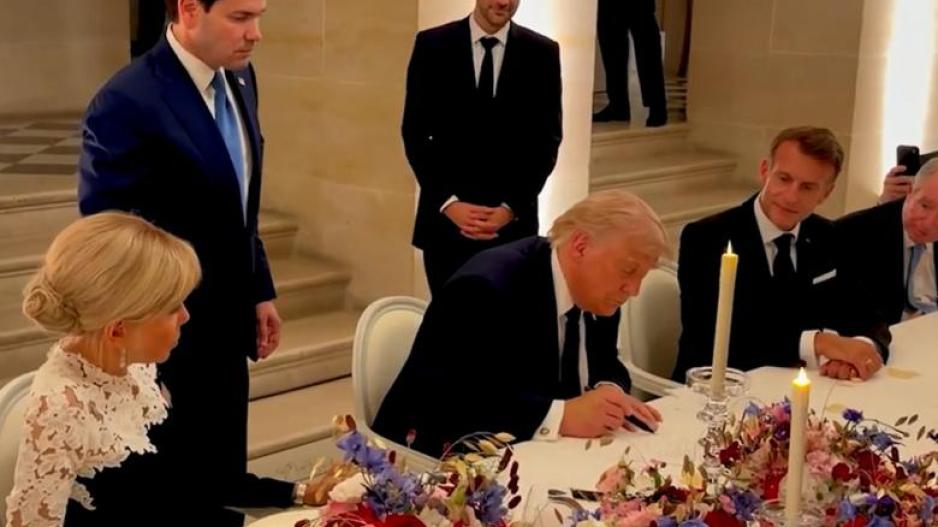
“I just signed it,” the Republican told the press as he left a palace in Versailles, where he had attended an official dinner. The White House later released a video on X showing him signing the document with a marker, seated beside his French counterpart Emmanuel Macron, who congratulated him, before handing it to his Secretary of State Marco Rubio, who was standing behind him.
The text was signed by Iranian President Masoud Pezeshkian and his American counterpart, Iranian Foreign Ministry spokesman Esmaeil Baghaei announced.
The IRNA news agency published photographs showing President Pezeshkian as he signed the document.
According to Press TV, Baghaei noted that the decision for the document to be signed by the presidents was not accidental. The fact that it was signed by the heads of the two states means that the political cost of any violation will be higher, he explained, according to the television network.
Analysts noted that Tehran preferred to avoid public handshakes between Iranian and American officials at an official signing ceremony. The Iranian side holds Washington responsible for the death of the Islamic Republic’s Supreme Leader Ali Khamenei on February 28, and the political cost of such images domestically would not have been insignificant.
The signing of the agreement by the presidents means that the Strait of Hormuz will fully reopen “without delay” and that the blockade of Iranian ports by the US armed forces will be lifted “immediately,” Pakistani Prime Minister Shehbaz Sharif assured in the early hours of the morning.
He also confirmed that a ceremony will be held in Switzerland on Friday to mark the important “development” and to launch “technical talks” between the parties.
Until Wednesday night, it had been expected that the agreement would be signed by US Vice President JD Vance and Iranian Parliament Speaker Mohammad Bagher Ghalibaf on Friday in Switzerland.
The agreement “records the failure of the United States,” Ghalibaf said on Wednesday night during an interview with state television.
The secretary-general of Hezbollah, the Lebanese Shiite movement aligned with Tehran, Naim Qassem, described the agreement as a “great victory” for Iran, which he thanked for insisting that the Lebanon front be included in it.
In a televised address, he urged the government in Beirut to “take advantage” of the agreement to “drive Israel out” of Lebanese territory.
Opponents of the movement accuse Hezbollah of dragging Lebanon into the war on March 2 by firing rockets at Israel in retaliation for the death of Ali Khamenei.
Hezbollah leader Qassem also called on the Lebanese government to stop direct negotiations with Israel, which began in April under Washington’s auspices.
Lebanese President Joseph Aoun had earlier stressed that the process is “independent” of the Washington-Tehran agreement.
The text of the agreement, which a US official read to journalists on Wednesday, provides that Washington will suspend, from the moment of signing, its sanctions that had blocked Iranian oil sales. It also agreed to move forward with lifting all sanctions against Tehran if a final agreement is reached after negotiations lasting 60 days.
During those talks, the governments of the two countries will discuss the creation of a “mechanism that will allow the processing” of Iran’s enriched uranium stockpiles through a method of dilution “under the supervision of the IAEA,” the International Atomic Energy Agency, said the US official, who described the issue as a “major victory” for Washington.
According to the same source, Iran will allow the full restoration of navigation through the strategically important Strait of Hormuz within 30 days. Its de facto closure after the war broke out shook the global economy.
The United States committed, if a final agreement is reached, to facilitate, in coordination with its “regional partners,” especially Gulf monarchies, the release of $300 billion in frozen funds for Iran’s reconstruction and economic development, without this implying any US financial contribution.
Iran published the text of the agreement on Wednesday through the official IRNA news agency.
The leaders of the G7 countries, whose summit had just taken place in France, praised in a joint statement the “historic opportunity to prevent Iran from acquiring any nuclear weapon and to address the threats linked to its regional activities” and its ballistic missile program.
China, for its part, said it was “absolutely necessary” for “all parties” to fully implement the agreement and avoid external “interference,” during a telephone conversation between Foreign Minister Wang Yi and his Iranian counterpart Abbas Araghchi, Beijing announced.
China’s top diplomat, whose country depends heavily on oil imports from the Gulf, stressed the need for the “proper management” of navigation through the Strait of Hormuz and for “the serious concerns of the international community” to be eased.
Oil prices closed slightly higher on Wednesday, with markets appearing cautious ahead of the signing of the agreement. Brent crude, the benchmark North Sea variety, rose 0.75% to $79.55 a barrel.
Source: news247.gr