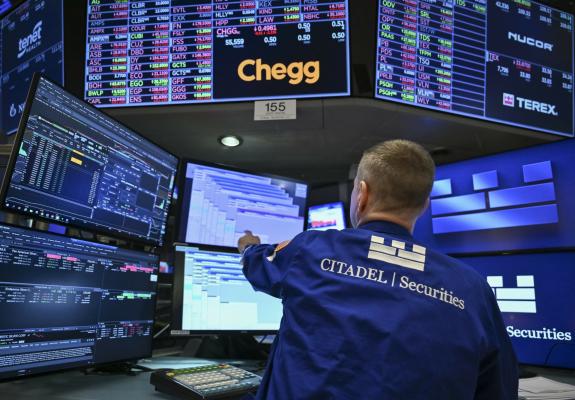
Wall Street: Indices Rise Fueled by Inflation Relief and Rally in Chips and Banks
Cooling Inflation in the US Reignited Investor Interest on Wall Street, With Tech Stocks and Banks Leading the Gains, While Bond Yields Declined.
-
Wall Street closed in positive territory as lower-than-expected US inflation reduced the likelihood of an immediate interest rate hike.
-
The tech-heavy Nasdaq recorded gains, receiving a significant boost from a strong recovery in semiconductor manufacturer stocks.
-
Positive corporate earnings from major US banks, such as Goldman Sachs, strengthened the market, confirming the economy's resilience.
-
Refining company stocks hit historical highs, while oil prices eased off due to geopolitical developments in the Strait of Hormuz.
-
US bond yields fell noticeably, reflecting the revision of investor expectations regarding the Federal Reserve's monetary policy.
Wall Street completed Tuesday's transactions in positive territory, as weaker-than-estimated inflation data in the US reignited optimism that the Federal Reserve might delay its next interest rate hike, while a sharp recovery in semiconductor sector stocks and strong results from major banks provided a significant boost to the main indices.
In this market climate, the Dow Jones closed almost unchanged with a minor gain of 0.02% at 52,508 points, facing heavy pressure from IBM, which slumped approximately 24% after warning that second-quarter profits would finish lower than forecasts due to weaker demand in its software and infrastructure businesses. The broader S&P 500 strengthened by 0.38% to 7,543 points, and the tech-heavy Nasdaq recorded an advance of 0.90% to 26,107 points.
Bond yields, on the other hand, fell following the publication of the lower-than-expected US inflation figures.
The yield on the 10-year US bond fell by more than 2 basis points to 4.583%. The drop was larger for the 2-year bond, as its yield decreased by more than 5 basis points to 4.204%. At the same time, the yield on the 30-year US bond edged down by less than one basis point, forming at 5.091%.
Cooling inflation shifts Fed expectations
The catalyst for the positive sentiment was data showing that the Consumer Price Index (CPI) fell by 0.4% in June on a monthly basis, with annual inflation settling at 3.5%, lower than both analyst forecasts and market estimates.
This development led to a significant revision of interest rate expectations. According to derivatives market data, the probability of a rate hike at the Fed's July meeting dropped to 17%, down from 42% a day earlier. Nonetheless, investors still consider a September hike likely, assigning an approximate 63% probability to a new increase of 25 or 50 basis points.
Despite the cooling of inflation, several analysts appear cautious, pointing out that the deceleration might prove temporary, as tension in the Middle East continues to feed uncertainty into energy markets.
At the same time, Federal Reserve Chairman Kevin Warsh, during his first semi-annual testimony to Congress, reiterated that "the inflation explosion of the past five years will soon be a thing of the past," underlining that the central bank will continue to implement the monetary policy required to restore price stability.
Strong comeback for semiconductor stocks
Semiconductor production companies stood at the center of investor interest, reacting dynamically after the heavy liquidations of the previous session.
The VanEck Semiconductor ETF (SMH) strengthened by about 2%, while significant gains were recorded by Applied Materials and Teradyne, both rising over 4%. The picture was even better for Lam Research and Micron Technology, which gained more than 5%, while STMicroelectronics strengthened by over 3%.
However, intense volatility remains a characteristic of the sector. According to market data, the variance of semiconductor stocks has skyrocketed to its highest level since 2020, reflecting investor doubts over whether high valuations can be justified by the future growth of artificial intelligence.
Volatility is particularly elevated in companies directly connected to AI applications, such as Marvell Technology, ARM Holdings, Astera Labs, Micron, and Credo Technology. Conversely, the largest players in the industry, such as Nvidia, Taiwan Semiconductor Manufacturing (TSMC), and Broadcom, display noticeably milder fluctuations, a fact suggesting that investors continue to view the large conglomerates as safer options.
Banks push the market forward
Corporate results from major US banks also functioned positively.
Goldman Sachs recorded a rise of about 7% after announcing profits that surpassed analyst estimates, while JPMorgan Chase and Bank of America also moved upward following the disclosure of their second-quarter results.
The strong image of the banking sector reinforced the assessment that the American economy continues to display remarkable resilience, despite the environment of high interest rates and geopolitical uncertainties.
Rally in refining companies
Significant gains were also recorded by the stocks of refining companies, as refinery profit margins (crack spreads) remain at historically high levels due to surging diesel prices.
Valero Energy, Marathon Petroleum, Phillips 66, and Par Pacific Holdings hit new historical highs, while PBF Energy, Delek US Holdings, and HF Sinclair finished very close to their own historical records.
The returns since the beginning of the year are impressive. Valero records a rise of about 83%, Marathon Petroleum 86%, Phillips 66 56%, while Par Pacific has more than doubled its value with gains of around 108%. Even larger is the rise of PBF Energy, which exceeds 123%, while Delek US and HF Sinclair are strengthening by approximately 103% and 79%, respectively.
Oil eases off its highs
In the commodities market, oil prices limited their initial gains after the decision of US President Donald Trump to abandon the plan to impose a 20% fee on ships passing through the Strait of Hormuz.
Despite correcting from the day's highs, US WTI crude remained above 78 dollars a barrel, while Brent maintained a position higher than 84 dollars, as the reinstatement of the US blockade against Iranian vessels continues to feed concerns regarding global energy supplies.
The session's picture confirmed that investors continue to balance between expectations for cooling inflation, which act positively for stocks, and geopolitical risks, which continue to support energy prices and maintain elevated volatility in international markets.