Not Every Dream Deserves a Body: What Happens When AI Learns to Build Anyone’s Fantasy
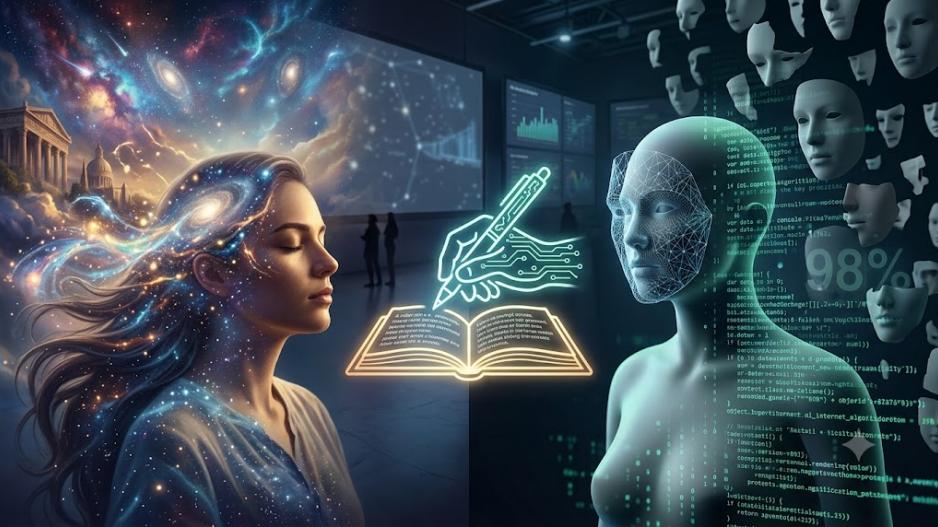
Technology typically removes the barrier between what a person privately imagines - any fantasy, light or dark - and what they can actually produce and show to others. And that barrier, that friction, was never just an inconvenience. It served a protective function.
Previously, turning a fantasy into something real - a film, an image, a video - required budget, equipment, skill, and time. That difficulty filtered out impulses: most people, even with a "dark" idea, never got as far as realizing it, simply because it was too expensive or too hard. The friction itself restrained the worst expressions of human nature - not through morality, but through sheer practical inconvenience.
And that's where the problem surfaces: the technology renders 'riding a Pegasus' with exactly the same ease it renders the nonconsensual content that made up 98 percent of deepfakes online, according to Home Security Heroes' 2023 State of Deepfakes report.
That is the uncomfortable subtext running under a much more delightful demo at AI Expo Cyprus, held in Larnaca from July 4 to 6, 2026. On one conference day, one presentation showed just how far the friction has already fallen. And raised the same question the statistic above answers in the worst possible way: once imagining something and producing it become the same act, who decides which imaginings deserve to exist?
For as long as film has existed, there has been a gap between having an idea and watching it happen: a budget, a crew, a studio, months of production standing between someone’s private fantasy and a finished frame. That gap did more than slow people down. It filtered. Somewhere between imagining a thing and paying to produce it, most people reconsidered, or simply ran out of resources before the impulse became an artifact. What happens to that filter when imagining something and watching it rendered back to you takes the same amount of effort?
Kevin Zhang, a solution architect at Alibaba Cloud, spent his talk demonstrating exactly how far that gap has closed. He screened a series of short Alibaba AI models generated films he called “dreams” - a rider crossing open sky on a winged horse, a figure gliding through the ocean on the back of an enormous fish, a body drifting weightless through open space - each one built from a text prompt and rendered as convincingly as anything shot on location. “Whatever you can picture, you can now watch,” he told the room. “The only budget left is your imagination.” There was no cynicism in the framing; the room reacted as audiences do to genuine wonder. A person with no camera, no studio and no crew can now produce a version of practically anything they can describe. For marketers and creators in that audience, the implication was clear: the execution bottleneck that once separated an idea from a finished asset is dissolving. What used to take a production budget now takes a sentence.

Massimo Martina, an art dealer, framed the darker corollary two days earlier, unaware that he’d be answering Zhang’s demo before it happened. His talk, “Will AI Replace the Artist?”, argued that the machine itself carries no taste, no morality, no aesthetic compass of its own - only whatever we put into it. “AI has no heart,” he said. “But it is capable of creating images that evoke deep emotion in us. We transmit our ideas of beauty, goodness, and harmony to algorithms. What we embed today will become their aesthetic of the future. If we want a moral and benevolent AI, we must endow it with the right aesthetics.” Strip the optimism from that sentence and what’s left is a warning: the model has no dark side and no light side of its own. It only has whichever side the person prompting it decides to feed it, rendered with the same fluency and the same indifference either way.

Put Zhang’s demo next to Martina’s warning, and the shape of the actual problem becomes apparent. Zhang shows a technology that has genuinely closed the distance between imagination and reality - and for most people, most of the time, that closing is a gift: flight without a plane ticket, an ocean without a boat, a fantasy that used to live only in a person’s head now sitting in a shareable file. Martina supplies the reason that the gift isn’t unconditionally good. A tool with no restraint of its own doesn’t distinguish between someone who wants to fly on a fish and someone who wants to weaponize a stranger’s face. It renders both requests with the same competence, because competence was never where the restraint was supposed to live.
That is the industry question neither speaker fully answered. Previously, the real restraint on bad ideas wasn't morality. It was economics. Producing a film took a budget, a crew, a studio, and months of work. That barrier filtered projects by accident: most harmful or exploitative ideas never got made simply because they were too expensive and too difficult to produce.
AI removes that barrier. And the model itself carries no morality of its own, as Martina's quote made clear. It executes a request to ride a Pegasus and a request to harm someone with the same competence, because competence was never where the restraint was supposed to come from.
So both filters are gone now. The old accidental one, built from cost and effort, and any deliberate one that might replace it. Neither the economics nor the model supplies restraint anymore, and nobody at the conference addressed who or what should take on that role, because the event wasn't built to answer governance questions. It was built to show what the technology can do.
Platform policy is another one filter, and an inconsistent one. Law is next one, and it moves slower than the tools it’s meant to govern. The uncomfortable answer, the one implicit in Martina’s talk, is that restraint has to be rebuilt deliberately into the people doing the prompting and the companies building the models - because it will not show up on its own, and the deepfake numbers are the proof of what happens when nobody rebuilds it in time.
None of this argues for slowing down the wonder. The audience watching Zhang’s dream-films wasn’t wrong to be delighted; a tool that lets an ordinary person fly on a mythical fish without a studio budget is, on its own terms, a genuinely good thing. But the friction that used to separate imagination from reality wasn’t only ever holding back good ideas. It was holding back the other kind too, and it isn’t coming back. What replaces it - in a prompt, a platform policy, a person’s own judgment - is now the entire question.
The technology was never going to ask what kind of dream it was building. That was always going to be someone else’s job. Not every dream deserves a body, and now, for the first time, giving one costs nothing at all - which means the choosing has to happen earlier than it ever did before.
The AI Expo Cyprus was organized by EMS Events.