Money Laundering: 62% Surge in Suspicious Transaction Reports, Says Cyprus’s MOKAS
A major driver of this surge is the rapid expansion of the Crypto and FinTech sectors.
Cyprus’s Unit for Combating Money Laundering (MOKAS) has released its annual report for 2024, revealing unprecedented rise in suspicious transactions reports. According to the report, a total of 3,870 Suspicious Transaction Reports (STRs) and Suspicious Activity Reports (SARs) were submitted last year—an all-time high and a 62% jump from 2023.
A major driver of this surge is the growing footprint of cryptocurrency and electronic finance services. For the first time, providers of crypto-asset services accounted for nearly 20% of all suspicious reports, filing 760 reports. This makes them the second-largest reporting sector, after cross-border disclosures from other EU Financial Intelligence Units (FIUs).
“The financial market is shifting decisively beyond traditional banking,” said MOKAS head Maria Kyrmizi Antoniou. “This expansion into digital assets and FinTech presents new risks, requiring us to adapt our tools, analysis, and strategies accordingly.”
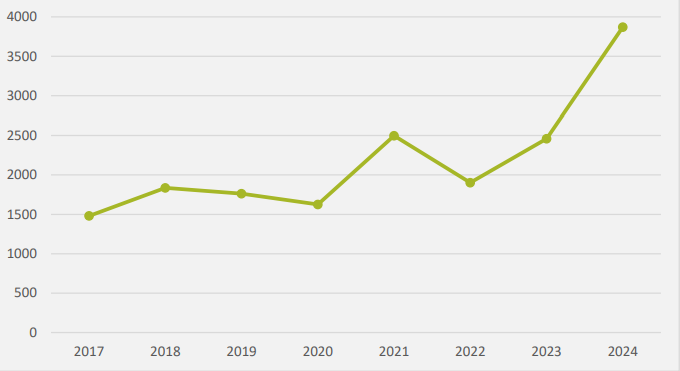
Number of Reports for the Years 2017–2024
Cross-border financial activity also rose sharply, with MOKAS receiving 1,369 international reports from EU FIUs—up 39% from the previous year. These mostly involve FinTech companies operating under EU passporting rights.
Despite the volume, many of these reports do not concern entities physically present in Cyprus. Nonetheless, under EU rules, MOKAS is responsible for relaying these reports to the appropriate jurisdictions.
-
Traditional banks filed 676 reports in 2024, a 44% increase year-over-year.
-
Electronic money institutions submitted 370 reports.
-
Investment firms and money transfer services submitted 347 and 152 reports respectively.
-
The gambling sector saw a notable decline, from 117 reports in 2023 to 84 in 2024.
At the lower end of the spectrum, lawyers (26 reports) and accountants (19 reports) showed limited engagement, with the latter continuing a downward trend.

Operational effectiveness also improved. In 2024, MOKAS transmitted 132 intelligence files to the police for further investigation and responded to 129 additional police requests. The agency also processed over 1,300 cross-border data exchanges and initiated asset freezing measures totalling over €8 million—more than in any previous year.
“These efforts mark tangible progress in stripping criminals of their illegal gains,” said Antoniou. She emphasized that depriving offenders of financial benefit is not only punitive but also essential for curbing repeat offenses and deterring the infiltration of criminal funds into the legitimate economy.
MOKAS highlighted the successful launch of a new public-private partnership pilot initiative focused on analyzing complex international money laundering schemes. The first strategic analysis report, titled Complex International Money Laundering, was developed collaboratively by MOKAS, Cypriot banks, and law enforcement agencies.
Additionally, the unit launched a dedicated department for crypto-assets and financial technology, which has already been involved in investigating several cases involving peer-to-peer transactions, crypto exchanges, and asset concealment via digital wallets.
MOKAS is preparing for the implementation of the EU’s Regulation 2024/1624 and the establishment of the European Anti-Money Laundering Authority (AMLA), set to become operational by 2027. These changes are expected to expand due diligence requirements and tighten oversight over high-risk sectors, including crypto platforms and investment migration agents.