Cyprus Cities Are Heating Up Fast
A decade of satellite data shows rapid urbanisation is intensifying heat-island effects across Cyprus.
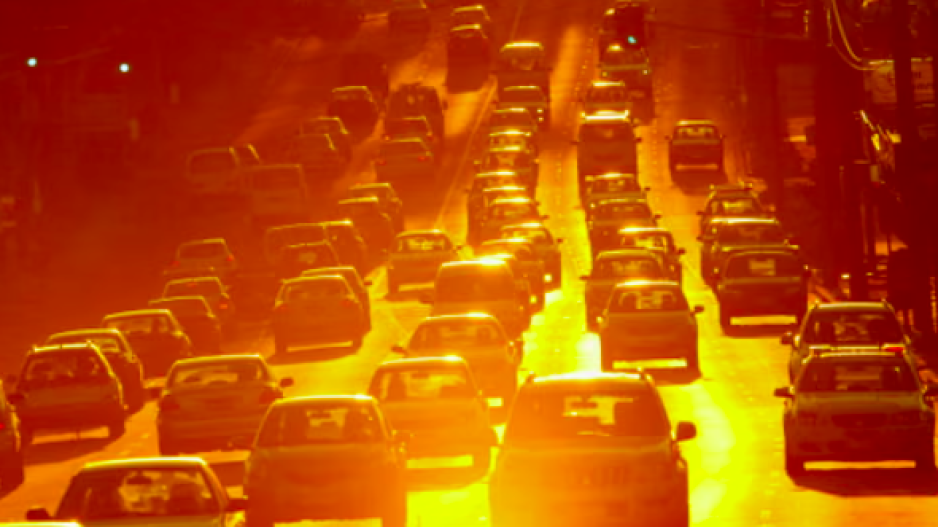
Cyprus’ largest cities are experiencing increasingly severe Urban Heat Island effects, according to a new study that analysed a decade’s worth of satellite data. The research, carried out by the Cyprus University of Technology and the Eratosthenes Centre of Excellence, used NASA’s Landsat-8 imagery through Google Earth Engine to assess temperature and vegetation patterns across Nicosia, Limassol, Larnaca and Paphos between 2013 and 2023.
The study shows that as urbanisation expanded and vegetation declined, surface temperatures in city centres rose noticeably compared to surrounding rural areas. The authors note that Cyprus’ rapid development over the past 35 years—combined with its semi-arid Mediterranean climate—has intensified the conditions that typically drive Urban Heat Island (UHI) formation, including the replacement of natural surfaces with asphalt, concrete and other heat-absorbing materials.
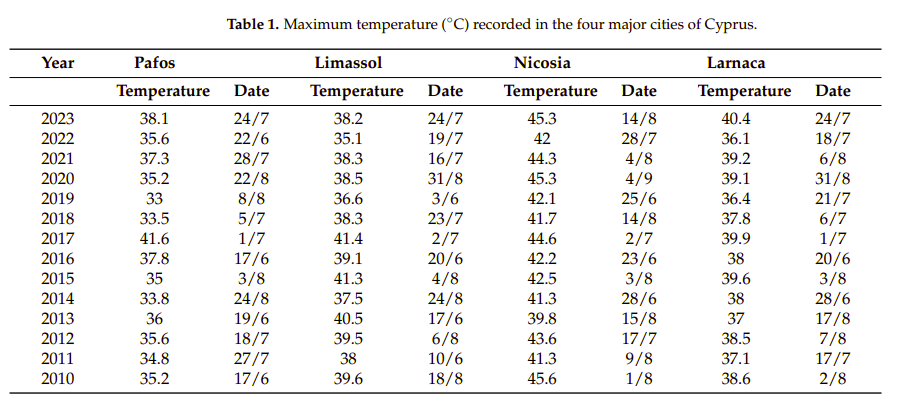
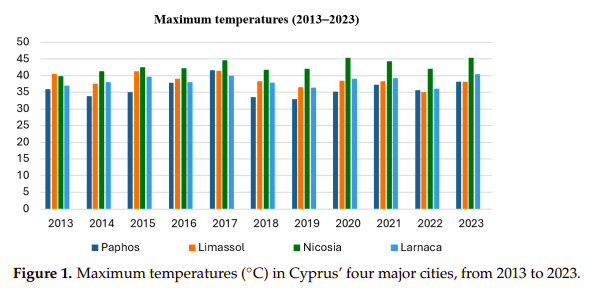
Nicosia recorded the highest maximum air temperatures over the study period, with several years exceeding 44°C and a peak of 45.3°C. Limassol and Paphos also showed consistently high summer maxima, while Larnaca remained the coolest of the four cities, though still following an upward trend.
The satellite analysis revealed that UHI intensity varied across cities and their rural surroundings. Limassol’s rural areas exhibited the weakest UHI behaviour, while Paphos and Larnaca showed more fluctuations, both reaching lower UHI levels in 2023. Nicosia’s rural areas, however, displayed the most pronounced UHI intensification across the decade.
A key finding of the research is the strong negative correlation between vegetation cover—measured through NDVI and Fraction of Vegetation Cover (FVC)—and heat intensity indicators such as UHI and the Urban Thermal Field Variance Index (UTFVI). According to the study, reduced vegetation in both city centres and rural zones is consistently linked with higher thermal stress and more intense heat-island conditions.
In their concluding remarks, the authors state that the loss of green spaces in urban centres and the urbanisation of rural areas are contributing directly to intensified UHI events in Cyprus, alongside a clear increase in UTFVI values. They note that understanding these relationships is essential for analysing how land-use changes affect local climate conditions.