Political Parties Remain Silent on the Attack on Giorgos Gavriel’s Family – A Timeline of the Case
How online outrage, far-right discourse, and political inaction preceded a violent attack.
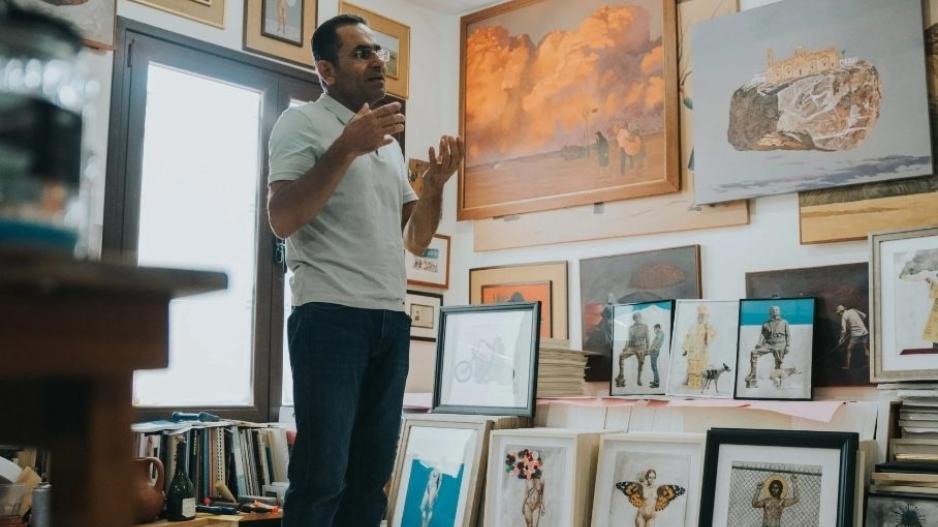
The explosive attack on the home of Cypriot painter Giorgos Gavriel has sharply escalated a controversy that began days earlier with political statements and online outrage — and has now met with a striking silence from most of Cyprus’ parliamentary parties.
On Thursday evening, unknown perpetrators on a motorcycle threw what police believe were improvised explosive devices at Gavriel’s residence in Kokkino Trimithia. The explosions occurred on the balcony and courtyard area of the house while the artist, his wife, children and grandchildren were inside. No one was injured, but material damage was caused and the incident triggered panic among the family.
The case is being investigated by the Nicosia Criminal Investigation Department. Police are examining CCTV footage from the surrounding area and have taken written testimony from the artist. According to police sources, investigators are focusing on threats made against Gavriel in recent days through social media, while increased protective measures have been put in place for him and his family.
The attack did not occur in a vacuum. It followed a week of escalating intimidation that began online, moved into a gallery space, and ultimately culminated in violence.
Gavriel’s exhibition Antisystemic Art was scheduled to open at Blue Iris Gallery in Paphos on December 13. In the days leading up to the opening, nationalist and far-right circles began circulating posts targeting the artist, following a video published by an ELAM parliamentary candidate using extreme language against the exhibition.
On opening night, a group of young individuals entered the gallery and removed several artworks, later returning them. During the same period, the gallery owner reportedly received threats to his life and property. The exhibition was cancelled a day later, amid fears for safety.
The controversy then entered the political arena. Within minutes of each other, DISY deputy leader Efthymios Diplaros and ELAM spokesperson Marios Pelekanos published strongly worded posts attacking the exhibition. Diplaros’ post included a collage image portraying multiple artworks as a single piece — later confirmed by FactCheckCyprus to be a fabricated image originating from a nationalist Facebook page known for content ranging from anti-vaccine narratives to pro-Putin and pro-ELAM positions, with a heavy emphasis on the military, and anti-migration rhetoric.
Despite the revelation, no apology or retraction followed. Instead, Diplaros returned with a new post arguing that the individual works were “even worse”.
In the days that followed, DISY, DIKO, EDEK and DIPA issued statements condemning the artworks as “blasphemous”.
Following the attack on Gavriel’s home, only two parliamentary forces issued clear condemnations: AKEL and Volt.
AKEL General Secretary Stefanos Stefanou described the attack as “an extension of organised fanaticism cultivated systematically within society, legitimised by far-right political discourse and encouraged, directly or indirectly, by public figures who invest in fear, division and hatred”.
“When intolerance becomes normalised, it inevitably turns into violence,” Stefanou said, warning that democracy cannot exist without freedom of expression and pluralism. He called on the government and political parties to take a clear stand against fanaticism and fascism.
Volt went further, explicitly linking the climate that preceded the attack to specific political actors. In its statement, the party argued that the “moral instigators” are those who “lit the fuse of hatred through public statements and collages”, naming ELAM, DISY — with specific reference to Diplaros — and centre parties that chose to normalise the same rhetoric.
Two additional parties later issued statements condemning the attack. DIPA described the use of explosive devices at Gavriel’s home as an unacceptable and dangerous act that endangers lives and undermines the rule of law, stressing that artistic disagreement must never be expressed through violence or intimidation. The Greens also strongly condemned the attack, stating that the use of explosives — even stun-type devices — crosses every boundary in a democratic society.
By contrast, all other parliamentary parties have not condemned the act of violence against the artist’s home, where children were present at the time of the explosion.
As of today, the government, the Ministry of Education and the Deputy Ministry of Culture have not issued any public statement.