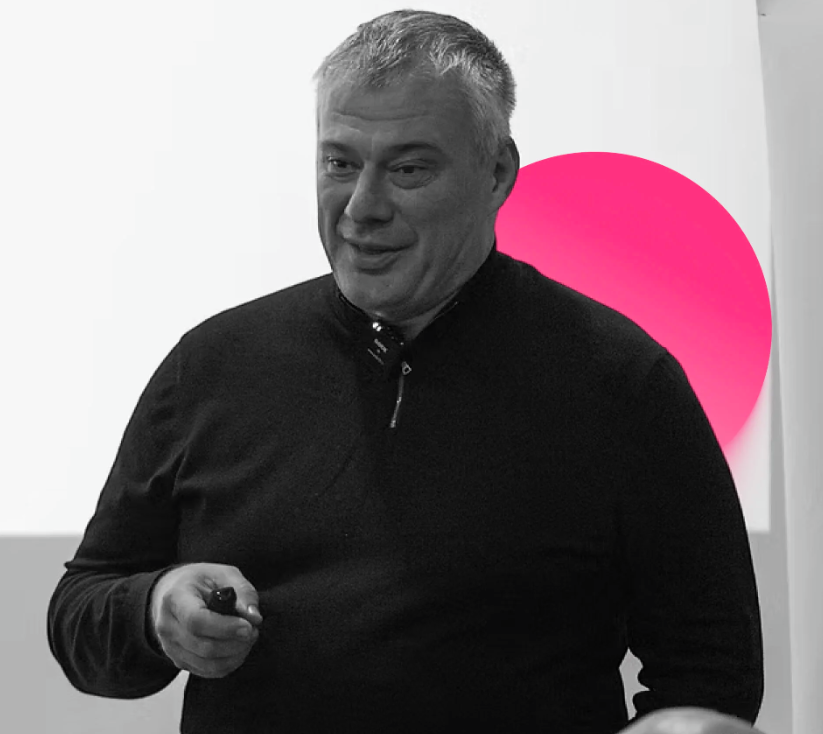
Andrey Kostyuk: “The Most Harmful Myth Is That Startups Make You Rich Fast”
The head of AAlchemy Ventures and Founder Institute Cyprus explains how angel investors think, why Cyprus is underestimated, and what founders consistently get wrong.

From building a neobank long before the term existed to backing early-stage founders across Europe and North America, Andrey Kostyuk has spent more than three decades moving between entrepreneurship, finance, academia, and venture investing. Today, as General Partner and CEO of AAlchemy Ventures and head of Founder Institute Cyprus, he operates at the intersection of founders and capital, helping startups navigate their earliest — and riskiest — stages of growth.
Speaking to FastForward, Kostyuk speaks candidly about what angel investors really look for when data is scarce, why Cyprus remains one of the EU’s most under-recognised startup gateways, and why small markets can be an advantage rather than a limitation. He also challenges persistent myths around venture capital, explains why startups must think globally from day one, and outlines what policymakers often get wrong when designing startup support schemes.

Actually, not at all. Moreover, I recently put back my founder’s hat again - I have been building Mentormatic, a mentoring and coaching platform, for over a year now.
Contrary to VCs, we have to make investment decisions without much company data available
I would argue that for business angels like myself, who invest in pre-revenue or early revenue startups, operator’s or founder’s experience is a major advantage. Contrary to VCs, we have to make investment decisions without much company data available - we rely on evaluating the team, predictive analytics of competitive landscape, and go-to-market strategy. Team quality plays a key role in our deliberations, and angel’s first-hand experience of building and managing teams is simply indispensable.
Mentoring experience significantly improves this capacity. If you do it a lot, you see most of the situations which could go wrong with the team, as well as great examples of cohesive collaborative work. It considerably sharpens your forecasting capacity, making it yet another reason for an angel investor to mentor founders.
I had been arguing since 2017, if not earlier, that Cyprus has a lot of components required to build a first-class startup ecosystem:
-
Common law, inherited from UK, which works much better for startups than continental one,
-
Advanced well-developed higher education system, number of research institutions,
-
Light taxation, both on corporate and personal level, IP Box regime, extensive network of double-tax treaties,
-
Opportunities to employ qualified third-party nationals,
-
Access to EU funding.
Missing from the picture were general public awareness of the startup economy and, consequently, lack of private funding and expertise. These two components are being addressed effectively as we speak, which is confirmed by the recent Cyprus accent in the rankings of innovative economies and startup ecosystems.
Cyprus is a great place for any foreign founder to start business in the EU, and this is its underdeveloped and underrecognised strength. We are working hard to make it visible for the outer world, so that the country benefits as it deserves.
The answer to this question lies in a definition of a startup - in how a startup is different from a new small business. Startups are about growth, and they are built for exit, classic businesses are about profit, and they are built to be owned. It is oversimplification, of course: startups need to make money, and traditional businesses need to grow and may well be sold, but the general idea is just that.
If you’re building only for the local market, that’s fine — just don’t approach VCs, it would be a waste of everybody’s time
VCs care way less about how much money you are making than whether your valuation can increase 100 times over three years, and this is chiseled into their business model - they invest other people money in risky asset class, so they need to provide high returns, while they know that 8 to 9 out of each 10 companies in their portfolio will either go bankrupt or perform sluggishly. So they bet on stars, who will pay for everything at the end of the day.
The way the game is set, a startup has no other option than to have a global mindset from day one, and being born in a small market is a blessing in disguise in this regard. If you don’t - it’s not a problem per se, it would just mean that you build a traditional business for your local market, which is a totally valid model. Just don’t approach VCs with that, it would be a waste of everybody’s time.
Two or three factors are not nearly enough when we speak about such a complex thing as a country's startup ecosystem, it’s rather twenty or thirty. But the main cornerstones of sound policies would be as following:
1. Let investors inform and shape the government's investment policy - professional market players know way better what constitutes a smart investment. Design co-investment policies directing funding to where market players invest themselves, and make them always have skin in the game.
2. Promote entrepreneurship as a sound and even noble career choice for students, faculty, and corporate employees: focus on knowledge transfer, seed funding, and emotional soft landing for those who didn’t succeed - the failed entrepreneurs should not be stigmatised but encouraged to try again. It is a shame to waste their expensive experience.
Encourage and promote commercialisation of IP developed by government-owned or funded research institutions - this is a notoriously difficult task, and today a lot of public funding used for research sits idle, which does not sound too smart, does it?
Founder Institute is a global early-stage acceleration program present in 100+ countries and 200+ cities, with over 35000 registered mentors. Technically speaking, designing an acceleration program is not too difficult - anyone can check out the best programs out there and copy-paste their curriculum. The difference begins with who will be delivering the course, continues with what kind of investors will be present at the demo day, and ends with what kind of post-program support is available.
As you can see, the difference is in the networking capability of the accelerator. No local player can compete with that, and if we recall the definition of a startup, here is the catch: global players open global markets, local players stay local.
The Founder Institute opens the whole world to its alumni - effectively, whenever you want to go and whatever you want to do, they can provide necessary resources to build upon.
That said, it’s not a magic wand. The curriculum is tough, quite a lot of applicants fail because of the demanding schedule, volume of information to process, and tasks to complete. To benefit, you need to work really hard and smart. But there is a reward at the end of this journey as I already said.
We follow an evergreen case-by-case syndicate model for a reason: this setup is truly countercyclical. As we invest in early-stage startups, our investment horizon is long, 7 to 10 years, which means that we will inevitably face one or two downward economic cycles with each of our investments; and we can weather it better without being forced to invest or divest at improper time.
This is an achilles heel of traditional VCs - when you raise a fund, you have four years to invest, four years to divest, two years to extend. If you invested when the market was down and divested when the market was up - you are a king, but let God have mercy for you if you did it the other way around.
That said, for us it is important not to fall victim to herd syndrome and to take our own investment decisions, benefitting from the flexibility of our model. We have another embedded circuit breaker - as we syndicate case-by-case, our members take their own investment decisions after listening to the arguments of the executive team, and in many cases our members are subject-matter experts in the field where a target startup operates. This is a great source of wisdom, and a great validation when such an expert puts his or her money in, providing our network an additional layer of comfort.
I think the most harmful myth is that building a startup is a way to get rich fast. It’s definitely not. There are always cases of blind luck, which people generalise instead of seeing them for what they truly are - massive outliers. Highly improbable events occur - but very rarely, it’s the two sides of the same coin.
Succeeding in the startup game as a founder will require 10+ years of absolute commitment, laser focus and perseverance
Succeeding in the startup game as a founder will require 10+ years of absolute commitment, laser focus and perseverance (there are talks that AI will accelerate it, but it remains to be proven). As your success lies in your company being acquired, you’ll need to build something truly valuable for others - so valuable, that they will decide to invest in you, and finally buy your business, not hundreds or even thousands of other opportunities they see around them literally every day. You’ll have to consistently be better than most, at the top 0,01% or less of people playing the same game as you - it’s kind of getting accepted to Harvard or Stanford, not once but ten times in a row.
Does it sound like an easy game to play?
Do that if you enjoy what you are doing, if your customers are happy with your product, then money will come. But do not expect easy cash anytime soon.