breakpoint: Dr. Marinos Soteriou on Redefining Cardiac Care in Cyprus
Season 1, Epsidode 4: From Surgeon to System Builder: How
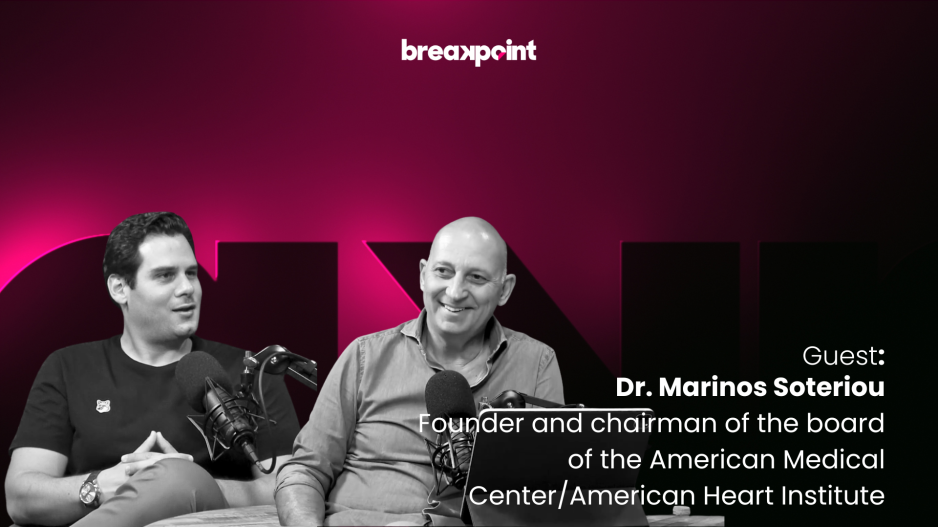
When I invited Dr. Marinos Soteriou onto my podcast, I wasn’t just curious about his career — I wanted to understand the decision-making behind one of the boldest moves in Cyprus’ healthcare history. What I got was a masterclass in conviction, calculated risk-taking, and redefining what’s possible within institutional limits.
We sat across from each other in the studio — modest, unconventional, nothing like the surgical precision of the operating room — and yet, his presence grounded the space. “This is my first podcast,” he told me with a half-smile. “I’m not sure I have much to say.” By the end of our conversation, it was clear he had already said what so many policymakers, founders, and professionals needed to hear.
Choosing Cyprus Over Comfort
Dr. Soteriou could have stayed in the United States. After all, he spent over 15 years between Switzerland and Nashville, Tennessee, building his expertise in cardiac surgery at world-class institutions like Vanderbilt. But home tugged at him. “It wasn’t planned,” he admitted. “We just wanted to come back and practice medicine. That was all.” And yet, his return would spark one of the most transformative journeys in Cypriot private healthcare.
Returning meant starting from scratch. No hospital wanted to invest in two relatively young doctors with no track record on the island. At best, they were politely dismissed. At worst, outright ignored. But instead of folding, Soteriou and his partner made a critical decision: they would create the infrastructure themselves.
That’s how the American Heart Institute was born — not as a grand vision, but as a necessity. What followed was years of slow, steady credibility building. And eventually, the gamble paid off. Patients started coming. The public sector came knocking. And the old belief — that serious cardiac care required flying abroad — began to fade.
Reconciling Medicine with Business
When I asked Dr. Soteriou whether he ever set out to become an entrepreneur, his response was instant. “Not at all. Doctors are trained to heal, not to monetize.” But he also recognized a truth that most healthcare systems still struggle with: modern medicine requires serious investment in infrastructure, technology, and human capital. “You either learn how to build systems, or you become dependent on someone else’s.”
That awareness became even more pressing when the Institute outgrew its original facility. He faced another turning point: stay small and stable, or scale up and build something Cyprus hadn’t seen before. He chose the latter — and took on financial exposure that most would walk away from.
The new campus would evolve into the American Medical Center, a hub designed not just for care but for experience — a fusion of clinical excellence and patient hospitality, built with longevity in mind. “We didn’t just want to survive,” he told me. “We wanted to offer something future generations could build on.”
Policy, Populism, and the Pain of Progress
In our discussion, we turned to Cyprus’ national healthcare system (GESY), the role of the public sector, and the challenges of attracting investment in a small market. Here, Dr. Soteriou was candid. “You can’t expect quality care while demonizing profit,” he said, referencing an article he had recently published. “The idea that healthcare should be altruistic and investment-free is dangerous.”
His critique wasn’t aimed at ideology, but at execution. Poorly coordinated regulations, inconsistent subsidies, and a bloated public sector often undermine the very outcomes they aim to protect. “We’ve seen reforms stall because the system favors the status quo. But health doesn’t wait.”
When I asked him what he would say to policymakers, his answer was equal parts visionary and practical: eliminate the obsession with populism, and make bureaucracy work faster. “We need leaders willing to do what’s right even if it costs them politically,” he said, invoking the courage of Jimmy Carter during America’s inflation crisis. “Without that kind of sacrifice, no real change happens.”
The Legacy Question
Our final exchange was more personal. What comes next? After decades building an institution, what does succession look like?
“We’re planning to expand to Limassol,” he told me. “But the bigger goal is continuity. We want this organization to outlive us.” For a man who started without any entrepreneurial ambition, the idea of legacy has clearly taken root. And it’s not about ego — it’s about building structures that last beyond individuals.
His final advice to young professionals? Be fully engaged in what you do — or don’t do it at all. “Success is rarely about talent. It’s about sustained attention, positive energy, and being present with your work — like a farmer watching over his crops every single day.”
It’s a metaphor that stuck with me. In a world chasing quick wins and instant validation, Dr. Soteriou’s story is a reminder that true transformation takes time — and that sometimes, the most disruptive thing you can do is simply stay.