Cypriot Ballot Box Reshapes Politics and Reflects Society
The Ballot Box Kept DISY Upright and Showed How Much Society Has Changed
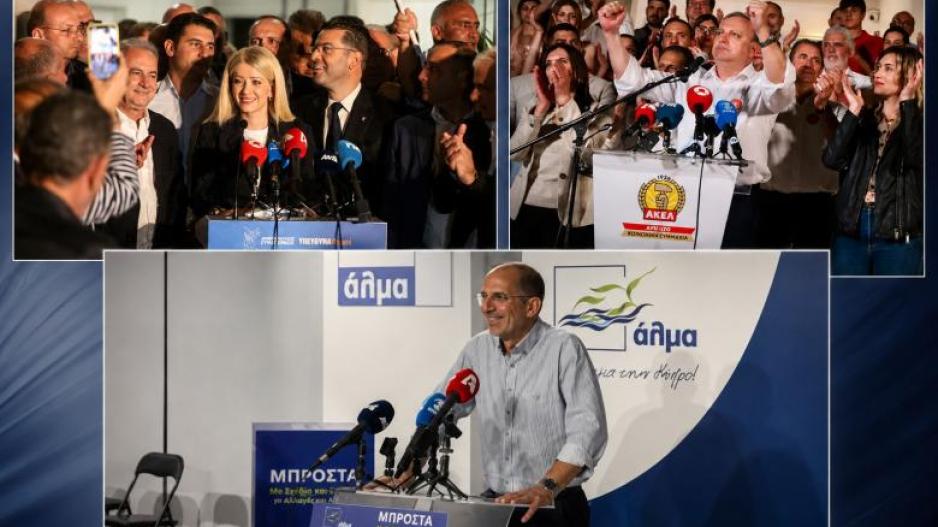
The 2026 parliamentary elections ended very differently from what the political system expected just a few months ago. The pre-election climate pointed toward a night of severe weakening for the major parties, an explosive rise of new formations, and generalized upheaval.
None of this happened to the extent predicted. Anyone present at party headquarters on Sunday night could easily see that the initial feeling almost everywhere was relief rather than triumph. Relief in DISY because it avoided a major electoral wound. Relief in AKEL because, after many years, its continuous decline finally stopped. Relief in DIKO because it escaped a result that seemed much more dangerous a few weeks ago. Society sent a message of dissatisfaction, but not of dissolution.
The Democratic Rally (DISY) emerges politically upright from this contest. From 27.9% in 2021, it went to 27.1%, losing just 0.8%. For months, however, an image was built of a party at risk of hitting historically low percentages. Within DISY, some seriously envisioned the possibility of the party dropping close to 22% or 23%.
Ultimately, the ballot box said otherwise. At Pindarou (DISY HQ), the mood began to change quite early. Not with celebrations, but rather with that silent relief that comes when you realize the damage you feared never arrived. The results from Nicosia played a major role in this.
DISY clearly held onto first place, maintained its 17 seats, and proved once again that when politically pressed, it still possesses the deepest party machinery in Cyprus. Yet, the picture is not entirely cloudless. A portion of the party’s traditional base believes that the Rally has lost some of the political self-confidence it once held in recent years. At several moments, it appeared defensive, overly cautious, and almost fearful of difficult issues. The center-right electorate wants seriousness and institutional discourse, but it also wants straight talk. Migration, security, and the feeling that daily life is increasingly squeezing the average citizen played a role in this discussion.
AKEL recorded its most significant success in fifteen years. From 22.3% in 2021, it rose to 23.9%, marking its first substantial electoral increase after a very long period of continuous attrition. This is no small feat.
After 2013, many believed the party had entered a path of permanent retreat. The ballot box showed that AKEL remains much more resilient than even its political opponents calculated. High prices, pressure on the middle class, rents, and daily exhaustion gave the party space to speak on social issues in a way that resonated. The political dynamics did not shift radically—DISY remains first by a clear margin—but AKEL stopped looking like a party on the defensive.
At DIKO, as the night progressed, it became increasingly clear that the result was better than many within the party itself expected. From 11.3% in 2021, it found itself at 10%, losing about 1.3%. Opinion polls in recent weeks had created a much heavier atmosphere. There was a real fear that the logic of a "wasted vote" would trigger a mass flight from the center. The absence of Marios Garoyian from the ballot also stripped away a portion of the party's cohesion and organizational mobilization.
Despite the pressure, DIKO endured much better than many had predicted. This carries political weight because it now essentially stands as the only traditional force of the intermediate center space with a clear parliamentary presence.
EDEK was left out of Parliament for the first time in its history. Falling from 6.7% to 3.3%, this is a heavy result. For those who grew up politically in different eras, the scene on Sunday night held a certain sadness. EDEK was a piece of the country's political history for decades. In recent years, however, it looked tired. Introversion, continuous conflicts, an inability to renew itself, and a political discourse that often seemed trapped in the past took their toll.
DIPA was also left out of Parliament with 3.1%. The negative climate in the polls visibly affected the party in the final stretch of the campaign. For many voters, the logic that a vote for DIPA would unlikely translate into parliamentary presence took hold. Without Marios Garoyian as a candidate, the party also lost a portion of its political weight and organizational momentum.
ELAM is now a regular player in the political system. Rising from 6.8% in 2021 to 10.9%, it went from four seats to eight. Anyone who dismisses this rise as a simple protest vote will be making a serious mistake. There is a segment of society that believes the major parties avoid speaking clearly on issues of security, migration, and national identity. ELAM found its space there.
ALMA entered Parliament with 5.8%, a figure significantly lower than the momentum shown in certain polls a few weeks before the elections. The reality is simple: without Irene Charalambidou, the party would have struggled to see the inside of Parliament. Her personal influence, particularly in Nicosia, essentially kept the venture afloat during a period when ALMA's initial momentum was visibly deflating.
The case of Fidias Panayiotou is of particular interest. Securing 5.4% and entry into Parliament is a political event. However, anyone comparing the final outcome to the noise that existed for months on social media can easily see that the landing was abrupt. For a long time, an image of a political wave was generated. Real society proved more cautious than TikTok.
Fidias managed to express anger, disappointment, and an intense anti-establishment sentiment, particularly among younger ages. But that was its limit. The ballot box also showed the boundaries of a politics based almost exclusively on image, online influence, and the rejection of the political system without clear political positions. Society gave him space; it did not give him a blank check.
VOLT believed more than it should have in the momentum it was seeing on social media. For a while, the impression was truly created that entering Parliament was within reach. From the moment the Sandy story broke, the party lost a large part of the "clean, new political space" image it was trying to build. The damage proved greater than many within VOLT believed.
The Greens paid the price for years of low visibility and political inertia. Dropping from 4.5% to 2%, they found themselves sidelined. At a time when environmental issues are steadily rising across Europe, in Cyprus they seemed almost entirely absent from public debate.
The new Parliament will be a difficult one. Society is tired. This is now visible everywhere: in the way people vote, the way they listen, and the way they treat parties and politicians. The ballot box did not dismantle the political system, but it clearly showed that the old relationship of trust with society has begun to erode much more deeply than many within the political personnel care to admit. Whether they have truly understood this will become apparent very soon.