Cyprus and Greece Coordinate on EU Council Presidencies and Cyprus Issue
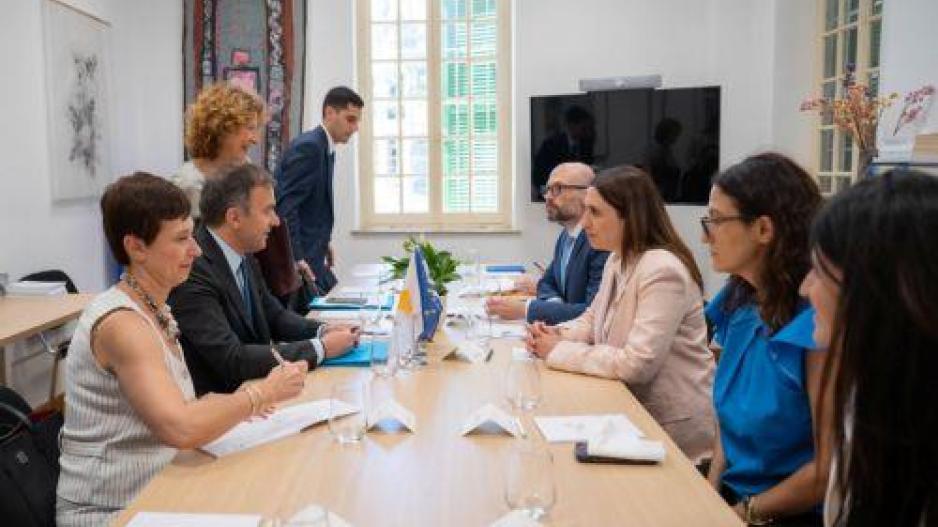
Following the completion of the Cyprus EU Council Presidency, Deputy Minister Marilena Raouna met Greece's new Deputy Foreign Minister Tasos Chatzivasileiou to discuss strategic cooperation ahead of Greece's 2027 presidency and reiterate absolute alignment against a two-state Cyprus solution.
Handing Over the Trio Presidency Cycle
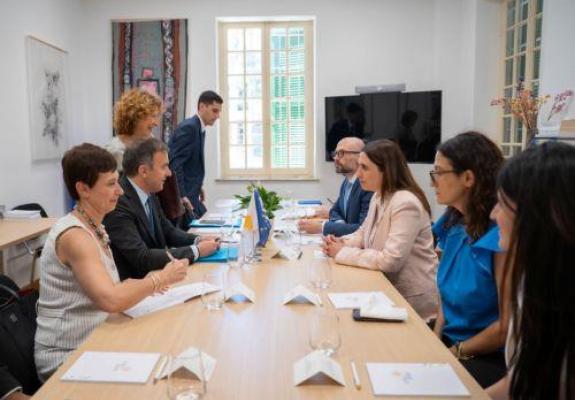
The completion of the Cyprus Presidency of the Council of the EU, priorities on the European agenda, preparations for the Greek Presidency in 2027, and the Cyprus issue were at the centre of a meeting held in Nicosia between Deputy Minister for European Affairs Marilena Raouna and Greece's newly appointed Deputy Foreign Minister for European Affairs, Tasos Chatzivasileiou.
Welcoming Chatzivasileiou to the Secretariat of the Cyprus Presidency, Raouna congratulated him on assuming his new duties and thanked Greece for its support throughout the Cyprus Presidency. She noted that the Cyprus Presidency leaves a tangible legacy across all policy areas, under its central message of a European Union that is more strategically autonomous and open to the world.
Raouna also pointed out that, with the conclusion of the Cyprus Presidency, a new Trio Presidency cycle of the Council of the EU begins, with Greece assuming the Presidency in the second half of 2027. She assured him that the Republic of Cyprus will be available to provide every possible support during its preparations, just as Greece had done throughout the Cyprus Presidency. At the same time, she said the two sides would discuss issues high on the European agenda, both in light of the Presidency that has just concluded and within the framework of the continuous coordination and dialogue between Cyprus and Greece.
Greece Commends a Resilient and Effective Presidency
For his part, Chatzivasileiou conveyed the congratulations of Greek Prime Minister Kyriakos Mitsotakis and Minister of Foreign Affairs George Gerapetritis on what he described as an "extremely successful" Cyprus Presidency, which, he said, had been planned and organised under the guidance of President Nikos Christodoulides.
He said that, from Greece's perspective, the Cyprus Presidency proved above all to be resilient, as despite developments in the region and the outbreak of a new war in Europe's neighbourhood, it maintained its course and successfully completed its work. He also described the Presidency as effective, highlighting the large number of trilogue negotiations between the Council and the European Parliament, as well as the numerous documents and legislative texts concluded during its six-month term.
The Greek Deputy Foreign Minister further said that the Cyprus Presidency had been substantive, noting progress on key European issues, including financial support for Ukraine, the new package of sanctions against Russia, the advancement of discussions on the Multiannual Financial Framework, and the launch of discussions on Article 42.7 of the Treaty on European Union concerning mutual defence assistance. Referring to relations between Athens and Nicosia, he expressed his expectation that close cooperation would continue in preparation for the Greek Presidency, stressing that the two countries would remain closely coordinated on all major European dossiers.
Cyprus Issue Remains a Top Foreign Policy Priority
The Greek Deputy Minister also reiterated that the Cyprus issue remains a top priority of his country's foreign policy, stressing the need to continue efforts to resume negotiations under the auspices of the United Nations and its Secretary-General.
He reiterated that the objective remains to end the Turkish occupation and achieve a just settlement based on a bizonal, bicommunal federation, stressing that, for Greece, "any discussion of a two-state solution is unacceptable." Concluding, he reaffirmed that Greece will continue to stand firmly by the Republic of Cyprus and the Greek Cypriot people.