AI Legal Platform Flagged Search Warrant Concerns Before Supreme Court Decision
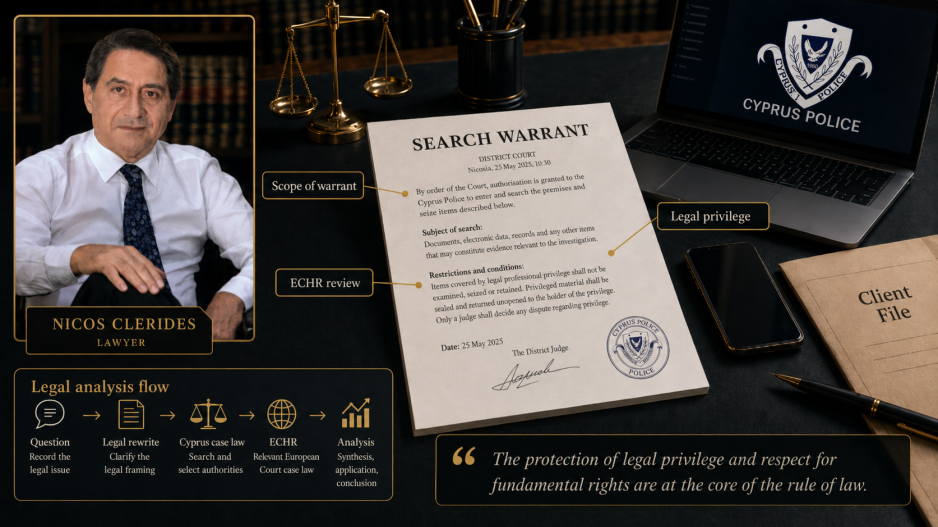
A new artificial intelligence legal research platform had already identified concerns around the general and vague grounds of the police search at the home and office of lawyer Nicos Clerides, before the Supreme Court issued its decision.
The Supreme Court ruled today that there is an “arguable case” concerning the legality of the search warrant in the case involving lawyer Nicos Clerides, referring to general and vague descriptions of evidence, as well as issues relating to legal professional privilege.
What makes the development particularly noteworthy is that the same core legal issues had already been identified, before the Court’s decision, by EasyLawCy, a new artificial intelligence platform that uses Cyprus legislation, case law and judicial precedent to analyse complex legal questions.
Today’s decision by the Supreme Court in the case of lawyer Nicos Clerides is not yet a final ruling on the legality of the search warrant executed at his home and office. It is, however, a significant judicial indication that the issues raised deserve substantive examination.
The Court granted leave to file an application for certiorari seeking to set aside the warrant, finding that there is an arguable case concerning the process by which it was issued. According to information emerging from the proceedings, the Supreme Court identified concerns relating to the vagueness of the evidence described, the sufficiency of the supporting testimony and the possible infringement of legal professional privilege.
What is particularly notable is that these same legal concerns had already been highlighted through a test analysis carried out by EasyLawCy, an AI legal research platform recently made available in Cyprus. The platform can be used both by legal professionals for legal research and case assessment, and by citizens seeking guidance or answers on questions of legality, rights and the application of Cyprus law.
The system was asked to examine a simple but critical question:
When the initial evidence concerns a specific document or communication, can a search warrant extend broadly to mobile phones, electronic devices, professional correspondence and a large volume of digital data?
The answer produced by the system was particularly interesting.
The analysis concluded that the warrant could potentially be considered excessively broad and lacking a sufficiently specific connection to the evidence under investigation, particularly in relation to electronic devices and data that may be protected by legal professional privilege.
It also noted that searches involving law offices require heightened safeguards, precisely because of the risk of access to confidential communications, client files and privileged material.
The importance of this analysis lies in the fact that it did not remain at the level of general or theoretical observations. It drew on Cyprus case law, Supreme Court decisions and European Court of Human Rights jurisprudence, structuring a legal assessment around the proportionality of the warrant, the need for a specific connection between the evidence and the search, the possibility of partially setting aside overly broad terms, and the need for safeguards protecting legal professional privilege.
Among other things, the analysis pointed out that general references to “electronic devices”, without specific supporting justification, often create legal difficulties, especially where the subject of the investigation concerns a limited number of documents or communications.
These appear to be precisely the issues that concerned the Supreme Court today.
This case may represent one of the first instances in Cyprus where a specialised artificial intelligence legal research system identified in advance, with notable accuracy, the core legal risks of a case that would shortly afterwards come before the Supreme Court.
And perhaps this is where the real significance of this technological development lies: not in replacing legal judgment, but in assisting legal professionals and the justice system by helping complex legal issues to be analysed faster, potential weaknesses or excesses to be identified earlier, and the critical questions to be framed at an earlier stage.
Whether this particular case will ultimately lead to the search warrant being set aside is a matter for the Supreme Court to decide at the next stages of the proceedings.
However, today’s development appears to mark something more:
possibly one of the first occasions in Cyprus where an artificial intelligence legal research platform identified, in advance and with notable accuracy, the same legal issues that the Supreme Court would later place under judicial examination.
EasyLawCy is a Cyprus-focused artificial intelligence legal research platform designed to assist with the analysis of Cyprus law, case law, legislation and relevant legal sources. The platform helps users search and assess legal questions by drawing on Cyprus judicial material and related legal authorities, supporting faster and more structured legal research.
EasyLawCy is intended to support, not replace, professional legal judgment. Legal conclusions, strategy and advice remain matters for qualified legal professionals.