AI as Your Co-Pilot: 5 Ways to Active Daily Productivity, Not Passivity
How to Leverage Machine Intelligence to Supercharge Execution Speed Without Falling Into the "Intuition Rust" Trap.
The biggest fear surrounding the rise of Artificial Intelligence is that we will stop thinking for ourselves, that we will become passive consumers of automated systems to navigate our daily lives.
This concern has been given empirical weight by a landmark MIT study titled The Augmentation Trap: AI Productivity and the Cost of Cognitive Offloading, authored by researchers Michael Caosun and Sinan Aral. Their research warns that while outsourcing tasks to AI yields immediate, short-term productivity boosts, habitual or passive reliance over time actively erodes domain judgment and critical human expertise, a phenomenon termed "intuition rust".
To avoid this trap, the key to active productivity is interaction. You don't ask AI to build your life; you use it to supercharge the actions you are already taking. As Microsoft’s large-scale AI and Productivity Report data confirms, when AI is utilized actively as an operational assistant, handling information retrieval and scheduling friction, professionals see a massive acceleration in execution speed without a drop-off in structural quality.
Furthermore, Microsoft's Work Trend Index highlights that top-performing "Frontier Professionals" are highly deliberate about keeping themselves "in the loop," with 43% intentionally doing some work without AI to keep their skills sharp. By driving the reasoning, you protect your biological bandwidth for the creative and dialectic thinking only a human can provide.
Here Are Five Smart, Active Ways to Integrate AI Into Your Daily Routine to Boost Your Output Without Losing Your Edge:

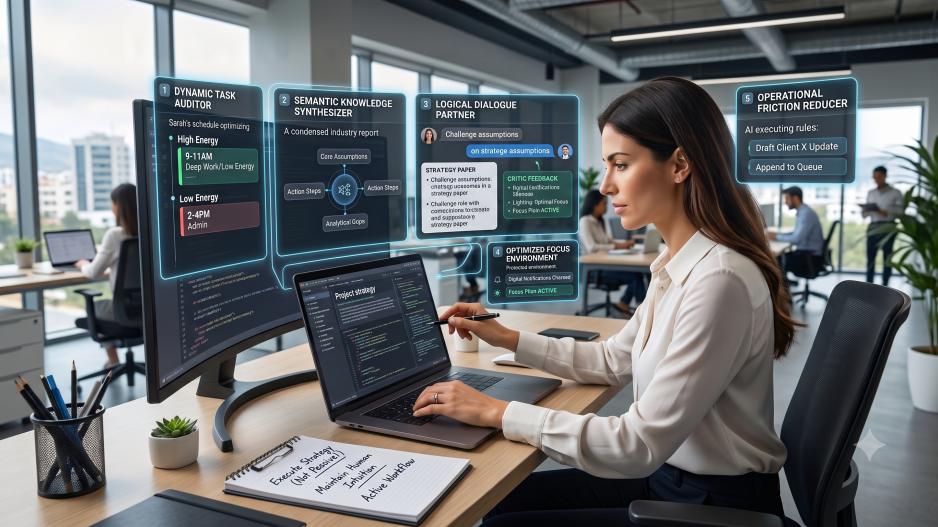
The Dynamic Task Auditor
Instead of letting AI passively write your to-do list, use it as a real-time logical auditor of how you spend your cognitive energy.
-
The Active Workflow:
Input your raw daily tasks along with your expected peak energy windows (e.g., High 9-11 AM, Low 2-4 PM). Instruct the AI to map deep-work priorities strictly to your sharpest hours and bundle minor administrative tasks into your slump windows.
-
The Result:
The AI handles the logistics of energy management, freeing up your mental bandwidth to execute rather than organize.
The Semantic Knowledge Synthesizer
We often become passive when overwhelmed by information drag. AI is masterful at logical synthesis, turning heavy research files into sharp, core logical nodes.
-
The Active Workflow:
Upload a massive industry report or complex transcript and prompt: "Synthesize this document into a series of logical node points. Highlight the core assumptions, the primary action steps, and any potential analytical gaps you detect."
-
The Result:
The AI handles the semantic filtering, allowing you to bypass the reading drag and move immediately into high-level strategy and active execution.
The Logical Dialogue Partner
Passivity thrives in isolation. When you hit a creative or logical wall, use AI not to give you the final answers, but as a rigid logic engine that actively challenges your assumptions.
-
The Active Workflow:
Paste a pitch, article outline, or project proposal into the interface and prompt: "Act as a hyper-skeptical investor/critic. Tear this logic apart. Challenge my core assumptions and point out the weakest links in my argument."
-
The Result:
The AI doesn’t write the pitch for you. It forces you to defend and refine your own ideas, utilizing a machine-driven dialectic to sharpen your critical reasoning.
The Optimized Focus Environment Architect
Maintaining deep work requires protecting your environment from constant micro-distractions. AI can actively manage and optimize your workspace variables.
-
The Active Workflow:
Connect environmental or calendar data and ask the AI to trigger a focus protocol: silencing non-urgent digital notifications, setting room lighting to an optimal color temperature, and streaming background noise frequencies that correlate with your longest blocks of uninterrupted activity.
-
The Result:
The AI manages the mundane variables of your workspace, keeping you locked in an active flow state longer.
The Operational Friction Reducer
The most significant drain on productivity isn't complex problem-solving; it's the repetitive, rules-based micro-tasks that constantly fracture your focus.
-
The Active Workflow:
Define specific rule-based logic strings for the tool to execute. For example: "If an email arrives from Client X regarding Project Y, check my current task status. If completed, draft a standard notification update; if pending, append it to the queue and send a brief holding acknowledgment."
-
The Result:
You retain total ownership over the decision tree. The AI simply executes the routine operational repetition, protecting your high-level bandwidth from death by a thousand administrative cuts.