“Digital Citizen” Shows Gaps and Poorly Documented Costing
What a special report by the Audit Office finds
- Questions over the procedure – No prior joint planning or joint call for tenders
- Delays recorded in the inclusion of documents – Concerns raised by the Auditor General
Lack of sufficient and properly documented costing at the contract stage, particularly regarding the financial management of the “Digital Citizen” project, is among the findings of the Audit Office (AO) in a special report concerning the matter involving the Deputy Ministry of Research, Innovation and Digital Policy.
The report, released earlier today, examines aspects of the award procedure, implementation, and financial management of the project.
According to the report, the choice of this specific procedure, following the implementation of the corresponding Greek project and without prior joint planning and a joint call for tenders by the two states, raises questions as to whether the process upheld the principles of transparency and equal treatment of potential economic operators.
The AO notes that such agreements cannot function as a mechanism for indirectly bypassing public procurement procedures, posing a risk of favorable treatment toward specific economic operators, even though cooperation between member states may bring benefits, mainly through the exchange of know-how.
Regarding the financial aspect, the AO identifies a lack of sufficient and documented costing at the contract stage, as well as limited ability to assess the project’s financial efficiency.
It is noted that a previous attempt to implement a “Digital Wallet” had not been successful.
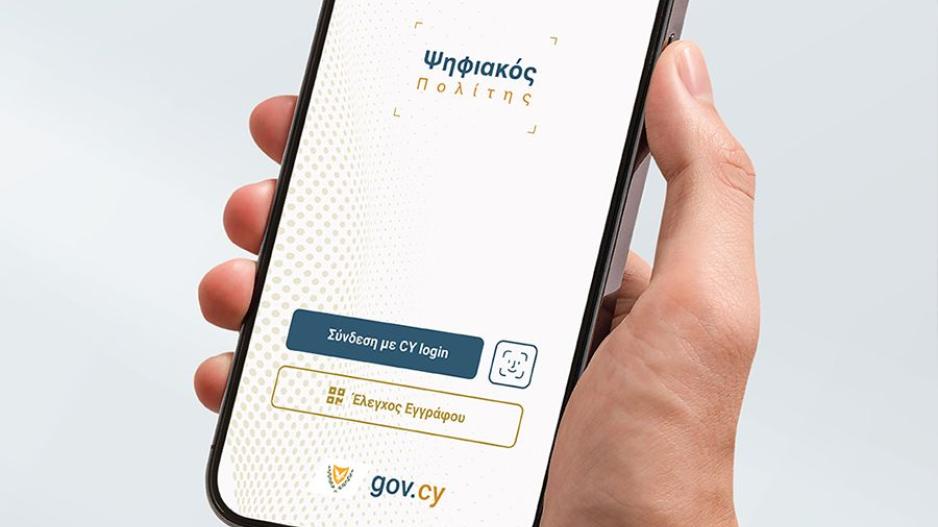
The “Digital Citizen,” according to the AO, constitutes a new approach, also offering interoperability with the corresponding Greek application.
On the positive side, the “Digital Citizen” already includes the identity card, driving licence, vehicle roadworthiness certificate, and fan card.
However, delays have been recorded in the inclusion of the remaining documents.
The project was implemented through a Memorandum of Cooperation and a Contract between the Republic of Cyprus and the Hellenic Republic, with its legal basis deriving from an article of an EU Directive.
Implementation was assigned by the competent Ministry of Greece to the existing private contractor of the corresponding Greek project through a negotiated procedure.
The AO clarifies that it did not have the authority to examine the procedures followed by the competent Ministry in Greece.
The Audit Office notes that although such an approach may provide some speed at the initial stages of implementation, as a “ready-made” solution is applied, over time it may lead to serious rigidity or even disproportionate dependency, since the Republic of Cyprus does not have direct contact with the private contractor.
Governance Issues and Reservations
The sequence of actions, including the commencement of works prior to the signing of the memorandum of cooperation and the contract, as well as the completion of the legality review at a later stage, creates the impression of a predetermined course of implementation, the AO observes.
In his foreword, Andreas Papakonstantinou, Auditor General, expresses reservations and concerns, noting that the Republic of Cyprus will soon be required to implement the European Digital Wallet.
He questions whether the overall effort invested in the implementation of the Digital Citizen, in terms of time and money, will be sufficiently utilized.