How Much Did Cypriot Startups Raise So Far in 2025?
Most of that funding didn’t come from Cyprus, revealing the ecosystem’s biggest gap.

When StartupBlink ranked Cyprus 40th in its Global Startup Ecosystem report, everybody celebrated and cherished the ecosystem’s “development”, as well as our brilliant young minds.
But nobody really knows how many startups are launching in Cyprus. How much funding they receive and where that capital comes from.
That’s because in Cyprus, angel investors fund startups behind closed doors, incubators and grant programs don’t publicly announce their winners immediately, and there’s barely any active and visible venture capital funds.
So over the past month, I manually tracked and analyzed all publicly disclosed equity funding rounds that happened this year. This wasn’t an easy task. Press releases are rare, data is scattered, and many founders still hesitate to share their numbers.
Here are some of the data and the biggest takeaways. Stay tuned for the full list of names and amounts to be published at the end of the year.

In 2025, Cypriot startups raised roughly $77 million across 13 publicly confirmed equity rounds.
The year kicked off with a $500,000 pre-seed round raised by UFarm.Digital, a decentralized finance asset management platform seated in Limassol.
In February, Nodes & Links raised its Series B round of $12 million. Now it’s a bit ambiguous if this round should count as Cypriot, since the company operates from London, but platforms such as Traxcn and Dealroom report it as a Cypriot-raised round.
The two most interesting rounds so far this year are actually the two crowdfunding campaigns by Ask Wire and The Doers Company, through Crowdbase. Ask Wire raised €539,720 (approx. $585,000) from 274 investors, while The Doers Company raised €213,600 (approx. $250,000) from 100 investors.
Besides those two examples where Cypriot investors actually participated, Svelta’s €850,000 (approx. $995,000) angel-backed seed round was the only other funding round that involved Cypriot investors.
The largest round belonged to Aiphoria, a Limassol-based AI company that closed a 34 million dollar strategic investment led by Ratmir Timashev, the US-based co-founder of Veeam. Aiphoria’s raise alone accounts for more than half of all capital deployed in Cyprus this year.
In gaming, Studio 42 and Nice Plans Studio, both based in Limassol, secured multimillion-dollar seed rounds from Play Ventures, GEM Capital, Arcadia Gaming Partners, and the family office Pixeldog.
These two rounds tell us that Cyprus is turning into a serious gaming hub, but the capital comes from Singapore, Finland, and Canada, and not from home.
The data was gathered from a mix of press releases, official filings, media reports, and investor announcements, cross-checked for duplicates and currency conversions. It does not include undisclosed rounds or grants.
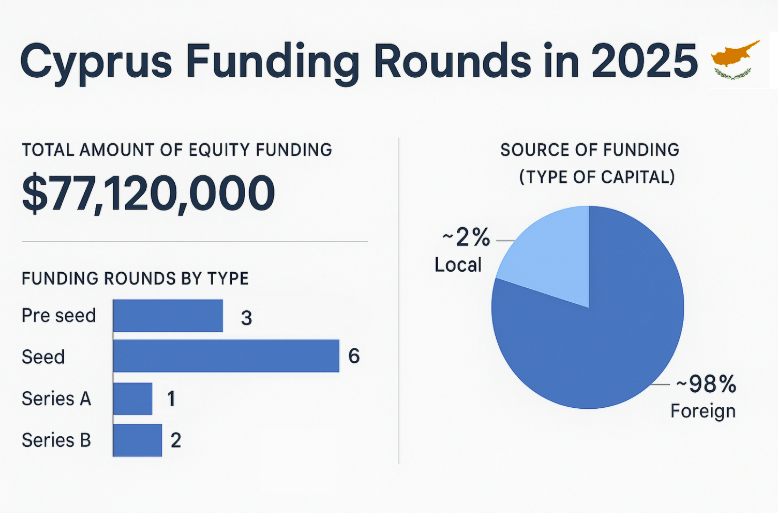
What these rounds reveal is not a lack of talent or traction, but a missing layer of local capital and public reporting. Cyprus has founders, customers, and success stories, but the financial backbone of those stories is still external.
The first and most urgent lesson is about visibility. Many investors, incubators, and even public programs operate quietly. Cheques are written but never announced, grants are awarded without press releases, and founders raise small rounds without publishing them. When activity stays invisible, it might as well not exist. Startups lose signaling power, investors lose reputation capital, and the ecosystem as a whole loses credibility. If we want a stronger base of local conviction, every stakeholder needs to treat transparency as a public good. Announce your investments. Publish your wins. Credit your co-investors. Visibility is what builds trust.
The second lesson is about readiness. Too many Cypriot founders reach a point of traction and then realize they are not structurally ready to raise. Their financial data is scattered, their cap tables messy, their ESOPs undefined. Many don’t have Cyprus-law compatible fundraising documents, so they end up using foreign templates that create legal friction later. This isn’t a question of intelligence or willpower. It’s about missing infrastructure and guidance. With a bit of education and standard documentation, the number of fundable pre-seed companies could easily double.
Third, angels are still in the dark. There are plenty of Cypriots and long-term residents who have the wealth and the appetite to invest in startups, but there’s no organized way to do it. There’s no shared deal-flow, syndicate platforms such as CYBAN are non-profit so they also struggle to remain visible. There’s no real, practical angel education, and tax incentives are locked behind complex requirements. Those who do invest tend to do it quietly, which means nobody else learns from their experience. Bringing these people together in a visible, coordinated network would instantly change how founders experience fundraising. They would know who to approach, how to prepare, and what to expect.
The next problem ha to do with the structure of the industry. Cyprus still has no LP base and barely any domestically domiciled VC funds. Without local general partners and limited partners, the country has no capital engine of its own. That’s why foreign funds lead and price almost every round. Greece faced the same problem before EquiFund, which used EU structural money to seed local VCs. A Cyprus-specific equivalent could do the same, starting small and matching local angel investments 1:1. Even a few million euros in a matching pool could double local participation within a year.
Finally, we need to speak directly to founders. Building from Cyprus takes persistence. The talent pool is small, legal frameworks are complex, and the narrative of local capital scarcity is real. But founders are still doing it. They are still building products, hiring teams, shipping from here. What they need is a real working system that supports them when the grants end and the first big customer arrives. They need local angels who understand risk, transparent reporting, and local institutions that want to be part of the story.
Cyprus is capable of producing companies that attract serious foreign money. That is already a success. The next chapter should be about local conviction. Angels stepping forward, government support toward investors, founders building publicly and policies that keep capital circulating on the island.