What Makes Startup Ecosystems Thrive and Why These Lessons Matter for Cyprus
Global competition for innovation is intensifying. Small countries and island economies, previously recognized for tourism, trade, or services, are now becoming strategic hubs for globally scalable companies. Cyprus is entering this race with strong momentum. AI startups, fintech teams, research-driven companies, and international founders are choosing the island as both a place to live and a base to build.
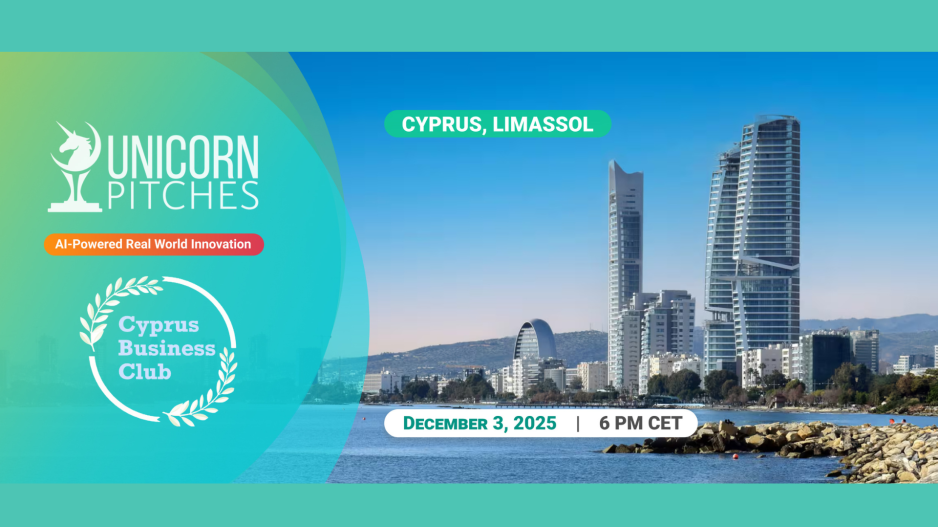
Events such as Unicorn Pitches Limassol, which will bring together innovators and investors from over ten countries this December, signal a larger shift: Cyprus’s innovation ecosystem is now a reality. The key question is how quickly and strategically this ecosystem can grow.
In venture capital, we focus on mechanisms rather than geography. The world’s leading innovation hubs differ in history, culture, and scale, yet they share core principles that drive their success. These universal principles can guide Cyprus as it shapes its trajectory.
Below, we outline five key lessons that define strong innovation ecosystems and explain their relevance for Cyprus today.
Government must act as a catalyst, not just a regulator
In every high-performing innovation economy, the state plays a decisive role by accelerating progress rather than adding bureaucracy. Market forces alone rarely build successful ecosystems. Instead, targeted public instruments reduce early-stage risk and move ideas from research to market.
These mechanisms include competitive innovation grants for early-stage teams, state-supported incubators, co-investment schemes with venture funds, tax incentives for R&D, and programs that help researchers commercialize scientific discoveries. The purpose is always the same: to make it easier for founders to build and for investors to deploy capital.
For Cyprus, this approach translates into the need for a unified innovation body - an institution that can coordinate grants, incubation programs, R&D support, and incentives for both founders and investors. With clear architecture, Cyprus can accelerate the growth of an ecosystem that is already forming organically.
Venture capital must come before the “critical mass” of startups
One of the persistent myths in early ecosystems is that a country needs thousands of startups before attracting venture capital. In reality, the opposite is true. Venture capital must arrive first - because capital creates momentum. When early-stage investors are active, founders take risks, talent joins nascent teams, and the number of companies grows rapidly.
Successful innovation hubs achieved this through early co-investment programs, incentives for angel investors, corporate venture initiatives, and structures that reduce financial risk in the pre-seed and seed stages. Once capital is present, company formation accelerates naturally.
Cyprus has a unique opportunity. The island attracts international entrepreneurs, but its early-stage investment landscape remains fragmented. Introducing mechanisms such as angel tax incentives and co-funding schemes for venture funds would immediately enhance Cyprus’s appeal to founders and investors.
Talent is the engine - everything else is infrastructure
No ecosystem can scale without a strong pool of skilled individuals. Leading startup hubs invest in human capital through robust STEM education, university-industry partnerships, applied research centers, and programs that enable students and young professionals to build companies early in their careers.
The formula is straightforward: more skilled people generate more ideas; more ideas produce more startups; more startups attract more capital; more capital fuels the next generation of talent. It is a cycle, and talent is its beginning.
Cyprus is already well positioned. The island hosts a growing population of international engineers, developers, data scientists, and product builders. Local universities can become research and startup hubs for AI, data science, cybersecurity, and fintech - fields where Cyprus is already active. If these institutions integrate closely with the startup lifecycle, Cyprus could develop one of the region’s strongest talent ecosystems.
Entrepreneurial culture is an environment
In successful innovation hubs, founding a company is seen as an accepted and respected career path. These environments feature rapid communication, a willingness to experiment, openness about failures, and a shared expectation of mutual support.
This culture is built on mentorship, horizontal networks, and the belief that collaboration creates value. Investors know founders personally, founders support each other, and communities foster the connections that lead to products, partnerships, and deals.
Cyprus is currently building exactly this kind of culture. Entrepreneurial communities are forming, industry clubs are gaining influence, and major events are bringing together innovators, CEOs, researchers, and investors. This social infrastructure - the “network effect” of the ecosystem - is one of the strongest signals that Cyprus is on the verge of a significant transformation.
Every ecosystem accelerates when it produces its first “lighthouse” companies
Analysis of mature ecosystems shows that turning points often begin with a few breakthrough companies. These early successes attract talent, prompt investment funds to establish a local presence, and inspire new founders.
Cyprus already has promising candidates for “lighthouse” status, including companies in AI, fintech, blockchain infrastructure, iGaming, and cybersecurity that serve global markets and employ skilled teams. Providing these companies with visibility, support, and pathways to scale can create a ripple effect throughout the ecosystem.
Once an economy has its first global winners, growth accelerates exponentially.
Why now is the right moment for Cyprus
Cyprus holds several advantages that many successful hubs lacked at the start: a mature international business community, an established legal and tax framework, significant global talent inflow, strong geographic positioning, and a diverse tech sector spanning fintech, AI, and digital services.
The island now needs strategic alignment. Coordinated instruments, including early-stage funding support, R&D incentives, and university-industry collaboration, can transform Cyprus from an emerging hub into a recognized center for innovation in Europe and the Eastern Mediterranean.
In venture capital, timing is critical. Cyprus is now entering a phase where its natural strengths, demographic trends, and global interest converge. This is the moment when ecosystems either accelerate or plateau.
Cyprus has the momentum. It has the talent. It has the community. What remains is to amplify these strengths using strategic tools that have proven effective worldwide. If Cyprus seizes this moment, it can build not only a startup ecosystem but a sustainable innovation economy that shapes the next decade.