Cyprus Excels in EU Trade Surge
Leading the Pack with Export Growth
In August 2023, Cyprus led the EU with a staggering 55.2% surge in exports compared to August 2022. Additionally, Cyprus ranked second in the largest increase in extra-EU imports. This data comes courtesy of Eurostat, the EU's statistical service.
The Eurozone showcased a trade surplus of 6.7 billion euros in August 2023, marking a significant turnaround from a deficit of 54.4 billion euros in August 2022. This change was fueled by a 3.9% decrease in exports (amounting to 221.6 billion euros) and a sharp 24.6% decline in imports, which stood at 214.9 billion euros. Moreover, intra-eurozone trade dipped by 13.2% to 189.3 billion euros.
Considering the broader January-August 2023 period, the Eurozone reported an 8.1 billion euro surplus, a commendable recovery from the 242.9 billion euro deficit observed during the same months in 2022. During this period, exports grew by 1.5% while imports dropped by 10.6%.
On the EU front, August 2023 saw a 1.4 billion euro surplus, contrasting with a 66.0 billion euro deficit in August 2022. Extra-EU exports decreased by 4.1% to 198.5 billion euros, and imports plummeted by 27.8% to 197.1 billion euros. Intra-EU trade also experienced a decline, falling 10% to 302.1 billion euros.
From January to August 2023, the EU faced a 9.8 billion euro deficit, an improvement from the 311.4 billion euro deficit recorded in 2022's comparable months.
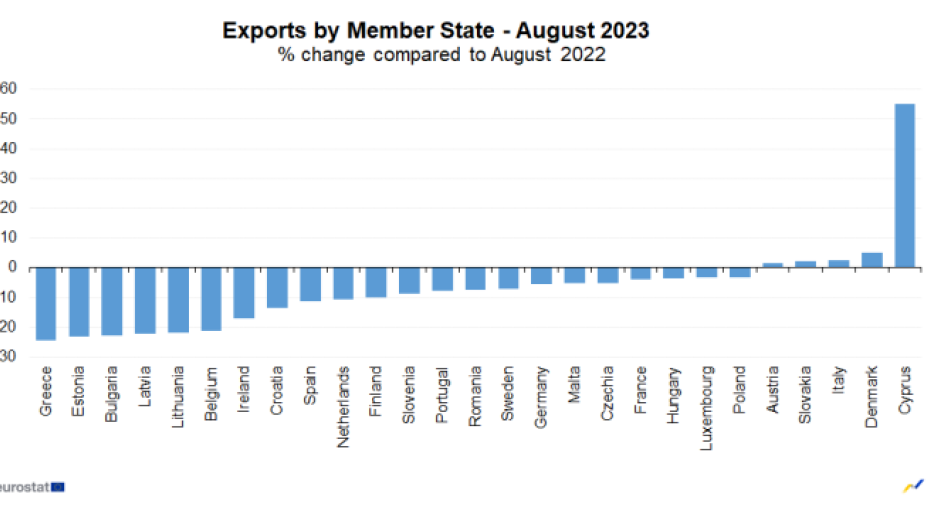
In a year-over-year analysis for August, most Member States reported export decreases, with only five exceptions. The steepest declines were seen in:
-
Greece: -24.5%
-
Estonia: -23.1%
-
Bulgaria: -22.7%
-
Latvia: -22.3%
-
Lithuania: -21.8%
-
Belgium: -21.3%
For extra-EU imports, a similar trend was evident. Most countries posted reductions in imports, but three countries, notably, bucked the trend. The largest drop-offs were in:
-
Belgium: -28.0%
-
Lithuania: -27.9%
-
Finland: -25.7%
-
Croatia: -24.6%
-
Latvia: -22.8%
-
Ireland: -21.6%
-
Italy: -20.9%
Conversely, Malta and Cyprus were the frontrunners in import increases, registering at 16.5% and 12.4% respectively.