Halloumi - More Than a Culinary Delight

Your first squeaky bite of halloumi, fried or grilled, will exceed any expectations you may have about cheese. Halloumi cheese is a true delight local to Cyprus. It is a semi-hard, unripened cheese made from a mixture of sheep, goat, and cow milk. The unique taste and texture of halloumi cheese have made it a staple in the Cypriot diet for centuries, and it has gained popularity globally over the years.
Not only is it a culinary specialty of the island sought out by many tourists and Cypriots abroad, but the cheese has also sparked controversy, economic benefits, and a gradual shift to a more sustainable farming method.
The history of halloumi is as rich as its flavor. It has been a part of Cypriot culture for more than one and a half millennia. Cyprus’ Ministry of Energy, Commerce, and Industry documented the history of halloumi, and noted several historical accounts referencing the cheese. One such account dates back to 1554 when the Venetians ruled Cyprus. Found in the writings of Florio Bustron, a renowned jurist and author of Historia Overo Commentarii de Cipro, documents the processes of making halloumi.
Another historical account referencing halloumi is that of an English churchman, writer and traveler, Richard Pococke. In 1738, he mentioned that “they make cheese from goat’s milk, which is famous all over the Levant, and it is the only good cheese to be met in these parts; they are small and thick, much in the shape of ancient weights,” as referenced in the previously mentioned Ministry’s documentation.
The cultural and historical significance of halloumi for Cypriots is evident. Even more so in 2022’s incident regarding protected designation of origin product (PDO) status over the cheese. The PDO was delayed, and the audits in the halloumi cheese making process were lacking, with some accounts claiming that some processes included the use of powdered milk - a huge red flag.
Other suggested processes completely cut out the use of cow’s milk which in-turn contributes to methane, nitrous oxide, and carbon dioxide pollution. While these suggestions aim to protect the environment, they would negatively impact farmers who use cow’s milk to produce their halloumi cheese. This outraged farmers and halloumi producers across the island, leading them to protest and set fire to hay bales outside of Cyprus’ Presidential Palace.
Their outrage is not without reason. In just the first quarter of 2022, halloumi exports generated over €68,000, accounting for nearly 17% of exported domestically produced goods in Cyprus, constituting the largest margin of Cyprus’ agricultural products. In 2021, Cyprus generated over $225 million through halloumi exports, and is projected to increase to over $300 million by the end of 2023. Cyprus also exports an estimated 27,000 tons of halloumi each year across Europe.
In this sense, farmers believe their contribution to the island’s continued historical practice of halloumi production deserves further support. In light of this, in February of 2023, amendments were made to halloumi’s PDO. The amendments grant farmers further flexibility to the manufacturing and production of the cheese, ultimately enabling higher exports of halloumi in greater quantity.
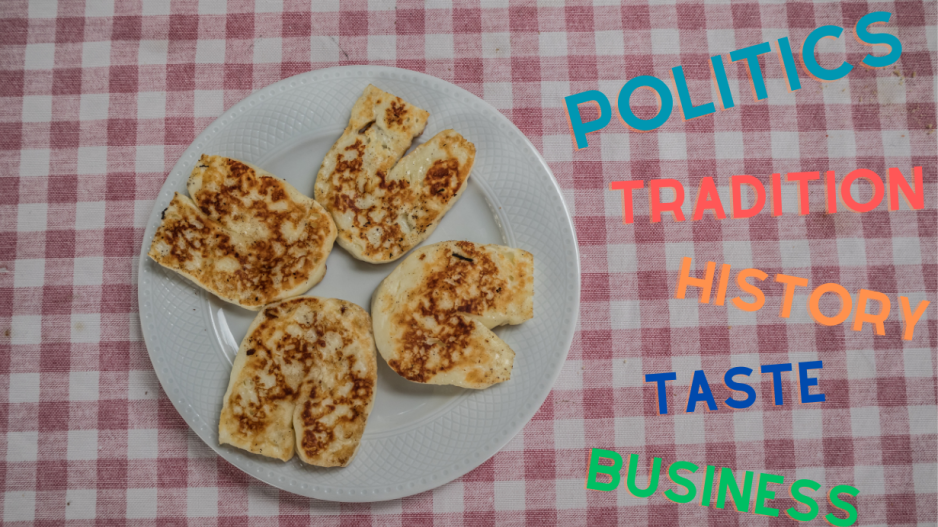
Interestingly, halloumi also plays a role in the long-standing troubled relationship between North and South Cyprus. Turkish Cypriots in north Cyprus can only export their hellim products to Turkey and gulf countries, limiting their market-entry potential into the international halloumi market. However, there have been ongoing negotiations and discussions between the EU, Greek Cypriots, and Turkish Cypriots.
According to Euronews, “the EU is endeavoring to bring the two communities together,” further adding a perspective on the halloumi market from Sokratis Sokratous, Cyprus’ government official who led the halloumi PDO registration process that “the market can handle halloumi made by both Greek Cypriot and Turkish Cypriot producers.” Additionally, Gulgun Dair Products’ export manager, Ali Bayraktar, believes that “halloumi does not belong to North or South or East or West Cyprus. Halloumi is a Cypriot product. It was produced before the Turkish and the Greek on this island.”
The largest exporter of halloumi cheese in Cyprus include Charalambides Christis, Dafni Dairy, Lefkonitziatis, and Petrou Bros Ltd, locally known as Alambra. The four companies operate as the leading exporters of the island’s traditional cheese. Their exports span across various countries and regions, mostly to Europe, but also to Asia, the US, the Middle East, and Australia and New Zealand. Additionally, they, as well as other various, smaller halloumi producers, will be receiving financial support from the European Commission’s (EC) Common Agricultural Policy (CAP) Strategic Plan.
Through this plan, the EC aims to “support the production of halloumi cheese, the main Cypriot agricultural export and a registered Protected Designation of Origin, the Cypriot Plans will particularly support the sheep and goats farming sector.” With this additional support, it is likely that Cyprus will see a boom in its halloumi production and exports, generating further revenue. CAP also aims to provide new and improved sustainable farming methods, which may bring additional changes to the seemingly iterative halloumi cheese PDO.
The long standing adoration for halloumi now reaches past the regions mentioned across historical accounts, and has caught the attention of regulators and farmers globally. What is important for Cyprus is that the cheese is globally recognized as a Cypriot product, and that it not only continues to reach plates internationally, but that Cypriot farmers receive the appropriate support from the government to ensure its sustainability as a product. The cheese may even contribute to peaceful negotiations between North and South Cyprus where both communities can benefit from the production of the island’s historical cheese.