EIB Denies Keravnos’ Claim That the GSI Is Not Viable and Was Rejected for Funding
Speaking to FastForward, a senior EIB official said no formal financing request has been submitted — and therefore no conclusion has been reached on the project’s viability.
Multiple questions continue to surround Cyprus Finance Minister Makis Keravnos’ claims about the European Investment Bank’s alleged rejection of the Great Sea Interconnector, as the Bank has clarified that it has not received any formal financing request for the project — and therefore has reached no conclusion on its viability or eligibility for funding.
Speaking to FastForward, a senior EIB official closely involved in the matter, said that "at this stage, no formal financing request has been submitted to the EIB, and therefore no conclusion has been reached regarding potential financing eligibility or viability.”
The clarification comes just 36 hours after Finance Minister Makis Keravnos told lawmakers during the presentation of the 2026 state budget that the EIB had “refused to finance” the GSI over concerns about its economic sustainability — a statement that appears inconsistent with the Bank’s position.
The source added that the Bank “remains fully committed to supporting projects that strengthen European energy security and the decarbonisation of our economies,” noting that it is “monitoring developments and information as they become progressively available. The EIB has reviewed the project in the past and continues to follow developments closely. As with any project, the EIB evaluates technical, economic, and financial aspects in detail, to ensure that it aligns with the Bank’s standards," the source said.
Keravnos’ main line of defense regarding the project’s viability has relied on two reports: one prepared by a private American consulting firm, selected parts of which were selectively leaked to specific media outlets (the public has still not seen it in full), and another review conducted by the EIB.
However, sources stress that the EIB’s review back to 2023 was carried out to examine whether the project was eligible —for EIB standards— for funding and to assess whether the Bank could approve a potential loan to Cyprus to finance the Interconnector — not to determine whether the project was financially viable for the Republic itself.
That distinction appears central to the current confusion. As the EIB official told FastForward, the Bank’s evaluation process cannot reach any final judgment on eligibility or viability without a formal financing application.
The EIB’s relationship with the project has gone through multiple stages since 2023. The Bank initially reviewed the Interconnector in the summer of 2023, expressing reservations at the time.
But by November 2023, it had re-examined its position as the project’s structure evolved under new terms. Then-EIB President Werner Hoyer said that “the project idea is further evolving, and we are very happy about that,” leaving open the possibility of financial participation, thereby differing from the summer’s comments.
Recent months have seen a marked shift toward conditional support. On September 25, 2025, EIB Vice President Kyriakos Kakouris stated that no financing request for the Great Sea Interconnector had yet been submitted, emphasizing that the Bank would only proceed once the energy plans of Greece and Cyprus are approved by the EU.
“We will examine it when the energy plans of Greece and Cyprus are approved by the EU,” Kakouris said, highlighting the need for institutional and technical validation before any financial decision.
Just three days later, on September 28, 2025, EIB President Nadia Calviño reiterated the Bank’s readiness to back strategic cross-border energy projects, specifically naming the Great Sea Interconnector.
“As for the GSI — a project that brings together climate policy and energy security for Cyprus and Greece — I think we have been very clear from the beginning that we would support strategic projects endorsed by the two countries and embedded in their national energy strategies,” Calviño said.
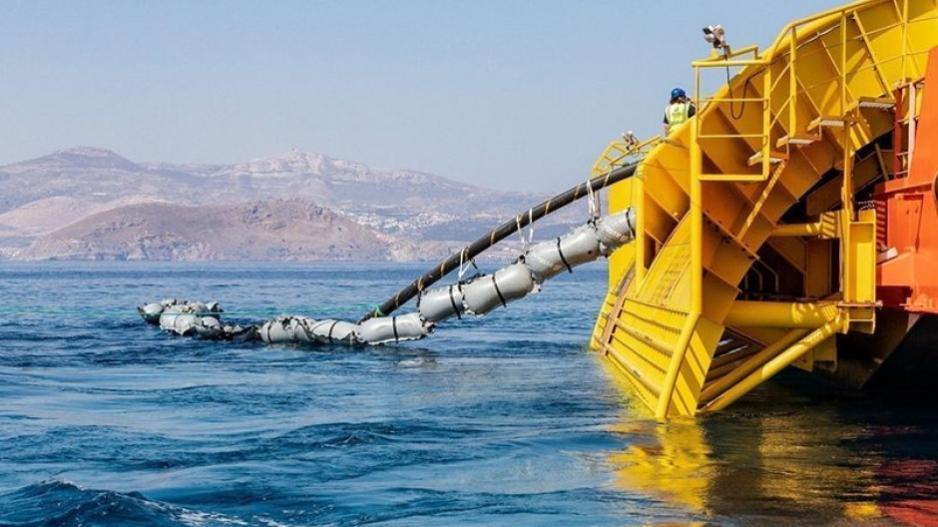
The questions arising after the EIB’s strong denial of Finance Minister Keravnos’ statements are numerous.
The first is why the Finance Minister confused the review conducted by the EIB — whose purpose was to assess whether the project was eligible for a loan to Cyprus to cover part of the GSI’s cost — with a supposed conclusion by the Bank on whether the project is economically viable for the country.
The second is why the Finance Minister claimed that the EIB refused to finance the project, when only a few days ago — and again today — the EIB stated that no official funding request has ever been submitted.
And the third is why Mr. Keravnos’ reasoning relies on initial statements by the EIB from the summer of 2023, when the project was still called EuroAsia Interconnector, rather than on later ones — such as in November 2023, when then-EIB President Werner Hoyer left open the possibility of financial participation, thereby differing from the summer’s comments — or on more recent statements in September 2025, when current EIB President Calviño said that if Greece and Cyprus agree, the Bank is willing to support.
In any case, the argument about 'economic viability' appears to rest on two studies — one of which has now proven never to have indicated what was claimed, leaving one remaining study that the public has still not seen in full, only carefully selected excerpts leaked to specific media outlets.
It is recalled that the GSI has been examined and has received funding from the European Commission, the EU’s highest institutional body.