How Much It Costs to Live in Cyprus's Largest Cities Today – The Grand Survey on the True Cost of Living
The Latest Numbeo Data Reveals the Discrepancies in the Cost of Living Across Limassol, Nicosia, Larnaca, Paphos, and Paralimni.
Choosing which city to live in within Cyprus can cost a person an additional €8,000 per year. This does not stem from price differences in groceries or daily outings, but from every household's single largest expense: housing. According to the latest data from the international database platform Numbeo, the difference in rent for a one-bedroom apartment in the city center between Limassol and Nicosia approaches €700 per month, a reality that fundamentally alters the total budget of any employee or family.
Inflation has evolved into one of the greatest challenges for those living and working in Cyprus. From rent prices and the supermarket basket to electricity bills, commuting, and dining out, every daily expense eats away at disposable income. However, data indicates that not all cities are equally expensive.
The Numbeo survey clearly maps the significant differences between Limassol, Nicosia, Larnaca, Paphos, and Paralimni. While basic goods maintain relatively uniform price tags, the picture changes drastically once rent and residential purchasing costs enter the equation.
The Platform Tracking the Cost of Living Worldwide
Numbeo stands today as the largest online database for the cost of living globally. It compiles data from thousands of users across more than 12,000 cities, computing average costs for groceries, rents, transport, utility bills, dining out, education, property purchases, and dozens of other everyday expense categories.
For Cyprus, the figures are continually updated through hundreds of user entries. In Limassol alone, over 825 entries from 92 distinct contributors were recorded over the last twelve months, while Nicosia gathered nearly 600 entries from 52 users. Corresponding data exists for Larnaca, Paphos, and Paralimni, though the platform itself points out that in smaller towns, the sample size of participants is limited, meaning averages can fluctuate more easily.
Limassol Comfortably Holds the Title of the Most Expensive City
It comes as no surprise that Limassol remains the most expensive city in Cyprus. The heavy presence of international corporations, heightened housing demand, and the continuous boom of the local real estate market have forged an environment where the cost of living sits noticeably above the national average.
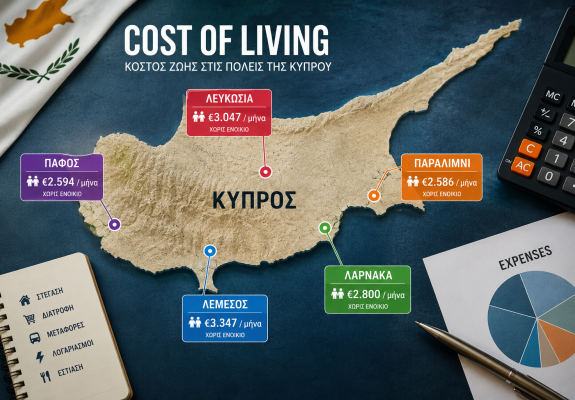
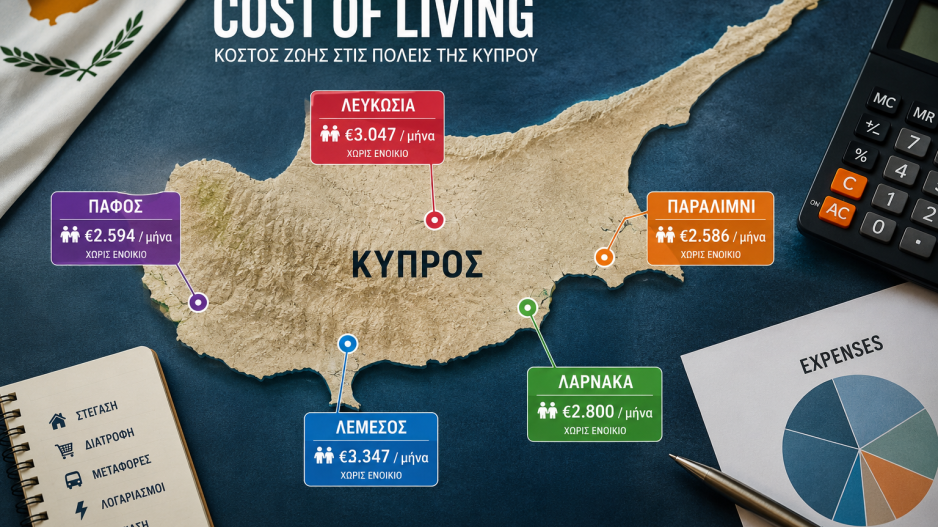
According to Numbeo’s figures, a four-member family requires roughly €3,347 per month to cover basic daily needs, excluding rent. For a single individual, that baseline amount sits at around €933.
The true burden, however, manifests when housing is added.
The average monthly rent for a one-bedroom apartment in the city center reaches €1,419, while even outside the center, rent remains exceptionally high at about €1,210. For a three-bedroom apartment, a family is asked to fork out an average of €2,318 in the center or roughly €1,813 outside the center.
The residential purchase market mirrors this reality. The average price to buy an apartment tracks at approximately €4,647/sq.m. in the center of Limassol and €3,472/sq.m. outside the center, levels significantly higher than those found in any other major city.
Despite the fact that Limassol registers the highest average net monthly salary at around €2,306, hyper-inflated housing costs absorb a massive portion of disposable income. It is telling that an increasing number of professionals now choose to reside in neighboring regions and commute to the city daily.
The Supermarket Basket Does Not Make the Massive Difference
Contrary to common consumer belief, the most stark deviations between cities are not found in basic grocery items.
One liter of milk costs roughly €1.64 in Limassol, €1.65 in Nicosia, €1.47 in Larnaca, and around €1.50 in Paralimni. Similarly, a 500-gram loaf of bread costs about €1.97 in Limassol, €1.81 in Nicosia, €1.80 in Larnaca, and roughly €1.25 in Paralimni.
White rice ranges from approximately €1.97 to €2.86 per kilo, while a dozen eggs ranges from €3.64 in Larnaca up to about €4.63 in Paralimni.
Discrepancies in meat remain minimal as well. Chicken fillet costs about €7.87 per kilo in Limassol, €8.10 in Nicosia, €7.71 in Larnaca, and roughly €6 in Paralimni. Beef stands at about €12.16 per kilo in Limassol, €11.58 in Nicosia, and €10.37 in Larnaca.
Fruits and vegetables display an identical trend. Apples retail from around €2.39 to €3 per kilo, bananas from €1.45 to €2.05, tomatoes from roughly €2.37 to €3.50, and potatoes sway between €1.26 and €1.75 per kilo.
Simply put, a consumer relocating from Nicosia or Larnaca to Limassol will not notice a major shock on their supermarket receipt. The divergence appears only when it is time to pay the landlord.
Dining Out Remains Pricier in Limassol
The gaps become more evident when choosing to eat or drink outside the house.
A meal at an inexpensive restaurant costs an average of €20 in Limassol, compared to €15 in Nicosia and €12 in Larnaca. A three-course dinner for two at a mid-range restaurant requires roughly €70 in Limassol, €60 in Nicosia, and around €50 in Larnaca.
Coffee price gaps are narrower. A cappuccino costs roughly €3.42 in Limassol, €3.18 in Nicosia, €3.36 in Larnaca, and €3.27 in Paralimni. Soft drinks hover between €1.50 and €1.75, while a local beer costs anywhere from €3 to €4, depending on the municipality.
Utility Bills Follow a Gentler Pace
Unlike housing, basic utility bills exhibit smaller disparities across urban areas.
For an 85 sq.m. apartment, the combined cost of electricity, water, garbage collection, heating, and cooling hits about €201 in Limassol, €195 in Nicosia, €157 in Larnaca, and around €150 in Paralimni.
High-speed broadband internet connections cost roughly €28–€30 per month in most areas, while a mobile plan with at least 10GB of data ranges between €15 and €18.
Transportation depicts a similar lack of variance. Unleaded petrol costs between €1.44 and €1.53 per liter, while a single ticket on public transit scales between €2 and €2.40, depending on the city.
The data compiled up to this point yields a clear takeaway: despite price jumps sweeping across nearly all categories of goods and services, the single greatest dividing factor between these cities remains housing. Looking closer at Nicosia, Larnaca, Paphos, and Paralimni, lower rental rates shape a completely different narrative for total living costs.
Nicosia Remains the Most Balanced Choice
If Limassol serves as the country’s priciest urban hub, Nicosia continues to provide a more balanced relationship between cost of living, career opportunities, and housing. Despite price hikes registered over the last few years, the capital remains noticeably more affordable than Limassol, primarily due to lower rents and property values.
According to Numbeo data, a four-member family needs about €3,047 a month to cover baseline needs, excluding rent, while single-person monthly expenses track at around €855. Overall, the baseline cost of living is roughly 9.1% lower than in Limassol.
The largest discrepancy is anchored once again in housing. A one-bedroom apartment in the center of Nicosia rents for an average of €719, nearly half the cash required for an equivalent flat in Limassol. Moving out of the center drops rent down to about €610, while a three-bedroom property demands around €1,526 in the center and €1,189 on the outskirts.
Property acquisition rates remain within a healthier reach as well. An apartment in the city center costs an average of €2.763/sq.m., while outside the center, the average price balances out around €2,042/sq.m., almost half of what is encountered in Limassol.
In everyday life, the differences are minute. A basic restaurant meal costs about €15, a cappuccino is €3.18, and standard utilities for an 85 sq.m. residence tally around €195 a month. With an average net monthly salary of €1,614, the capital builds a more sustainable equilibrium between income and housing overheads.
Larnaca Emerges as the Big Winner
Larnaca is increasingly emerging as a magnet for new residents. Infrastructure upgrades, fresh investments, and significantly lower housing costs have turbo-charged its market momentum over recent years.
According to the study's findings, a family of four requires roughly €2,800 a month to satisfy basic needs without rent, while a single individual requires about €779. Overall, the baseline cost of living is roughly 17% lower than that of Limassol.
The differences in housing are particularly pronounced. A central one-bedroom apartment costs roughly €796 per month, shifting to €599 outside the center. For three-bedroom homes, rents average €1.475 centrally and €1,094 on the periphery.
Purchase rates remain highly competitive, as an apartment in the center averages roughly €3.329/sq.m., while outside the center it drops to about €1,780/sq.m.
Larnaca stands out in daily expenses too. An inexpensive restaurant meal sits at about €12, the lowest among the major cities included in the survey, while a mid-range dinner for two settles around €50.
Supermarket costs are equally competitive. A liter of milk costs roughly €1.47, bread sits around €1.80, a dozen eggs is €3.64, and beef settles around €10.37 per kilo. Basic monthly residential utility bills hover at a low €157, while the average net salary floats at €1,706.
This economic matrix explains why many working professionals now select Larnaca as their permanent home base even if they commute to work in other cities, as cheaper housing frequently overrides the daily travel premium.
Paphos Sustains Its Inward Draw
Paphos continues to serve as one of the most popular relocation choices for both Cypriots and expatriates making a permanent move to the island. Its blend of higher quality of life, a gentler pace of daily living, and reduced housing overheads functions as a foundational selling point.
Though rising tourism development has squeezed the real estate and rental markets over the last couple of years, the absolute cost of living stays lower than in Limassol. Dining, service industries, and several everyday outlays track at more accessible thresholds, maintaining Paphos high up on the radar for those seeking an affordable routine without compromising on fundamental infrastructure and services.
Paralimni Remains Among the Most Economical Choices
Even though Numbeo explicitly emphasizes that the available data for Paralimni relies on a smaller pool of entry submissions, the broader overview indicates that the region ranks among the cheapest in Cyprus.
A one-bedroom apartment centrally costs roughly €600 per month, softening to €567 outside the center. For a three-bedroom house, rental prices track roughly between €1,100 and €1,300 depending on the specific neighborhood.
Basic monthly utility bills for an 85 sq.m. home settle at around €150, while several baseline groceries, such as bread, chicken, bananas, and potatoes, register some of the lowest average prices documented in the entire survey.
Concurrently, the average apartment purchase rate is priced at roughly €2.750/sq.m. in the center, while the average net monthly salary hovers around €1,463.
Where the Gap Widens Plainly
If there is one absolute conclusion to draw from Numbeo’s raw data, it is that the ultimate differences across Cypriot cities do not lie within the grocery aisle. The prices for milk, bread, fruits, vegetables, and the vast majority of foodstuffs display minor variance from region to region.
The true disparity is anchored solely in housing. A tenant opting for Limassol might easily spend upwards of €8,000 more per year just for a one-bedroom apartment compared to someone choosing Nicosia. Correspondingly, property purchase differentials can exceed €2,000/sq.m., drastically reshaping the total layout of an acquisition investment.
At the same time, gaps in average wages do not follow that same explosive pace. Limassol boasts the highest average net salaries, yet hyper-inflated housing overheads swallow up the bulk of that premium. Conversely, in cities like Nicosia and Larnaca, the correlation between net earnings and structural living expenses remains vastly more proportional.
The data map from this survey underscores that where you choose to plant roots in Cyprus doesn't just dictate your quality of life, it commands your personal finances. For as long as rental and property prices linger at such record highs, especially in Limassol, housing will continue to stand as the single most dominant factor dictating the true cost of living in Cyprus.